



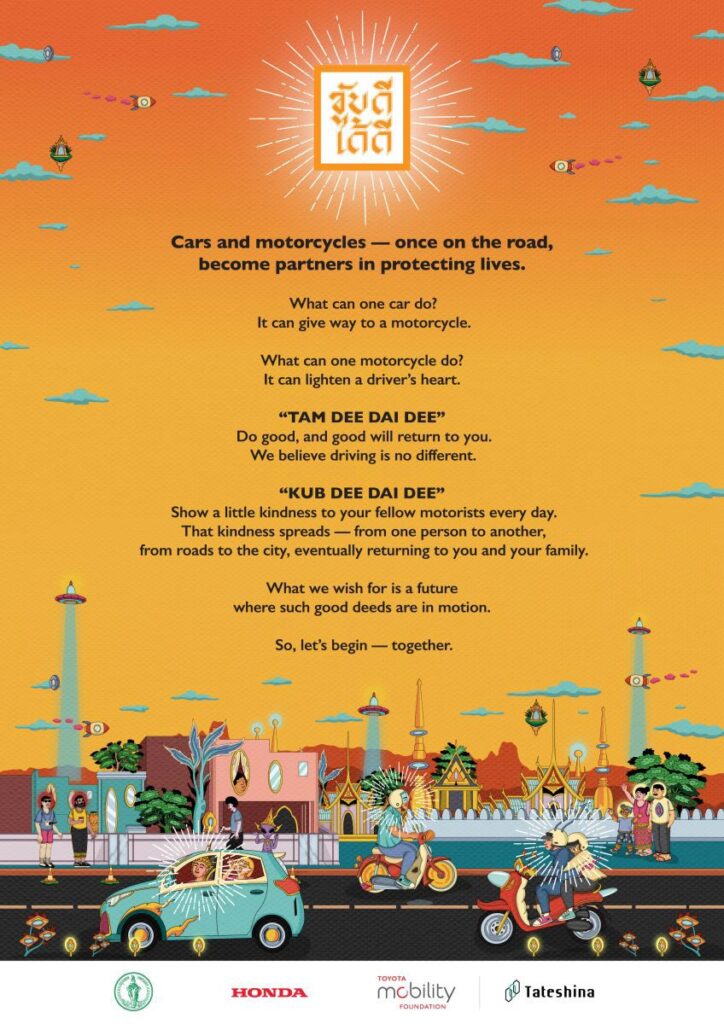
Toyota and Honda, fierce rivals in the automotive market, have joined forces with Hakuhodo in Thailand to confront the country’s alarming road safety crisis. Their campaign, ‘Kub-Dee-Dai-Dee (Good driving brings good returns)’, reframes cultural wisdom into behavioural change messaging, targeting car–motorcycle collisions and aiming to reduce fatalities among young road users.
Deadly crash statistics have achieved what market forces rarely do: unite Toyota and Honda. In Thailand, where road safety remains one of the most stubborn public health challenges, the two automotive giants have set aside competition to collaborate on a campaign designed to change driver behaviour and reduce collisions.
Thailand’s road traffic death rate stands at 25.4 per 100,000 people, according to the World Health Organisation (WHO). That figure places the country among the most dangerous in the world for road users. WHO estimates suggest that in 2021 alone, roughly 50 people died every day on Thai roads, with motorcyclists and young people aged between 15 and 29 disproportionately affected. The economic toll is equally sobering: in 2022, road accidents cost Thailand 531,058 million baht, or about $15.51 billion, representing 3.06% of GDP.
Against this backdrop, Toyota and Honda have launched ‘Kub-Dee-Dai-Dee (Good driving brings good returns)’, a joint initiative created with the support of Japanese advertising major Hakuhodo. The campaign is not merely about raising awareness but is positioned as a behaviour-change intervention. It is led by the Toyota Mobility Foundation (TMF) and Honda Thailand Foundation under the umbrella of the ‘Tateshina Meeting’ collaboration, a forum where the two companies explore shared social challenges.
The campaign draws inspiration from a familiar Thai proverb, ‘Tam-Dee-Dai-Dee (Good deeds bring good returns)’, reframing it into a road safety context. By adapting cultural wisdom into a modern message, the initiative seeks to resonate with Thai drivers and riders in a way that traditional public service announcements often fail to achieve. The emphasis is on encouraging motorists to adopt safer practices, particularly in interactions between cars and motorcycles, which account for a significant proportion of accidents.
For Toyota and Honda, the collaboration marks a rare moment of unity in a fiercely competitive market. Both companies dominate Thailand’s automotive sector, with Toyota long established as the market leader and Honda holding a strong position in motorcycles. Their decision to work together underscores the gravity of the road safety crisis and the recognition that corporate responsibility must extend beyond sales figures.
Hakuhodo’s involvement adds a creative dimension to the campaign. Known for its ability to blend cultural insight with compelling storytelling, the agency has helped shape messaging that is both locally relevant and emotionally resonant. The campaign’s design avoids abstract warnings and instead focuses on practical behavioural cues, aiming to make safer driving habits feel rewarding and culturally meaningful.
Thailand’s road safety problem has long resisted policy interventions. Despite government efforts, including stricter helmet laws, speed regulations, and awareness drives, accident rates remain stubbornly high. Experts often cite enforcement gaps, cultural attitudes towards risk, and the sheer volume of motorcycles on Thai roads as factors that complicate progress. Against this backdrop, private-sector initiatives such as ‘Kub-Dee-Dai-Dee’ represent an important complement to official measures.
The campaign also reflects a broader trend in corporate social responsibility, where companies are increasingly expected to address systemic social issues. For Toyota and Honda, the stakes are not only moral but also reputational. As leading automotive brands, they are closely associated with mobility in Thailand, and their involvement in tackling road safety enhances their credibility as responsible corporate citizens.
The economic argument is equally compelling. With road accidents costing Thailand billions annually, reducing fatalities and injuries could deliver significant savings. For businesses, safer roads mean fewer disruptions, lower insurance costs, and a healthier workforce. For families, it means fewer tragedies and greater security. By framing safe driving as a collective good, the campaign taps into both emotional and practical motivations.
The choice to focus on car–motorcycle collisions is particularly strategic. Motorcycles are ubiquitous in Thailand, serving as affordable transport for millions. Yet they are also highly vulnerable in traffic, often weaving between cars and exposed to high-speed impacts. By encouraging car drivers to be more mindful of motorcyclists, and motorcyclists to adopt safer practices, the campaign addresses one of the most pressing causes of fatalities.
The collaboration between Toyota and Honda also carries symbolic weight. In a market where rivalry is intense, their decision to unite sends a powerful message: road safety is a challenge that transcends competition. It suggests that when lives are at stake, even the fiercest rivals can find common ground.
Whether the campaign will succeed in shifting behaviour remains to be seen. Behavioural change is notoriously difficult to achieve, particularly in contexts where risk-taking is normalised. Yet by grounding its message in cultural wisdom and delivering it through trusted brands, ‘Kub-Dee-Dai-Dee’ has a chance to cut through the noise.
For Thailand, the stakes could not be higher. With thousands of lives lost each year and billions drained from the economy, road safety is more than a public health issue—it is a national priority. The involvement of Toyota and Honda signals that the private sector is ready to play a more active role in addressing it.
In the end, the campaign’s message is simple but profound: good driving brings good returns. If that wisdom can take root on Thai roads, the benefits will be measured not only in reduced fatalities but also in stronger communities and a safer future. For Toyota, Honda, and Thailand alike, the hope is that this rare alliance will deliver more than just words—it will deliver lives saved.
Discover more from Creative Brands
Subscribe to get the latest posts sent to your email.