


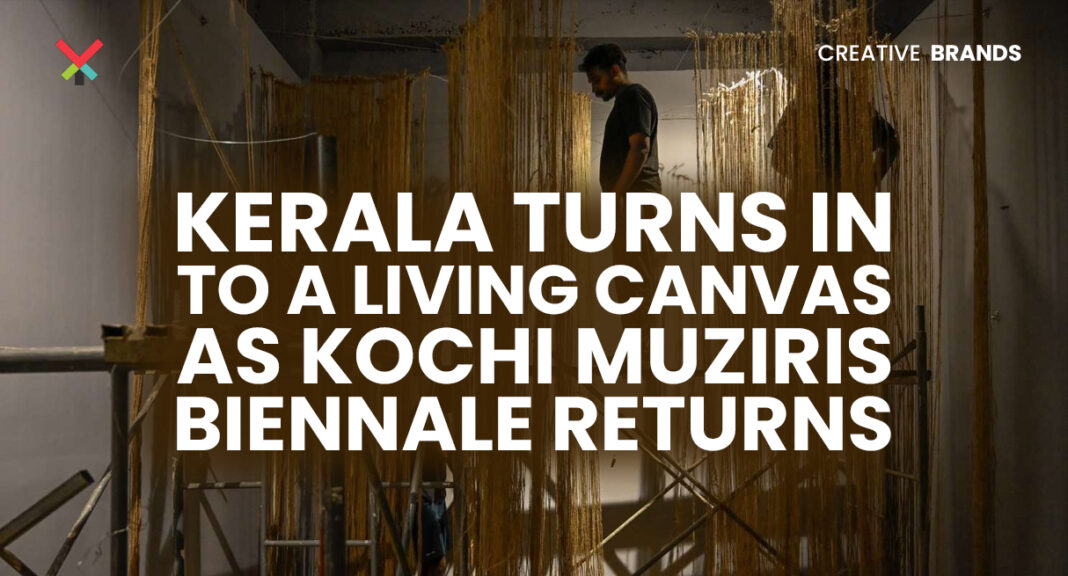
As the Kochi Muziris Biennale unfolds, Kerala reveals itself as a living work of art where culture, history and nature merge seamlessly. With Kerala Tourism ready to welcome visitors, the state invites travellers to explore picturesque landscapes, heritage spaces and contemporary art woven into everyday life.
Every corner feels as though it has been lifted from a painting, its colours gently layered by time, light and tide. In Kerala, beauty does not announce itself loudly; it reveals itself slowly, in backwaters that mirror the sky, in moss-covered laterite walls, in the rhythmic sway of coconut palms against the Arabian Sea. This is the setting in which the Kochi Muziris Biennale unfolds, transforming the state’s natural poetry into a living canvas where art, history and everyday life converge. As the Biennale returns, Kerala Tourism is ready to invite the world to experience this rare alignment of place and imagination.
Kochi, the heart of the Biennale, is a city shaped by centuries of exchange. Once a bustling port on the ancient spice route, it has absorbed influences from across the globe while retaining a distinctly local rhythm. Narrow streets wind past colonial-era buildings, synagogues, mosques and churches standing within walking distance of one another. Fishing nets dip into the sea like giant lacework, while ferries glide between islands carrying commuters, traders and travellers alike. During the Biennale, this layered city becomes more than a backdrop; it becomes a collaborator in the artistic process.
The Kochi Muziris Biennale is not confined to white-walled galleries. It spills into warehouses, heritage homes, courtyards and public spaces, inviting visitors to move through the city as they move through ideas. Art installations converse with crumbling walls and sea-salted air, blurring the line between the curated and the accidental. For many visitors, the experience is as much about wandering as it is about viewing. Turning a corner might lead to a thought-provoking installation, a quiet café, or a view so striking it feels composed by an unseen hand.
Kerala’s natural beauty amplifies this sense of discovery. The state’s landscape has long inspired poets, painters and filmmakers, and during the Biennale, that inspiration feels palpable. The monsoon-washed greens, the play of light on water, and the slow pace of life create an atmosphere that encourages reflection. Art does not feel imposed upon the environment; it feels as though it has emerged from it. This harmony between art and nature is central to the Biennale’s appeal and to Kerala Tourism’s invitation to travellers seeking experiences that engage both the senses and the mind.
Beyond Kochi, the spirit of the Biennale extends into the wider region, echoing the idea of Muziris, the ancient port believed to have connected Kerala to the world over two millennia ago. While its exact location remains a subject of scholarly debate, the concept of Muziris symbolises openness, exchange and cultural flow. These themes resonate strongly within the Biennale, which brings together artists and audiences from diverse geographies, fostering dialogue across borders. Kerala, with its long history of welcoming traders, travellers and thinkers, provides a fitting stage for such conversations.
Kerala Tourism’s readiness for the Biennale reflects a broader vision of positioning the state as a destination where culture and creativity thrive alongside natural beauty. Infrastructure, hospitality and curated experiences are being aligned to ensure that visitors can immerse themselves fully in the event. From heritage walks through Fort Kochi to boat rides along the backwaters, from culinary trails to performances rooted in local traditions, the Biennale becomes a gateway to experiencing Kerala in all its dimensions.
For artists, the Biennale offers a unique opportunity to engage with a context that is both grounded and global. The humidity, the sounds of the sea, the presence of everyday life all influence how works are perceived and experienced. For audiences, this creates a sense of intimacy rarely found in large-scale international exhibitions. Art is encountered not as something distant or elite, but as part of the lived environment. Children play near installations, fishermen mend nets nearby, and conversations flow easily between locals and visitors.
This accessibility has been one of the Biennale’s defining strengths. It has helped cultivate a new generation of art enthusiasts within India, many of whom experience contemporary art for the first time in Kochi. The event has also contributed to the revitalisation of heritage spaces, drawing attention to the value of preservation and adaptive reuse. Old warehouses and colonial structures, once neglected, find new purpose as sites of creativity, demonstrating how art can catalyse urban renewal without erasing history.
The sensory richness of Kerala deepens the Biennale experience. Mornings begin with the scent of filter coffee and the sound of temple bells or church choirs. Afternoons unfold in a haze of sunlight and sea breeze, punctuated by the calls of street vendors. Evenings invite reflection, whether at a waterfront café watching fishing boats return or at a performance that blends traditional forms with contemporary expression. In this setting, art feels less like an event and more like a way of seeing.
Kerala Tourism’s messaging around the Biennale emphasises this seamless blend of art and place. The invitation is not merely to attend an exhibition, but to discover a state where every corner feels composed, where everyday scenes rival the most carefully curated installations. This approach speaks to travellers who value authenticity and depth over spectacle. It suggests that the true reward of visiting Kerala during the Biennale lies in the spaces between scheduled events, in the unplanned moments of beauty and connection.
As global travel gradually shifts towards experiences that are meaningful and mindful, Kerala’s offering feels particularly relevant. The Biennale encourages slow exploration, thoughtful engagement and openness to multiple perspectives. It aligns naturally with the state’s reputation for responsible tourism, wellness and sustainability. Visitors are invited to linger, to listen, and to engage with local communities rather than rushing from one highlight to another.
The Kochi Muziris Biennale also reinforces Kerala’s role in India’s cultural landscape. It demonstrates that contemporary art need not be confined to metropolitan centres, and that regional contexts can offer powerful platforms for global discourse. By hosting an event of international stature, Kerala asserts its place as a cultural crossroads, much as it was in ancient times. This continuity between past and present adds another layer of meaning to the Biennale experience.
Ultimately, exploring Kerala during the Kochi Muziris Biennale is about seeing the familiar with new eyes. A weathered wall becomes a canvas, a ferry ride becomes a meditation, a city becomes a gallery without boundaries. With Kerala Tourism ready to welcome travellers, the invitation is clear: step into a place where art and life intertwine, where every corner feels painted by history and imagination, and where discovery unfolds at its own unhurried pace.
Discover more from Creative Brands
Subscribe to get the latest posts sent to your email.