


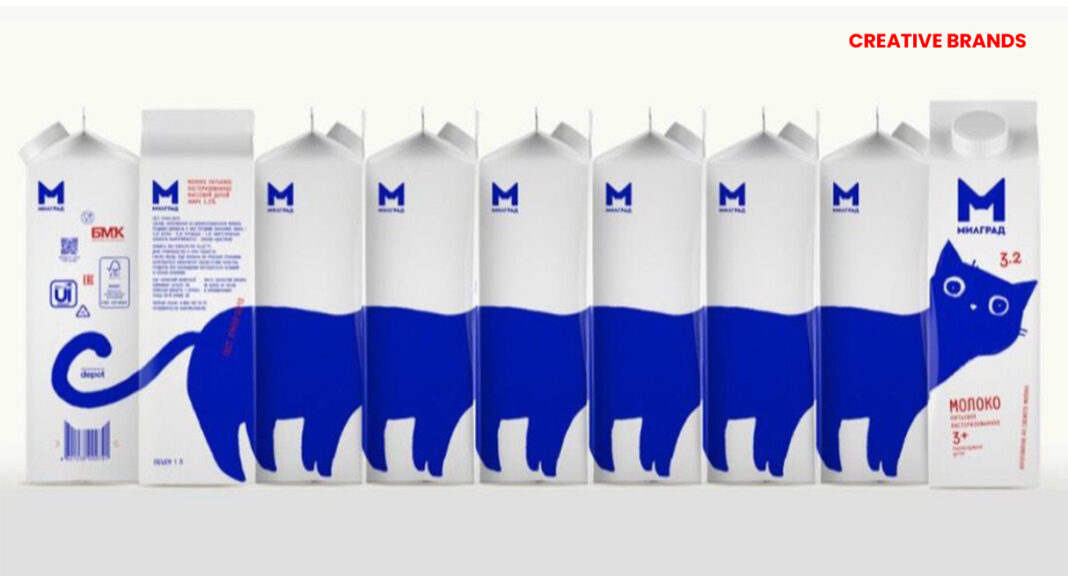
Russian milk brand Milgrad turned packaging into playful psychology by revealing a blue cat only when four cartons were placed together. Shoppers bought more not for milk, but to complete the picture. A simple design idea boosted sales, proving creativity can outperform discounts and advertising.
Great ideas don’t always come from bigger budgets. Sometimes they come from smarter design. In Russia, a milk brand called Milgrad demonstrated this truth with a packaging innovation so simple, yet so effective, that it transformed consumer behaviour without a single discount or advertising blitz.
The brand introduced cartons that, when placed side by side, revealed a playful blue cat. The catch was that the image only appeared in full when four cartons were aligned. On their own, each carton looked ordinary, but together they formed a charming, complete picture. It was a visual puzzle, waiting to be solved at the supermarket shelf.
The brilliance of the idea lay not in the illustration itself, but in the behavioural insight it tapped into. Consumers didn’t suddenly need more milk. They weren’t persuaded by slogans or promotions. They were compelled by the instinct to complete what was incomplete. Leaving the cat unfinished felt wrong, like abandoning a jigsaw puzzle with one piece missing.
The result was striking. Average daily purchase per shopper rose from three cartons to four. That single extra pack represented a significant behavioural shift, achieved not through persuasion but through design psychology. The packaging became more than a container; it became an experience.
Even those who weren’t regular buyers found themselves drawn to the shelf. Shoppers stopped, rearranged cartons, and played with the display just to see the cat appear. In that moment, the supermarket aisle became interactive theatre. The product was no longer passive; it invited participation. People didn’t just buy milk—they engaged with it, shared it, and remembered it.
This was marketing without words, without noise, without the heavy machinery of traditional campaigns. No billboards, no jingles, no discounts. Just a clever design that spoke directly to human behaviour. It was proof that packaging, often overlooked as functional, can be a powerful medium for storytelling and engagement.
The Milgrad cat became a silent salesman. It didn’t shout, but it nudged. It didn’t demand, but it invited. And in doing so, it achieved what many brands spend millions trying to secure: attention, memorability, and loyalty.
What makes this case remarkable is its elegance. In a marketplace saturated with aggressive promotions, Milgrad chose restraint. The brand trusted in the power of curiosity and completion. It recognised that consumers are not just rational buyers calculating needs, but emotional beings driven by subtle psychological triggers.
The blue cat was more than a mascot. It was a metaphor for how design can shape behaviour. It showed that people crave closure, that they are drawn to patterns, and that they find satisfaction in completing a picture. These are universal instincts, and Milgrad harnessed them with a stroke of creative simplicity.
The campaign also highlighted the social dimension of packaging. Shoppers didn’t just buy the milk; they shared the experience. Rearranging cartons became a small act of play, a moment worth capturing or talking about. In the age of social media, such moments are gold. They travel beyond the shelf, turning into stories, posts, and conversations.
For marketers, the lesson is clear. Engagement doesn’t always require spectacle. Sometimes it requires empathy with human behaviour. By designing packaging that invited interaction, Milgrad created a brand moment that was both personal and communal. It was a reminder that the most effective ideas often cost the least.
The success of the blue cat also challenges assumptions about consumer loyalty. People didn’t buy more milk because they were persuaded by rational arguments about quality or price. They bought more because they were emotionally invested in completing the cat. That emotional investment, however small, translated into measurable sales.
In a way, Milgrad’s cartons became a test case for how design can act as a behavioural nudge. Just as supermarkets place essentials at the back to encourage browsing, or as apps use notifications to prompt engagement, Milgrad used visual completion to drive purchase. It was subtle, but it worked.
The story of the blue cat is not just about milk. It is about the future of branding. As consumers grow weary of traditional advertising, brands must find new ways to connect. Packaging, often dismissed as secondary, can be a frontline tool. It can surprise, delight, and influence in ways that feel natural rather than forced.
Milgrad’s achievement lies in showing that creativity is not about scale. It is about insight. By understanding that people dislike leaving things unfinished, the brand turned a shelf into a stage and a carton into a puzzle. It proved that design can be psychology in disguise.
In the end, the blue cat was more than a clever trick. It was a reminder that brands live not in slogans or budgets, but in the minds and behaviours of consumers. And sometimes, all it takes to change behaviour is a playful image waiting to be completed.
Milgrad didn’t just sell milk. It sold satisfaction, curiosity, and joy. And it did so with nothing more than smart design.
Discover more from Creative Brands
Subscribe to get the latest posts sent to your email.