


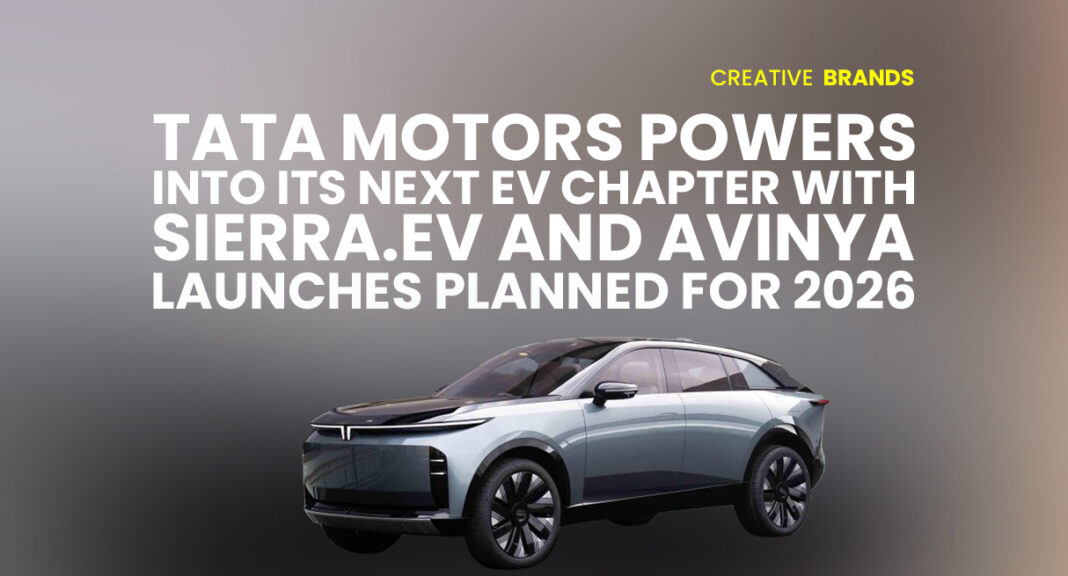
Tata Motors is entering a new phase of its electric vehicle journey, preparing to launch the Sierra.ev and Avinya range in 2026. With a 66% market share and Nexon.ev crossing 1,00,000 sales, the company aims to expand into premium EV segments and scale charging infrastructure nationwide.
Tata Motors’ electric vehicle journey is entering a decisive new chapter, one that marks a shift from pioneering participation to full-scale ambition. After laying the foundations of India’s mass electric passenger vehicle market, the company is now preparing for a more expansive, more premium, and more technologically sophisticated phase of growth. The planned launches of the Sierra.ev and the Avinya range in 2026 are not just additions to the product pipeline; they signal Tata Motors’ intent to redefine its role in the country’s rapidly evolving EV ecosystem.
For much of the past decade, Tata Motors has been synonymous with India’s electric passenger vehicle story. At a time when EV adoption was tentative and largely policy-driven, the company placed early bets on electrification, translating global trends into locally viable products. Those bets have paid off handsomely. With around 66 per cent share of all electric passenger vehicles sold in India so far, Tata Motors has achieved a level of dominance that is rare in a market as competitive and price-sensitive as India’s automotive sector. The milestone of the Nexon.ev becoming the first electric car in the country to cross 1,00,000 units in cumulative sales has further cemented the company’s leadership credentials.
That success has fundamentally altered the conversation around electric mobility in India. EVs are no longer niche, experimental offerings confined to early adopters and fleet buyers. They are now mainstream products, bought by families, professionals and first-time car owners, and Tata Motors has been central to that transition. The company’s ability to localise components, price competitively, and build consumer trust around range, safety and after-sales support has made electric vehicles a viable alternative to internal combustion engine models for a growing section of buyers.
Yet, the next phase of Tata Motors’ EV strategy suggests that maintaining leadership will require more than incremental updates and volume-led growth. As the market matures, competition is intensifying, with both global automakers and new-age EV specialists eyeing opportunities across segments. Against this backdrop, the Sierra.ev and the Avinya range are positioned as strategic pivots—vehicles that will allow Tata Motors to expand beyond its current stronghold in compact and mid-size EVs into higher-value, more aspirational categories.
The Sierra.ev, which revives a storied nameplate from Tata Motors’ past, carries both emotional and strategic significance. The original Sierra was a symbol of lifestyle motoring in India during the 1990s, and its electric reincarnation is expected to tap into that legacy while addressing contemporary expectations around design, technology and sustainability. By reintroducing the Sierra as an electric-first product, Tata Motors is signalling its confidence in EVs as not just practical urban solutions but as desirable, character-driven vehicles capable of shaping brand identity.
The Avinya range, meanwhile, represents an even bolder leap. Conceived as a premium electric architecture, Avinya is designed to showcase Tata Motors’ long-term vision for electric mobility, encompassing advanced battery technologies, connected features, and a more global design language. The move into premium EVs is a natural progression for a company that has already captured scale at the mass end of the market. It also reflects a recognition that future growth will increasingly come from higher-margin segments, where consumers are willing to pay for range, performance, comfort and digital integration.
Taken together, these two nameplates are expected to anchor Tata Motors’ transition from early EV adoption to broader segment expansion. They will also test the company’s ability to balance affordability with aspiration, a challenge that has defined the Indian automotive market for decades. Success in this phase will depend not just on product excellence but on how effectively Tata Motors can leverage its existing EV ecosystem, from manufacturing and supply chains to charging infrastructure and customer engagement.
Infrastructure, in particular, remains a critical pillar of Tata Motors’ EV roadmap. Recognising that widespread adoption cannot happen without reliable and accessible charging, TATA.ev has outlined ambitious plans to scale charging points to one million by 2030. This push goes beyond selling vehicles and reflects a more holistic approach to mobility, where the company positions itself as an enabler of the entire EV experience. Partnerships with energy providers, real estate developers and public authorities are likely to play a key role in turning this target into reality.
Looking further ahead, Tata Motors has indicated that it plans to introduce five new EV nameplates by FY30, alongside regular updates to its existing portfolio. This steady cadence of launches suggests a move towards a more diversified and resilient product strategy, one that can respond to shifting consumer preferences and regulatory landscapes. It also underscores the company’s belief that electric mobility will not be confined to a few body styles or use cases but will span everything from entry-level hatchbacks to premium SUVs.
What distinguishes Tata Motors’ approach is the advantage of scale it has already achieved. Being the market leader has allowed the company to gather real-world data on usage patterns, charging behaviour and customer expectations at a scale unmatched by its rivals. This feedback loop has informed product improvements and helped build confidence among buyers who might otherwise be wary of adopting new technology. As EVs become more integrated into everyday life, this experiential advantage could prove as valuable as technological innovation.
At the same time, the transition into premium EVs will require a recalibration of brand perception. While Tata Motors has made significant strides in design and quality over the past few years, competing in higher segments will demand a sharper focus on refinement, user experience and global benchmarks. The Avinya range, in particular, will be closely watched as an indicator of how successfully the company can translate its EV leadership into aspirational appeal.
The broader context also matters. India’s policy environment continues to support electrification, driven by concerns around energy security, urban air quality and climate commitments. As incentives evolve and charging infrastructure improves, the addressable market for EVs is expected to expand significantly. Tata Motors’ early investments have positioned it well to capitalise on this shift, but sustaining momentum will require continuous innovation and disciplined execution.
In many ways, Tata Motors’ EV journey mirrors the trajectory of India’s electric mobility story itself—from cautious beginnings to growing confidence, and now to a phase defined by scale, diversity and ambition. The upcoming launches of the Sierra.ev and the Avinya range are emblematic of this evolution. They represent not just new products, but a statement of intent: that electric vehicles are central to the company’s future, and that Tata Motors intends to shape that future across segments, price points and consumer aspirations.
As the company gears up for this next product cycle, the stakes are higher than ever. Market leadership brings both opportunity and scrutiny, and the success of these upcoming models will influence not only Tata Motors’ trajectory but also the broader perception of what Indian automakers can achieve in the global EV race. If the past few years have proven anything, it is that Tata Motors has the capacity to turn early conviction into market reality. The years leading up to 2026 and beyond will reveal whether it can do the same at an even grander scale.
Discover more from Creative Brands
Subscribe to get the latest posts sent to your email.