


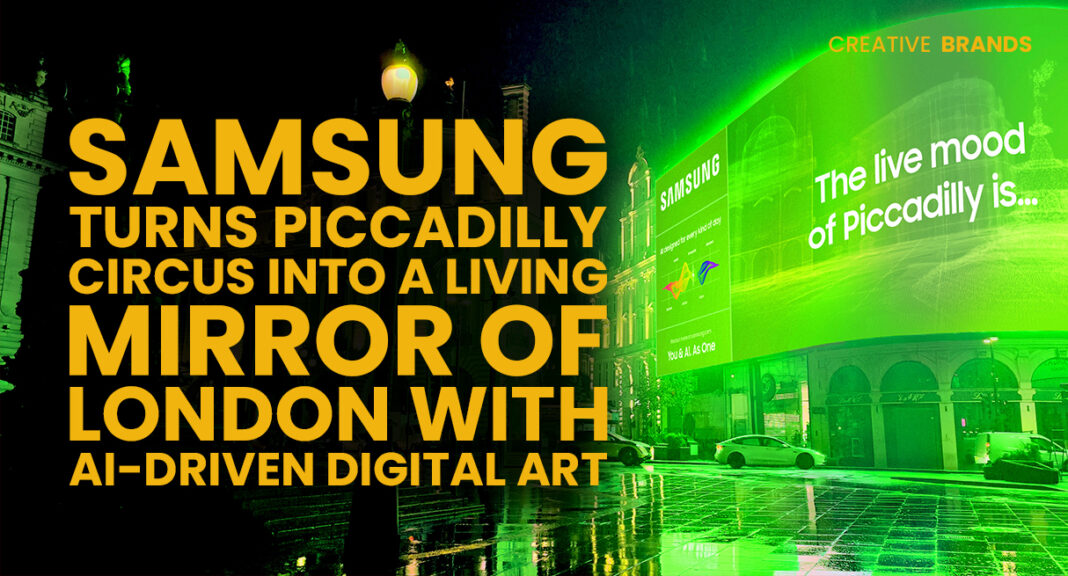
Samsung Electronics and Cheil Worldwide UK transformed Piccadilly Circus into a real-time, data-driven digital experience reflecting London’s changing mood. Powered by privacy-first AI, the activation translated crowd energy, movement and atmosphere into dynamic visuals, showcasing how artificial intelligence can enrich everyday public spaces with cultural and social meaning.
On a brisk December evening in the heart of London, one of the city’s most iconic public spaces seemed to come alive in a way that blurred the boundaries between art, technology and human emotion. Piccadilly Circus, already famous for its dazzling advertising screens and constant flow of pedestrians, became the stage for a groundbreaking digital experience that transformed the everyday energy of the city into a vibrant canvas of real-time creativity. The moment marked a fresh chapter in how artificial intelligence can be woven into public life, not as an abstract future concept, but as a tangible, dynamic encounter right at the crossroads of culture, technology and everyday human behaviour.
The initiative — brought to life by Samsung Electronics in collaboration with Cheil Worldwide UK — turned the vast Piccadilly Lights display into a mood-responsive installation powered by real-time data from the surrounding environment and the ebbs and flows of city life. Samsung, a global leader in consumer electronics, has long used the Piccadilly Lights to announce products and campaigns. But this latest activation went far beyond traditional advertising, aiming to demonstrate how data and AI can both reflect and enrich public experience.
Rather than showing a static advert, the digital display continuously shifted throughout the evening based on what organisers dubbed a “Mood Score”. This score was generated by a custom-built Mood Calculator, a system that captures and processes a range of anonymised, privacy-safe signals — including crowd density, movement patterns, local weather and the time of day — to interpret the collective mood of Piccadilly Circus in real time. The result was an immersive, kaleidoscopic visual spectacle that resonated with London’s trademark unpredictability and diversity.
From bright, energetic hues that reflected bustling crowds to softer tones that corresponded with quieter, more contemplative moments, the installation presented six distinct creative “mood” states, each visually linked to Samsung’s expanding ecosystem of AI-enabled products. On launch night, a large-scale lighting takeover synchronised the surrounding architecture with the screen’s mood colours, creating a unified sensory experience that drew crowds and passers-by alike to stop, watch and reflect.
In a world increasingly saturated with digital content, the activation stood out for its ambition. It wasn’t merely about showcasing cutting-edge technology; it was about illustrating how that technology might be experienced and felt in public life — intuitively, emotionally and contextually. For Samsung, this moment was positioned as more than a marketing exercise: it was a claim that artificial intelligence can be adapted to everyday life in ways that enhance cultural and social connection, all while respecting individual privacy.
Privacy was a core tenet of the project. Organisers were explicit that no personal identifiers were captured at any point. There was no facial recognition, no image recording or storage, and no tracking of individuals. Instead, only anonymised numerical data — the kind of aggregated signals that cannot be traced back to a specific person — were used to influence the visuals displayed. This “privacy-first” approach was central to Samsung’s messaging, aimed at reassuring the public that such AI-driven experiences can be responsible and respectful even in a bustling public space.
“It’s not about watching screens, but about feeling understood,” said a spokesperson from Samsung UK. “London never feels the same from one day to the next, and neither do we. Some days we’re full of energy, others we need a bit of help to keep life moving. This experience captures that feeling in a relatable way and shows how Samsung’s AI-enabled ecosystem can support people in those everyday moments.”
For those who paused to watch, the changing visuals offered a kind of public mirror — a reflection of London’s collective mood rather than a traditional commercial message. The installation drew on the ebb and flow of the city’s life: the rush of commuters at the end of the workday; the playful wanderings of tourists; the quiet lull as weather shifted; the flurry of activity as night descended. Each shift in the display was an abstract commentary on these rhythms, and in doing so, invited onlookers to contemplate the interplay between physical presence and digital interpretation.
Cheil Worldwide UK, the creative partner on the project, described the work as a rare opportunity to demonstrate how data and craft can combine to elevate brand experience in a public arena. Donna Buckingham, head of account management at Cheil UK, emphasised the challenge and opportunity of translating the “live mood of London” into real-time creative on one of Europe’s most recognised screens. Her team’s work sought to honour the city’s cultural dynamism while aligning it with Samsung’s vision of technology that adapts to human behaviour.
Alongside the technological innovation and creative ambition, there was a cultural resonance to staging such an experience in Piccadilly Circus itself. For decades, the junction — with its curved LED billboard and constant footfall — has been a hub of urban storytelling, advertising and public assembly. Its screens have carried everything from Coca-Cola jingles to iconic cinematic teasers, and Samsung’s presence there goes back to the mid-1990s. But even as the physical infrastructure evolved, the site remained symbolic of how media and daily life intersect in the urban landscape.
The latest campaign built on that legacy, repurposing the site not as a backdrop for passive viewing, but as an interactive stage that responded to the city in real time. In doing so, it reimagined the role of public displays in an AI-enabled future: not just as screens to look at, but as systems that listen, interpret and reflect.
Beyond the multimedia spectacle itself, Samsung’s broader strategy underscores a growing belief among tech giants that artificial intelligence will soon be embedded into every facet of daily life — from smartphones and smart home devices to public installations and shared spaces. While this shift raises complex questions about data, consent and ethics, the Piccadilly Circus activation illustrated one way those concerns might be addressed: by designing experiences that are transparent, contextual and attuned to human sensibilities.
By embracing real-time data and AI in a public context, Samsung sought not just to demonstrate technological prowess but to spark a conversation about how technology intersects with lived experience. For Londoners and visitors who found themselves lingering beneath the lights, the installation was a moment of pause — a chance to consider how the mood of a city might be translated into colour and motion, and what that says about the broader role of technology in shaping contemporary life.
As the nights lengthen and digital screens continue to proliferate across cityscapes worldwide, Samsung’s Piccadilly Circus activation stands as a testament to the possibilities and challenges of blending AI with public expression. It is a reminder that even in a world driven by data and algorithms, there remains a distinctly human impulse: to see ourselves reflected in the places we gather, and in the technologies that increasingly share our spaces.
If Samsung’s experiment leaves one enduring impression, it is this: that technology, when thoughtfully deployed, can do more than broadcast messages — it can resonate with the rhythms of life itself.
Discover more from Creative Brands
Subscribe to get the latest posts sent to your email.