


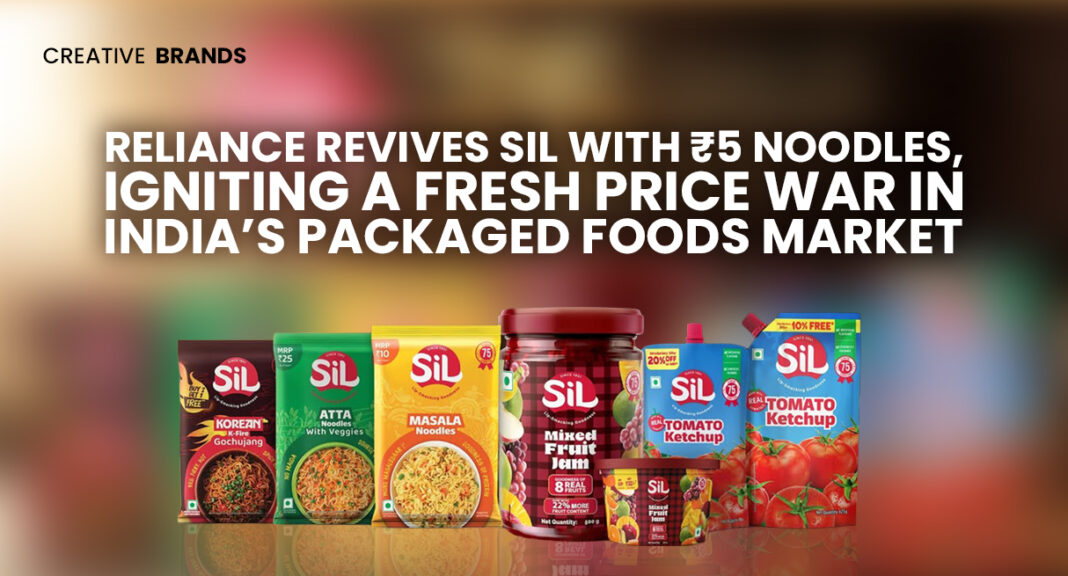
Reliance Consumer Products has relaunched the legacy SIL brand with ultra-affordable noodles, ketchup and jam, marking its first major push into packaged foods. Priced at ₹5 and ₹1 sachets, SIL targets mass households, intensifies FMCG competition, and signals a renewed battle for value-driven daily consumption.
Reliance Consumer Products Limited has brought back a familiar name from India’s grocery shelves, reviving the SIL brand in a move that signals a sharpened focus on everyday food consumption and price-led expansion. Acquired earlier this year, SIL has been relaunched with a compact but pointed portfolio that includes instant noodles in four flavours—Masala, Atta with Veggies, Korean K-Fire and Chow-Chow—alongside tomato ketchup made from real tomatoes and mixed fruit jam with higher fruit content. All products are positioned around natural ingredients and everyday affordability, with prices that are deliberately disruptive in a market long dominated by entrenched incumbents.
At the heart of the relaunch is a simple but powerful declaration of intent. SIL’s instant noodles are available at ₹5, and ketchup sachets at ₹1, making it one of the most aggressive price entries in the packaged foods segment in recent years. For an FMCG market that has spent the past few years navigating inflation, price hikes and shrinking grammage, Reliance Consumer’s move is less about incremental innovation and more about resetting the base of the pyramid. This is not a premium play designed to burnish brand credentials, but a volume-first strategy aimed squarely at India’s price-conscious households, semi-urban markets and deep rural pockets where value still drives daily purchase decisions.
The SIL relaunch also marks Reliance Consumer’s first major push into packaged foods, following the revival of Campa Cola, another legacy brand reintroduced with aggressive pricing to challenge multinational giants. Together, these moves underline a broader strategy: resurrect heritage Indian brands, modernise them with contemporary flavours and quality benchmarks, and deploy the full force of Reliance’s distribution, sourcing and scale to make them accessible at prices that competitors find hard to match. By blending nostalgia with modern product cues such as Korean-inspired flavours and atta-based noodles, SIL attempts to straddle both familiarity and novelty without drifting into premium territory.
In India’s intensely competitive instant noodles category, the implications are immediate. For decades, the segment has been shaped by brands like Maggi, Sunfeast and Yippee, with pricing that typically starts higher and relies on brand trust, taste equity and advertising muscle. Reliance’s entry at ₹5 fundamentally alters the price-pack architecture of the category. It challenges the assumption that quality noodles cannot be delivered at such low price points, especially when backed by claims of natural ingredients and global quality standards. For consumers, particularly in value-driven markets, the proposition is compelling: familiar food, new flavours and minimal risk at a price low enough to encourage trial.
For incumbent players, the challenge is less about matching a single SKU and more about defending margin structures built over years. Competing at ₹5 without eroding brand equity or profitability is not straightforward, especially for companies that depend on third-party distribution and lack the balance sheet strength to subsidise prolonged price wars. Reliance, by contrast, can afford to absorb early losses or operate on razor-thin margins, leveraging its integrated ecosystem, owned logistics and massive retail footprint to offset risks. This ability to play the long game makes SIL’s relaunch less of a tactical experiment and more of a strategic disruption.
The impact is equally significant for kirana stores and distributors, who remain the backbone of India’s FMCG consumption. SIL’s low-ticket, high-velocity products are designed to move fast off shelves, offering attractive trade terms that incentivise stocking and visibility. For small retailers, a ₹5 noodle pack or a ₹1 ketchup sachet is easy to sell, requires minimal consumer persuasion and fits neatly into the daily cash cycle of neighbourhood stores. Shelf space, always a contested resource, becomes a battleground where incumbents may find themselves pushed back unless they respond with sharper trade schemes or differentiated offerings.
In modern trade and quick commerce, the dynamics are slightly different. Ultra-affordable packs like SIL’s create opportunities for basket-building, allowing platforms to add low-value items that increase item counts and frequency. However, they also compress per-order value, a metric closely watched by quick commerce players striving for profitability. For them, SIL’s products may function as entry points or add-ons rather than margin drivers, reshaping how platforms curate assortments for value-seeking consumers without undermining their economics.
Beyond noodles, SIL’s ketchup and jam offerings also carry strategic weight. Condiments are staple purchases with high household penetration, dominated by a handful of trusted brands. By introducing sachets at ₹1 and emphasising real tomatoes and higher fruit content, Reliance is attempting to democratise access while subtly questioning whether higher prices necessarily mean better quality. This approach could resonate strongly in markets where consumers are trading down or stretching household budgets, especially as food inflation continues to influence buying behaviour.
For FMCG companies and their price-pack architecture teams, the SIL relaunch is a stress test. It forces hard questions about portfolio design, segmentation and the sustainability of premiumisation strategies in a market where the base remains vast and highly price-sensitive. Can brands stretch downward without diluting their core positioning, or is it more prudent to defend premium segments and cede the lowest price points to aggressive challengers? Reliance’s move suggests that owning the base can unlock scale, data and distribution advantages that ripple upward over time.
There is also a broader industry question embedded in SIL’s comeback. Does such value aggression expand the category by bringing new consumers into the organised packaged foods market, particularly those who previously relied on unbranded or loose alternatives? Or does it trigger a race to the bottom that compresses margins across the board, making it harder for smaller players to survive? History offers mixed answers. While lower prices can accelerate formalisation and increase penetration, prolonged price wars often lead to consolidation, with only the largest and most efficient players emerging stronger.
What is clear is that Reliance Consumer is not merely reviving old brands for nostalgia’s sake. It is deploying them as strategic tools to capture daily household spends in a value-driven market. By combining heritage recognition with modern flavours, natural ingredient positioning and shockingly low prices, SIL becomes more than just another product launch. It becomes a statement about where the next phase of FMCG growth may come from: not from chasing affluent consumers alone, but from winning the trust and loyalty of millions of households for whom affordability remains the primary filter.
As SIL finds its way back into kitchens across India, the real test will be execution. Consistent quality, reliable availability and sustained pricing discipline will determine whether the brand can build lasting equity or remain a tactical disruptor. For now, though, Reliance has made its intentions unmistakably clear. The price war for India’s mass market is on, and SIL is at the front line, reshaping how companies think about value, volume and the everyday food choices of Indian families.
Discover more from Creative Brands
Subscribe to get the latest posts sent to your email.