


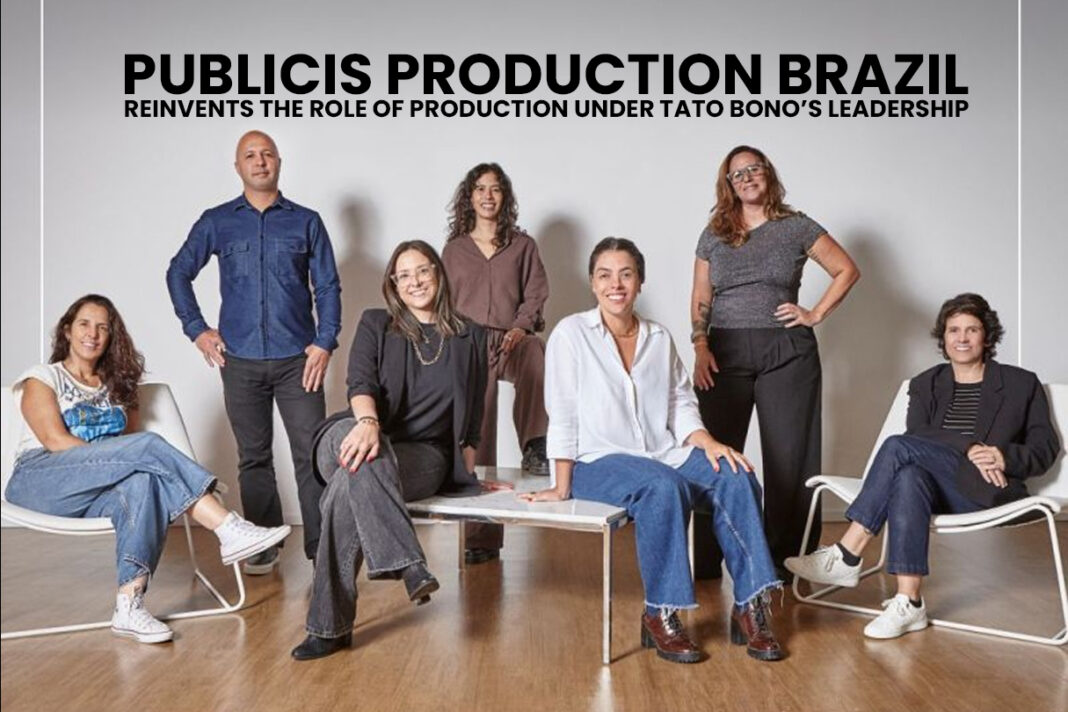
Publicis Production Brazil, led by Tato Bono, is reshaping production into a strategic business unit. With a strengthened leadership team and integration across data, media, and creative, the company is delivering personalized, culturally relevant content at scale, positioning itself to meet both local market demands and global priorities.
In Brazil, Publicis Production is undergoing a transformation that reflects the changing nature of the advertising and communications industry. Under the leadership of Tato Bono, the company’s local team has been steadily strengthening its structure, bringing together an exceptional group of leaders across production, studios, integrated graphic production, and growth and new business. This deliberate expansion is not simply about adding capacity—it is about redefining the role of production itself in a fast-moving, ever-evolving market.
For decades, production was often seen as the final step in the creative process, a technical function that executed ideas once they had been conceived. Bono, however, is clear that this perception no longer holds. “Production is no longer an appendix of the creative process,” he explains. “It has become a strategic business unit, focused not only on personalization at scale, but on true relevance.” His words capture the essence of a shift that is reshaping the industry: production is now central to how brands connect with audiences, not peripheral.
The Brazilian market, with its diversity, dynamism, and cultural richness, provides fertile ground for this evolution. Consumers are increasingly demanding content that speaks directly to them, not just in language but in tone, context, and cultural nuance. Meeting this demand requires more than creative brilliance—it requires a production system that is fully integrated with data, media, and creative teams. Publicis Production Brazil has positioned itself precisely at this intersection, producing what Bono calls “intelligent content that delivers the right message to the right person, on the right platform, within the right cultural context.”
This approach reflects a broader global trend in advertising, where personalization and relevance are becoming the twin pillars of effective communication. Yet in Brazil, the challenge is particularly acute. The country’s scale, regional diversity, and rapidly shifting consumer behaviours mean that brands must be agile, responsive, and deeply attuned to cultural signals. Publicis Production’s strengthened leadership team is designed to meet these challenges head-on, ensuring that the company can deliver both locally resonant campaigns and globally aligned strategies.
The integration of production with data and media is especially significant. In the past, creative ideas were often developed in isolation, with production teams tasked to bring them to life after the fact. Today, data insights inform creative decisions from the outset, and production teams are involved in shaping how those ideas will be executed across platforms. This creates a feedback loop where content is not only produced more efficiently but also optimized for impact. By embedding production within this ecosystem, Publicis Production Brazil is ensuring that its output is not just polished but purposeful.
Bono’s emphasis on cultural context is also telling. In a world where global brands often struggle to balance consistency with local relevance, the ability to produce content that resonates within specific cultural frameworks is a competitive advantage. Brazil’s advertising landscape has long been known for its creativity and boldness, but the challenge now is to combine that flair with precision targeting and data-driven insights. Publicis Production’s model seeks to do exactly that, marrying the art of storytelling with the science of personalization.
The strengthening of the team across studios and integrated graphic production further underscores this ambition. Studios are no longer simply places where content is produced; they are hubs of innovation where technology, creativity, and strategy converge. Integrated graphic production ensures that visual storytelling is consistent yet adaptable, capable of shifting seamlessly between local campaigns and global brand narratives. Growth and new business leadership, meanwhile, signals the company’s intent to expand its influence, bringing this new model of production to more clients and markets.
The implications of this transformation extend beyond Publicis Production itself. As production becomes a strategic business unit, it challenges the traditional boundaries between creativity, media, and technology. Agencies and brands alike must rethink how they structure their teams, how they measure success, and how they engage with audiences. In Brazil, where digital adoption is high and consumers are quick to embrace new platforms, the stakes are particularly high. Those who fail to adapt risk irrelevance; those who succeed can build lasting connections with audiences who are increasingly discerning.
Publicis Production Brazil’s journey under Bono’s leadership is therefore more than an internal restructuring—it is a case study in how production can drive business growth and cultural relevance. By aligning its teams with global priorities while staying rooted in local realities, the company is positioning itself as a leader in the next phase of advertising. The message is clear: production is not the end of the creative process, but the engine that powers it.
As Bono puts it, the goal is intelligent content—content that is not only seen but felt, not only delivered but understood. In a marketplace where attention is scarce and competition fierce, that intelligence may well be the difference between campaigns that fade and campaigns that endure. Publicis Production Brazil is betting on the latter, and under Bono’s guidance, it is building the structure to make that bet pay off.
Discover more from Creative Brands
Subscribe to get the latest posts sent to your email.