


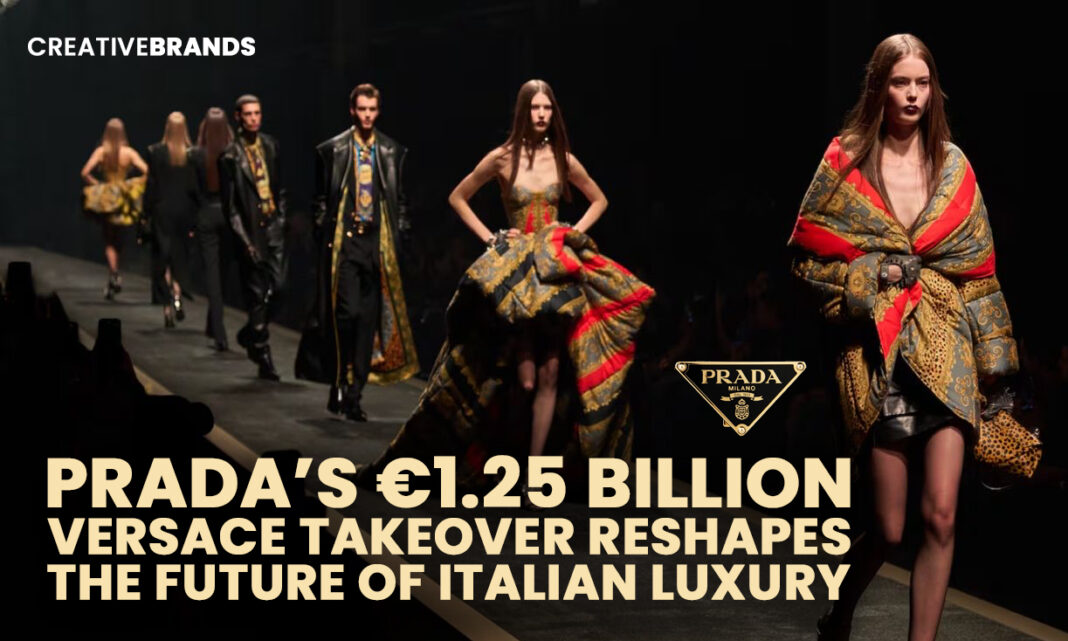
Prada Group’s €1.25 billion acquisition of Versace brings two iconic Italian fashion houses under one umbrella, blending Prada’s minimalism with Versace’s bold glamour. Versace will retain its creative identity as Lorenzo Bertelli leads its next phase. The move strengthens Prada Group’s global reach and signals a new era of luxury consolidation.
The global luxury world felt a powerful tremor this week as two of Italy’s most influential fashion houses—Prada and Versace—were brought under the same umbrella in a landmark €1.25 billion acquisition. With this move, Prada Group has formally absorbed Versace, forging one of the most intriguing alliances in modern fashion history. For decades, both houses have stood as icons of Italian design, yet their aesthetic vocabularies could not be more different: Prada with its cerebral minimalism and avant-garde intellectualism, Versace with its unapologetic sensuality, flamboyance and cultural boldness. Now, they coexist within a single luxury orbit, bound by strategy as much as heritage.
The acquisition signals a shift in the balance of power among global luxury conglomerates. While French groups like LVMH and Kering have long dominated through aggressive expansion, Italy’s major brands have traditionally remained independent or family-led. Prada Group’s takeover of Versace marks a decisive break from that pattern, positioning Italy as a formidable force in luxury consolidation. The move is both symbolic and strategic: a testament to Italian craftsmanship’s enduring influence and a pragmatic step toward competing on the global stage where scale, efficiency and diversified brand portfolios matter more than ever.
In announcing the acquisition, Prada Group emphasized that Versace will continue to operate with its own creative identity. This assurance is critical because Versace’s DNA—bold prints, high-octane glamour, sculptural cuts, and a sensuality bordering on theatrical—is deeply tied to its brand mythology. Over the years, it has created some of fashion’s most memorable pop-cultural moments, from the Medusa logo’s omnipresence in the ’90s to the iconic jungle dress Jennifer Lopez wore in 2000, a look that helped inspire Google Images. Preserving this spirit is essential not just for creative integrity but for commercial success, given Versace’s loyal global audience.
However, even as Versace retains its aesthetic autonomy, it now gains access to Prada’s extraordinary manufacturing ecosystem—considered among the finest in the world. Prada’s vertically integrated production model ensures exceptional craftsmanship, tight quality control, and high margins. This operational muscle could dramatically elevate Versace’s product consistency, innovation capabilities and supply chain efficiency. For a brand whose demand often outpaces production capabilities, this shift may unlock previously unreachable growth.
Beyond manufacturing, Prada’s expansive global retail network offers Versace new opportunities for expansion. While Versace enjoys strong visibility in major markets, it has often been perceived as a brand with untapped potential—popular, culturally powerful, yet uneven in geographic penetration. Prada’s infrastructure, relationships and retail insights could help standardize performance across regions, optimize store formats and accelerate growth in high-potential markets such as China, South Korea and the Middle East.
At the heart of this new era lies Lorenzo Bertelli, Prada’s next-generation leader and a central figure in the deal. As the group’s marketing lead and long-acknowledged heir to the family empire, Bertelli has been gradually shaping Prada’s transformation—bringing digital modernization, sustainability initiatives and sharper brand discipline. In his new role as executive chairman of Versace, he will guide the brand’s evolution while honoring its legacy. Prada Group has emphasized that no drastic changes in creative leadership or design direction are planned immediately. This suggests a strategy of steady reinforcement rather than rapid overhaul, with Bertelli expected to bring long-term clarity rather than short-term disruption.
What makes this acquisition particularly compelling is the creative interplay it could spark. Versace’s exuberant aesthetic stands in stark contrast to Prada’s intellectual coolness and Miu Miu’s playful irreverence. Together, the three brands form a sharply differentiated triad under one corporate family. Each speaks to a distinct consumer mindset—Prada to the thoughtful trendsetter, Miu Miu to the youthful experimentalist, and Versace to the glamorous maximalist. This diversity gives Prada Group a competitive edge in the global luxury market where versatility, demographic reach and cross-category strength are increasingly important.
The consolidation also comes at a time when luxury brands are expanding beyond fashion into lifestyle universes—beauty, homeware, hospitality, digital collectibles and more. Versace’s strong presence in fragrance and home décor aligns naturally with Prada’s emerging ambitions in these sectors. Together, they can build an ecosystem that goes far beyond apparel, offering a holistic luxury experience.
Yet the acquisition also raises questions. How will Prada balance Versace’s instinct for theatrical excess with its own reputation for conceptual restraint? Can a brand as bold as Versace thrive within a group known for artistic introspection? Will there be shifts in distribution, pricing, or creative experimentation? Prada Group has insisted that creative independence will remain intact, but the industry will be watching closely—particularly as luxury customers worldwide expect coherence, surprise and cultural relevance in equal measure.
In the broader industry context, Prada’s acquisition of Versace marks another chapter in the trend of luxury consolidation. For years, independent brands have struggled against the scale, marketing power and global distribution networks of mega-groups. Aligning with a major conglomerate has increasingly become a path to stability and accelerated growth. Yet few acquisitions bring together two brands with such powerful, contrasting identities—both unmistakably Italian, but architecturally different in spirit.
While the financials reflect a business strategy, the emotional symbolism is rooted in Italy’s creative legacy. Two titans of Milanese fashion, once competitors on the runway, now share not only cultural geography but corporate purpose. The merger strengthens Italy’s voice in an industry often dominated by French luxury powerhouses and opens a new chapter where heritage meets ambition on equal footing.
For consumers, the implications may unfold slowly—through improved quality, expanded collections, more precise storytelling and an even bolder presence on the global fashion stage. For the industry, the deal is a reminder that the future of luxury lies not merely in branding or trends but in the ability to fuse creativity with strategic scale.
Prada Group’s acquisition of Versace is more than a corporate transaction—it’s a reshaping of the luxury map, a recalibration of market power and a statement on the evolving identity of Italian fashion. As the dust settles, one thing is clear: the future for both brands just became far more interesting.
Discover more from Creative Brands
Subscribe to get the latest posts sent to your email.