


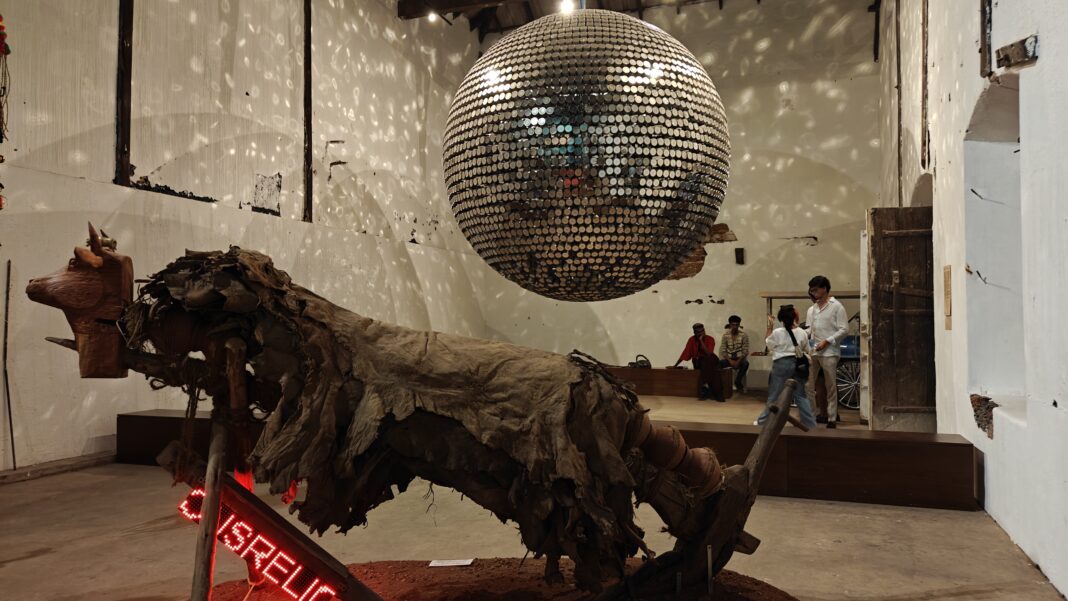
At the Kochi-Muziris Biennale 2025, artist Prabhakar Kamble unveils Vichitra Natak, a sculptural arena inspired by wrestling rings, where caste hierarchies are suspended through humour, craft, and solidarity. His installation interrogates ritualistic exclusions, reclaims dismissed forms, and invokes Ambedkarite consciousness to confront caste as an absurdity undermining democracy and humanity.
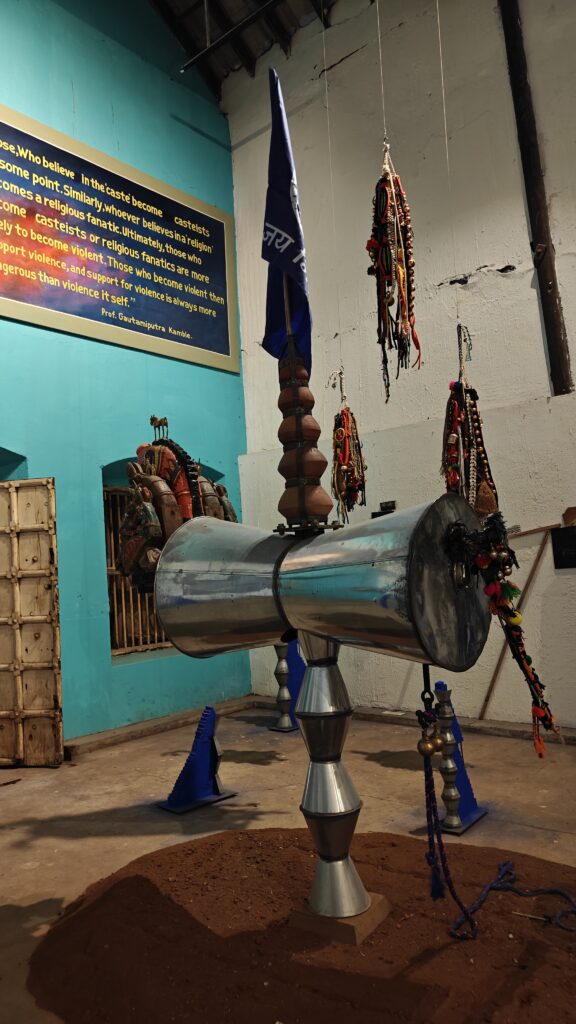
Prabhakar Kamble, born in 1986 in Shendur, India, has steadily emerged as one of the most incisive voices in contemporary art, using sculpture, installation, and performance to probe the aesthetic, social, political, historical, and cultural architectures of caste. His practice is rooted in the hinterland, mobilising materials and gestures drawn from agricultural life—harnesses, earthen pots, brass bands, and chandeliers—objects that carry the weight of everyday labour yet are often dismissed as decorative or folk. By recontextualising these forms, Kamble exposes the contradictions between labourers and labour, between ritualistic hierarchies and lived realities, and between exclusion and solidarity. His work is not merely anti-caste; it is a call for the annihilation of caste itself, inseparable from the struggle for radical democracy, equality, dignity, and humanity.
At the Kochi-Muziris Biennale 2025, Kamble stages Vichitra Natak (Theatre of the Absurd), a sculptural arena inspired by the talim, or wrestlers’ ring, where caste is momentarily suspended by the ethics of skill and friendship. Wrestling, in its traditional form, is a contest of strength and technique, but within the talim, caste divisions dissolve, replaced by mutual respect and camaraderie. Kamble seizes this metaphor to create a space where viewers must wrestle not with each other but with the absurdity of caste itself. His arena is both physical and conceptual, a theatre without script, sustained only by the collective presence of those who enter.
Descending into this arena, chandeliers composed of pierced and hollowed terracotta vessels hang in five tiers, mirroring the stratifications of the varnashrama dharma. These chandeliers, fragile yet monumental, embody the precariousness of caste hierarchies—structures that appear eternal but are, in fact, brittle and hollow. Around them, rusted metal doors resembling public latrines evoke the indignities imposed by caste, while videos of brass bands playing among sugarcane fields inject sound, colour, and satire into the space. The scenography is deliberately excessive, a cacophony of forms and gestures that confront the viewer with the contradictions of caste and the spiritual trickery that legitimises it under the guise of aesthetic purity.
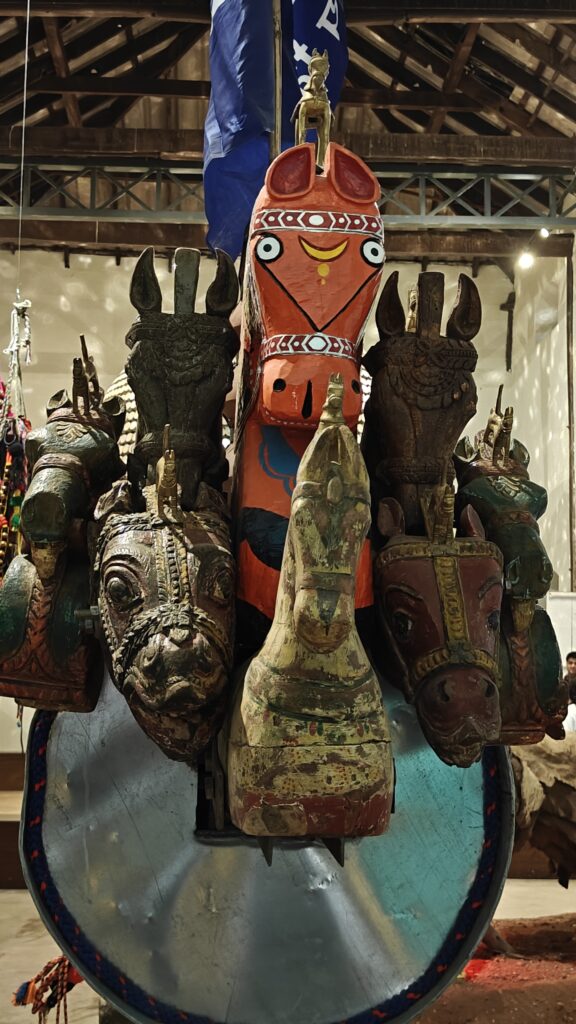
Kamble’s gestures challenge the abstraction prescribed by art school orthodoxy, revealing its complicity in erasing labour and locality. In the canon of modernist art, abstraction often claims universality, yet it frequently excludes the textures of lived experience, particularly those of marginalised communities. By reclaiming forms dismissed as decorative or folk, Kamble unsettles this orthodoxy, insisting that art must grapple with the realities of labour, survival, and faith. His humour and excess are not frivolous but strategic, a means of destabilising the solemnity with which caste is often cloaked. In calling Vichitra Natak a contemporary “Arte Povera of the subcontinent,” Kamble situates his work within a lineage of art that draws from the precarious afterlives of craft and survival rather than the detritus of industrial society. Here, art is sourced from the resilience of communities, from the faith that sustains them, and from the contradictions that threaten to undo them.
The installation demands that the viewer wrestle with caste as absurdity. Unlike a scripted performance, Vichitra Natak unfolds through the presence and participation of its audience. The absurdity lies not in the theatricality of the installation but in the persistence of caste itself, a system that continues to dictate lives despite its irrationality. Kamble’s arena becomes a mirror, reflecting the absurdity back at the viewer, forcing them to confront their complicity, their silence, or their resistance. It is a theatre where the stakes are not entertainment but humanity.
Kamble’s invocation of Ambedkarite consciousness is central to his practice. For him, Ambedkar is not merely an intellectual figure but a lived, critical, emotional awareness. Ambedkarite consciousness is both a position and a practice, a way of seeing and a way of being. In Vichitra Natak, this consciousness manifests as solidarity, as the bringing together of people across divisions, as the insistence that dignity and equality are not negotiable but fundamental. The talim-inspired arena is thus not only a metaphor but a lived proposition: a space where caste is suspended, however momentarily, by the ethics of skill, friendship, and solidarity.
The humour in Kamble’s work is sharp, cutting through the solemnity of caste with satire and excess. The brass bands playing in sugarcane fields, the chandeliers of terracotta vessels, the rusted latrine doors—all are gestures that expose the absurdity of caste by exaggerating its forms, by reclaiming its dismissed objects, by turning its hierarchies into spectacle. Yet this humour is not dismissive; it is a strategy of survival, a means of confronting oppression without succumbing to despair. In this sense, Kamble’s work resonates with traditions of satire and parody that have long been tools of resistance, from folk theatre to political cartoons, from carnival to protest.
The excess in Vichitra Natak is equally deliberate. By overwhelming the viewer with sound, colour, and form, Kamble refuses the minimalist purity often associated with high art. His excess is a refusal of erasure, a refusal to sanitise the realities of caste, a refusal to conform to the aesthetic hierarchies that mirror social ones. In this excess, Kamble insists that art must be messy, must be contradictory, must be uncomfortable, if it is to grapple with the realities of caste and democracy.
Kamble’s practice is deeply rooted in the agricultural hinterland, in the materials and vocabularies of everyday life. The harnesses, earthen pots, brass bands, and chandeliers he mobilises are not exoticised objects but lived forms, embedded in the rhythms of labour and survival. By bringing these forms into the arena of contemporary art, Kamble reclaims them from dismissal, insisting on their aesthetic and political significance. His work is thus both local and global, rooted in the specificity of caste yet resonant with struggles for dignity and equality across contexts.
In positioning the annihilation of caste as inseparable from the struggle for radical democracy, Kamble situates his work within a broader political horizon. For him, caste is not merely a social hierarchy but a fundamental obstacle to democracy, equality, and humanity. The struggle against caste is thus not only a struggle for Dalit dignity but a struggle for democracy itself, for a society where equality is not an aspiration but a reality. Vichitra Natak embodies this horizon, offering a space where caste is suspended, where solidarity is enacted, where democracy is rehearsed.
As viewers step into Kamble’s arena, they are invited not only to witness but to participate, to wrestle with the absurdity of caste, to confront their own positions, to imagine a society beyond hierarchy. The installation is not a spectacle to be consumed but a proposition to be lived, a theatre where the performance is sustained only by the presence and participation of its audience. In this sense, Vichitra Natak is both art and politics, both theatre and democracy, both absurdity and possibility.
Prabhakar Kamble’s Vichitra Natak at the Kochi-Muziris Biennale 2025 is a profound reminder that art can be a site of struggle, solidarity, and imagination. By mobilising the vocabularies of the hinterland, by reclaiming dismissed forms, by invoking Ambedkarite consciousness, Kamble confronts caste not as a social reality to be endured but as an absurdity to be annihilated. His arena is a space of possibility, where democracy is rehearsed, where equality is enacted, where humanity is imagined. In the end, Vichitra Natak is not only a theatre of the absurd but a theatre of hope, a space where the struggle for dignity and democracy is staged, lived, and sustained.
Discover more from Creative Brands
Subscribe to get the latest posts sent to your email.