


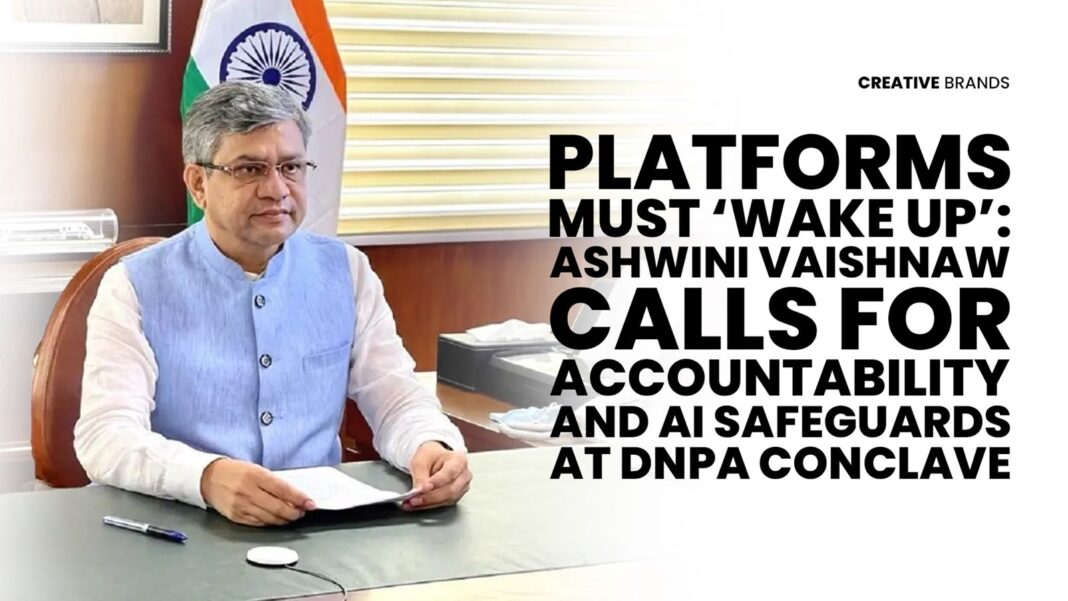
Speaking at the Digital News Publishers Association Conclave in New Delhi, Union Minister Ashwini Vaishnaw urged digital platforms to take responsibility for the content they host and to protect online safety. He warned that unchecked AI-generated content and deepfakes threaten institutional trust and called for urgent regulatory and ethical reforms.
In a forceful address that underscored the government’s growing impatience with Big Tech, Union Minister Ashwini Vaishnaw declared that digital platforms must accept responsibility for the content they carry, warning that failure to protect users—especially children—would invite accountability in an internet landscape that has fundamentally changed.
Speaking on Thursday at the Digital News Publishers Association Conclave in New Delhi, Vaishnaw said the era of platforms positioning themselves as neutral intermediaries is drawing to a close. “Platforms must take responsibility for the content that is hosted by them. The online safety of children, the online safety of all citizens, is the responsibility of the platforms,” he told an audience of editors, publishers and digital media leaders.
The minister’s remarks come at a time when governments across the world are grappling with the influence of social media giants, misinformation campaigns and the rapid rise of artificial intelligence tools capable of generating convincing but fabricated content. For India, one of the world’s largest digital markets, the stakes are particularly high.
Vaishnaw framed the issue not merely as a regulatory challenge but as a civilisational one. Human society, he argued, is built upon trust—trust in families, in social identity, in institutions such as the judiciary, the legislature and the media. That trust, painstakingly developed over thousands of years, now faces unprecedented strain.
“Platforms need to wake up and understand the importance of reinforcing trust in the institutions that human society has built over thousands of years,” he said. The phrase “wake up” resonated through the hall, signalling that the government expects a shift in attitude as much as in policy.
Drawing a parallel with the media industry represented in the room, Vaishnaw noted that journalism’s credibility rests on established principles: impartiality, verification before publication and accountability for errors. Media organisations are judged not only by what they publish but by how rigorously they check facts and how transparently they correct mistakes.
“Every arm, every institution built by humans, is based on these fundamental tenets,” he said. “Mutual trust defines the entire core of the institution.”
Yet, according to the minister, the digital ecosystem has too often operated by different rules. Platforms have scaled at extraordinary speed, connecting billions and democratising expression. But in doing so, they have also enabled the viral spread of harmful content, from misinformation and hate speech to manipulated media designed to deceive.
Vaishnaw warned that the “core tenet of trust” is under direct assault from emerging technologies, particularly deepfakes—AI-generated audio and video that can make individuals appear to say or do things that never happened. Such fabrications, he cautioned, are no longer crude or easily detectable. They are increasingly sophisticated, capable of deceiving even discerning viewers.
“The way the world is evolving, that core tenet of trust is under threat,” he said, pointing to the capacity of deepfakes to make people believe in events that never occurred.
The implications extend far beyond individual reputations. In an election season, a convincing fake video could inflame communal tensions or undermine faith in democratic processes. In financial markets, a fabricated statement attributed to a corporate leader could trigger panic. In private life, manipulated images can cause irreparable emotional and social harm.
Particularly concerning, Vaishnaw suggested, is the vulnerability of children and young people navigating digital spaces. Online harms—ranging from exposure to inappropriate content to cyberbullying and exploitation—have become pressing public concerns. By placing responsibility squarely on platforms, the minister signalled that safeguarding minors is not optional or peripheral but central to their operating model.
His comments also addressed the burgeoning field of generative AI, where tools can replicate a person’s face, voice or personality with startling realism. Vaishnaw called for clear regulation to ensure that such content is not created without consent.
“The time has come to make that big inflectionary change,” he said. “I request the platforms to cooperate with this human society’s basic needs. The society which is today asking for this change has to be respected.”
Consent, in this framing, becomes a cornerstone of digital ethics. The unauthorised use of someone’s likeness—whether for parody, profit or political manipulation—raises profound legal and moral questions. By urging regulation of AI-generated content, Vaishnaw aligned India with a broader global debate over how to balance innovation with the protection of individual rights.
His speech suggests that the government is prepared to act if voluntary compliance falls short. “Non-adherence” to these principles, he cautioned, would make platforms accountable. While he did not detail specific penalties or legislative proposals in his address, the tone indicated that regulatory patience may be limited.
For digital publishers in attendance, the message was double-edged. On the one hand, many traditional media organisations have long argued that platforms enjoy disproportionate power and revenue without equivalent responsibility. Calls for stronger oversight may therefore find sympathetic ears among news outlets competing in a challenging advertising environment.
On the other hand, publishers themselves operate in the same digital ecosystem and must contend with questions of moderation, verification and the ethical use of AI. Vaishnaw’s invocation of media standards served as both commendation and reminder: credibility is hard won and easily lost.
The minister’s emphasis on institutional trust also touches on a deeper anxiety of the digital age. As information flows accelerate and barriers to publication collapse, distinguishing fact from fabrication has become more complex. When citizens can no longer rely on the authenticity of what they see and hear, democratic discourse suffers.
In this context, Vaishnaw’s call for platforms to “cooperate with human society’s basic needs” reads as an appeal for alignment between technological capability and social responsibility. The transformative power of digital platforms is not in dispute; what is contested is the framework within which that power operates.
Industry representatives have often argued that moderation at scale is technically and ethically challenging, involving trade-offs between free expression and harm prevention. Yet governments increasingly contend that complexity cannot be an excuse for inaction.
India’s digital population, numbering in the hundreds of millions, makes it a critical testing ground for how these tensions are resolved. The country has witnessed both the empowering potential of social media and the destabilising effects of viral misinformation.
Vaishnaw’s speech at the DNPA Conclave thus signals more than rhetorical frustration. It reflects a broader shift in expectations: that platforms, like any other powerful institution, must anchor their operations in accountability, transparency and respect for societal norms.
Whether through new legislation, strengthened enforcement of existing rules or collaborative frameworks with industry, change appears imminent. The minister’s central argument was clear: technology cannot be allowed to erode the very trust upon which society depends.
As delegates filed out of the conclave hall in New Delhi, the message lingered. In an age of synthetic voices and fabricated faces, safeguarding authenticity is no longer a niche concern but a democratic imperative. For digital platforms, the warning was unequivocal: wake up, or be held to account.
Discover more from Creative Brands
Subscribe to get the latest posts sent to your email.