


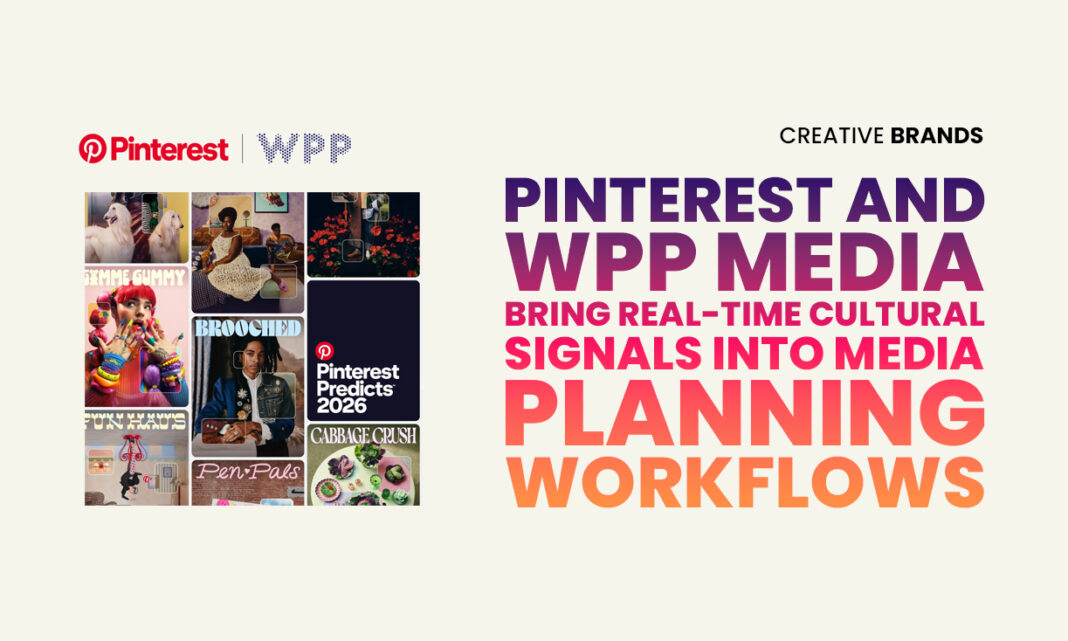
Pinterest is partnering with WPP Media to integrate Pinterest Trends into WPP Open, enabling teams to access real-time search intent within their planning and activation platform. The move helps brands spot emerging cultural trends early, translate insights into live campaigns, and close the loop between consumer intent and performance.
Culture rarely waits for a quarterly planning cycle. By the time a trend report lands in an inbox, the moment it describes has often already passed, leaving brands to react to yesterday’s signals rather than tomorrow’s intent. That gap between cultural momentum and media execution has become one of the central frustrations of modern marketing, where audiences move at the speed of search while planning tools often lag behind. It is this tension that underpins a new partnership between Pinterest and WPP Media, aimed at embedding real-time cultural insight directly into the heart of media planning and activation.
Pinterest is partnering with WPP Media to integrate Pinterest Trends into WPP Open, WPP’s AI-powered marketing operating system. The move is designed to eliminate the friction that arises when trend discovery sits outside a marketer’s everyday workflow. Instead of toggling between platforms, presentations and dashboards, WPP teams and their clients will now be able to access live Pinterest search momentum from within the same environment they use to plan, build and launch campaigns.
For brands, the promise is immediacy. Pinterest Trends draws on what people are actively searching for on the platform, offering a live view of emerging interests, seasonal spikes and shifts in consumer intent. By bringing those signals into WPP Open, planners and creatives can see cultural momentum as it forms, rather than retrospectively analysing it once it has already peaked. In an era where relevance is often measured in days or even hours, that difference can determine whether a campaign feels timely or tone-deaf.
The partnership reflects a broader shift in how media companies and platforms are thinking about data. Historically, trend intelligence has been something of a separate discipline, handled by specialist teams and delivered as reports or forecasts. While valuable, those insights have often struggled to translate cleanly into execution. By the time they reach media buyers or creative teams, they risk becoming abstract guidance rather than actionable signals. Embedding Pinterest Trends directly into WPP Open is an attempt to close that gap, allowing insight to flow seamlessly into decision-making.
From a planning perspective, the integration allows WPP teams to sharpen audience understanding using live intent signals rather than static profiles. Pinterest search behaviour is often an early indicator of what people are planning, whether it is a purchase, a life moment or a lifestyle change. Seeing that momentum in real time enables planners to align budgets, channels and messaging with what audiences are actively curious about, rather than what they were interested in weeks ago.
Creative development stands to benefit as well. With trend data visible within the same platform used to build campaigns, creative teams can shape ideas that are informed by what is gaining traction on Pinterest at that moment. This reduces the risk of misalignment between strategy and execution, where a culturally relevant idea identified during research fails to survive the journey into final creative. Instead, trend-informed thinking can guide everything from visual language to messaging cues, helping brands show up in ways that feel native to the moment.
Perhaps most significantly, the integration is designed to allow trend-informed plans to be pushed directly into live campaigns. This means that insights are not just inspirational but operational. Once a planner identifies a rising trend or shift in intent, that intelligence can be translated into targeting, creative choices and media activation without delay. In fast-moving cultural environments, that speed can be a competitive advantage.
The partnership also introduces a feedback loop that many marketers have long sought but struggled to implement. Performance data from campaigns activated through WPP Open can flow straight back into the next brief, allowing teams to see how well their trend-informed decisions translated into results. Over time, this creates a continuous cycle in which what people search for, how brands respond, and how audiences engage all inform one another. Rather than treating insight, activation and measurement as separate stages, the system encourages an always-on approach to learning.
For Pinterest, the collaboration reinforces its positioning as a platform rooted in intent rather than interruption. Unlike social feeds driven primarily by passive consumption, Pinterest is often used as a planning tool, where people actively search for ideas related to shopping, travel, home, fashion and life milestones. By integrating its trend signals into WPP Open, Pinterest is extending the value of that intent data beyond its own ecosystem and into the broader media planning process.
For WPP Media, the integration strengthens WPP Open as a central operating system rather than a collection of disconnected tools. As agencies and clients demand more agility and accountability, platforms that can unify data, planning, creative and activation are becoming increasingly important. Adding live Pinterest Trends into that environment supports WPP’s ambition to help clients move faster and make decisions based on current consumer behaviour, not historical averages.
The timing of the partnership is also notable. As marketing teams face growing pressure to demonstrate effectiveness, the ability to tie cultural insight directly to performance outcomes has become more than a nice-to-have. Brands are being asked not just to be creative, but to be relevant in measurable ways. By closing the loop between search behaviour and campaign performance, the Pinterest–WPP integration aims to make cultural relevance something that can be planned, executed and evaluated with greater precision.
At a broader industry level, the move highlights how the definition of “media planning” is evolving. No longer confined to reach and frequency calculations, planning increasingly involves understanding cultural context, consumer intent and creative resonance. Tools that can bring those dimensions together in one place are likely to shape how agencies operate in the years ahead.
Ultimately, the partnership is built on a simple insight: culture moves faster than most media plans, but it does not have to. By embedding real-time trend intelligence directly into the workflows where decisions are made, Pinterest and WPP Media are betting that brands can keep pace with what people care about right now. If successful, the integration could help shift the industry away from reactive marketing and towards a model where insight and execution move in lockstep, allowing brands to show up not just on time, but in tune with the moment.
Discover more from Creative Brands
Subscribe to get the latest posts sent to your email.