


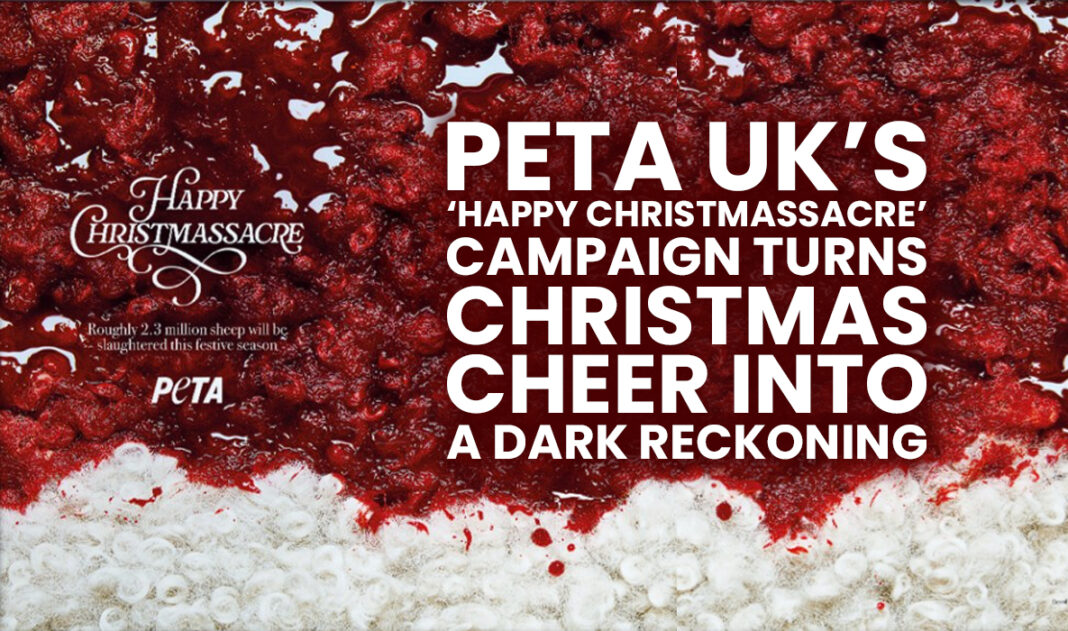
PETA UK and Grey London have launched Happy Christmassacre, a provocative festive campaign spanning cinema, social media and outdoor media. Through dark humour and unsettling imagery, including a horror-inspired film by David Shane, the campaign challenges audiences to confront the animal suffering behind traditional Christmas meals.
As the festive season descends on Britain with its familiar rituals of twinkling lights, crowded shopping streets and tables groaning under the weight of traditional feasts, a new campaign from PETA UK is asking viewers to pause and reconsider what lies beneath the holiday cheer. In partnership with advertising agency Grey London, the animal rights organisation has launched Happy Christmassacre, a provocative, multi-platform campaign designed to confront audiences with what it calls the hidden violence behind Christmas celebrations.
Rolling out across cinemas, social media platforms and out-of-home locations throughout the UK, the campaign deliberately positions itself in spaces typically associated with escapism and festivity. Rather than offering comfort or nostalgia, Happy Christmassacre opts for discomfort, using stark and unsettling imagery to challenge long-held associations between Christmas and goodwill. The visuals reimagine some of the season’s most recognisable symbols through a confrontational new lens, replacing warmth and joy with reminders of suffering that PETA argues are often pushed out of sight and mind during celebrations.
At the centre of the campaign is a striking visual metaphor: Santa Claus himself, traditionally clad in a cheerful red-and-white suit, is stripped of his familiar costume and reassembled from close-ups of stained animal pelts. The transformation is jarring, designed to shock precisely because it subverts an image so deeply embedded in popular culture. By turning Santa—a global emblem of generosity and childhood innocence—into an embodiment of animal suffering, the campaign seeks to underscore the contrast between the spirit of giving and the reality of animal slaughter linked to festive meals.
The hero film, a two-minute cinema spot, pushes this concept further through dark humour and cinematic storytelling. Directed by Emmy and Cannes Lions-winning filmmaker David Shane of O Positive Films, the film opens on a scene that will be instantly recognisable to many British families: a picture-perfect Christmas dinner. The table is laid with care, loved ones gather, and the atmosphere is warm and convivial. It is a moment that evokes comfort and tradition, deliberately lulling viewers into familiarity before pulling the rug from beneath them.
As the film unfolds, the tone begins to shift. What starts as a wholesome portrayal of festive togetherness gradually morphs into a horror-inspired depiction of the violence behind the feast. The transformation is both visual and emotional, juxtaposing the pleasure of the meal with unsettling reminders of its origins. The use of dark comedy allows the film to walk a delicate line—grim enough to provoke reflection, yet stylised enough to hold attention without descending into gratuitous shock.
For PETA, this balance is intentional. The organisation has long been known for controversial campaigns, but Happy Christmassacre represents a strategic effort to engage audiences who might otherwise dismiss more overtly graphic messaging. By framing the issue within the cultural language of Christmas—complete with its icons, aesthetics and rituals—the campaign seeks to meet viewers where they are, rather than preaching from the margins.
“PETA’s goal is to challenge perceptions,” says Mimi Bekhechi, vice president for UK and Europe at PETA. “The talented team at Grey London has done just that with this darkly humorous film, which highlights how easily people can overlook the suffering behind their Christmas lunch.” Bekhechi’s comment points to what PETA sees as a cognitive gap between the festive joy people experience and the processes required to deliver traditional meals to the table.
Grey London’s creative approach leans heavily on contrast and irony, tools often used in advertising to capture attention but here employed in the service of ethical questioning. Christmas is typically depicted as a time when values such as compassion, kindness and generosity are foregrounded. The campaign asks why these values seem to stop short when it comes to animals. By recasting symbols of joy as carriers of uncomfortable truths, Happy Christmassacre attempts to provoke moral reflection without explicitly instructing audiences on how to respond.
The timing of the campaign is also significant. Christmas is not only a cultural high point but also a period of heightened consumption, particularly of meat and animal products. According to industry estimates, millions of turkeys and other animals are slaughtered annually to meet seasonal demand. While such figures are rarely front-of-mind for consumers focused on celebration, they form the unspoken backdrop to festive excess. PETA’s campaign is designed to pull that backdrop into sharp focus.
The choice of cinema as a primary channel reinforces the campaign’s cinematic ambitions. Unlike fleeting social media posts, cinema advertising offers a captive audience and an immersive environment—conditions well suited to a narrative-driven, emotionally charged film. The two-minute runtime, longer than most conventional ads, allows the story to develop gradually, mirroring the way festive rituals themselves unfold and revealing their darker implications step by step.
Out-of-home executions extend the campaign’s reach into public spaces, ensuring that the message is not confined to the cinema or digital feeds. By placing unsettling festive imagery in everyday environments, the campaign disrupts the visual landscape at a time when it is usually saturated with cheerful, consumer-driven messages. Social media, meanwhile, provides a platform for discussion and debate, amplifying the campaign’s impact through shares, comments and reaction—positive or otherwise.
Unsurprisingly, Happy Christmassacre is likely to divide opinion. For supporters of animal rights, the campaign may be seen as a necessary intervention, forcing society to confront uncomfortable realities that are routinely ignored. For others, the use of horror aesthetics and the subversion of beloved Christmas imagery may feel confrontational or even offensive. Yet controversy has long been part of PETA’s strategy, grounded in the belief that silence and politeness rarely lead to meaningful change.
What distinguishes this campaign is its cinematic craft and tonal sophistication. Rather than relying solely on shock, it uses storytelling, humour and cultural symbolism to engage viewers on multiple levels. David Shane’s direction brings a polished, almost playful quality to the film’s darker moments, inviting audiences to laugh even as they feel uneasy. That tension—between amusement and discomfort—is precisely where the campaign wants its message to land.
As Christmas approaches and the rhythms of festivity gather pace, Happy Christmassacre enters the cultural conversation with a clear aim: to challenge the assumptions that underpin one of the year’s most cherished celebrations. Whether it succeeds in changing behaviour or simply sparks debate, the campaign underscores a broader question about how societies reconcile traditions of abundance with values of compassion. In asking viewers to look beyond the surface of Christmas cheer, PETA and Grey London are attempting to turn a season of indulgence into a moment of moral reckoning—one unsettling image at a time.