


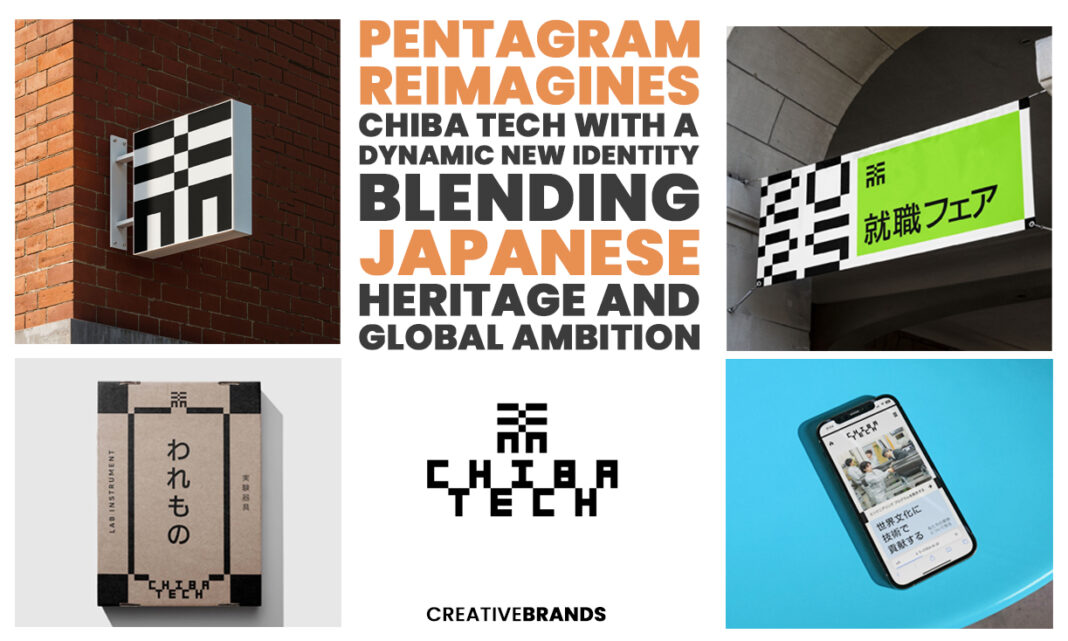
Chiba Tech, Japan’s oldest private technology university, has unveiled a bold new visual identity by Giorgia Lupi and Pentagram. Rooted in a 1942 character reimagined through the ichimatsu moyo pattern, the system unifies tradition and modernity, introduces the animated “Chibuggy” mascot, and positions the university to attract international students with clarity and personality.
Chiba Tech’s transformation arrives at a moment when universities worldwide are rethinking how they present themselves to a generation of globally mobile students who expect clarity, personality, and cultural authenticity in the institutions they choose. For the Chiba Institute of Technology—Japan’s oldest private technology university, founded in 1942—the question was not whether to evolve, but how to evolve without losing the heritage that defines it. The answer has emerged in the form of a bold new visual identity designed by Giorgia Lupi and her team at Pentagram, created in close collaboration with the university’s leadership and broader community. The rebrand reframes the institution simply as “Chiba Tech,” positioning it with renewed confidence on the global stage while celebrating its unique legacy.
The challenge was multifaceted. As Japan deepens its efforts to attract international talent and as engineering-driven innovation becomes increasingly borderless, universities like Chiba Tech are competing in a landscape where visual coherence and clear messaging matter. International students often make decisions based on a blend of academic reputation and the emotional resonance of a university’s identity. For a school with 80 years of history and a strong research core, the previous identity system lacked the cohesion and dynamism needed for global relevance. Lupi, together with Pentagram Senior Designer Yoshi T., approached the brief with the twin goals of preserving cultural specificity and building a contemporary system that could speak fluently across languages and contexts.
The heart of the new identity lies in a single character from the school’s original 1942 emblem. Rather than replacing it, the team reinterpreted the character using geometric forms that echo ichimatsu moyo—the traditional Japanese checker pattern symbolizing continuity and prosperity. This symbolism proved crucial: it embedded the design in Japanese visual heritage while providing a modular system flexible enough for modern communication needs. The result is a character that becomes more than a logo. It becomes a multi-dimensional tool, functioning as typography, pattern, symbol, and even the foundation of a new grid structure that underpins the entire visual ecosystem.
This multi-functional approach is part of what makes the rebrand striking. Where many university identities rely on crests or shields that remain static, Chiba Tech’s new identity is alive. The character stretches into expressive layouts, expands to frame content, and integrates seamlessly into digital interfaces. Its geometric base allows it to scale without losing clarity, and its cultural roots give it emotional weight. For an institution aiming to communicate innovation without abandoning tradition, this blend is both strategic and symbolic.
But the identity does not stop at formality. One of the most unexpected and charming elements of the new system is the creation of “Chibuggy,” a mascot that emerges organically from the geometric components of the character. Chibuggy is not a superficial brand add-on but an extensible personality—a figure that draws, laser-cuts, jumps, and interacts with the system itself. By building a mascot through the same grid logic that shapes the identity, the team demonstrates the system’s versatility while giving students, staff, and future applicants a relatable entry point into the brand. Mascots are often dismissed as childish, but in Japan—where character culture thrives—they play a vital role in humanizing institutions. Chibuggy feels distinctly Japanese yet universally appealing, making the identity feel contemporary and personable.
The process behind the design was equally thoughtful. Lupi and Yoshi T. worked not only with university leadership but also tapped into their own personal connections and feedback from community members. This participatory approach allowed them to understand the emotive dimension of the school’s identity: what alumni remembered, what faculty valued, what students aspired to, and what international applicants might find compelling. The collaboration ensured that the final system was neither imposed nor imagined in isolation but grew from collective meaning. For a school committed to technological progress and community pride, this inclusive development became a statement in itself.
The updated name—“Chiba Tech”—is another strategic choice that clarifies the school’s international positioning. The original name carries authority in Japan, but for prospective students abroad, simplifying and anglicizing the identity makes it easier to search, understand, and recall. The name signals specificity and expertise, aligning the brand with other globally recognized technology institutions while preserving its regional identity. The rebrand treats this shift not as a loss but as an expansion: Chiba Tech becomes a short, sharp, distinctive identifier that works across cultures.
Typography, color, and layout all reinforce the balance between heritage and innovation. The grid system derived from the geometric character allows for consistent modular layouts, while the updated color palette supports both seriousness and playfulness, depending on application. Academic documents look refined and stable; student-facing materials feel more vibrant and engaging; international recruitment collateral has a clarity that travels well. In digital formats, the identity performs particularly well, adapting to animations, motion graphics, and interactive elements without losing its structural logic.
More broadly, the rebrand reflects a shifting narrative in global higher education. Universities are no longer just repositories of knowledge; they are brands competing for attention, loyalty, and relevance. Visual identity systems must operate as bridges—bridges between generations, cultures, and disciplines. Chiba Tech’s new identity acknowledges that its future lies not only in its technical innovation but in how it communicates that innovation. By grounding the design in cultural tradition and expressing it through a contemporary, modular framework, the identity encapsulates the school’s dual commitment to legacy and forward momentum.
For students who will encounter Chiba Tech for the first time through social media, global rankings, or recruitment fairs, the identity offers immediate clarity. For alumni who remember the older visual language, it offers continuity and evolution. For faculty and researchers, it provides a platform capable of representing their work with precision and aesthetic strength. And for international audiences, it signals a university ready to stand confidently on the world stage without diluting its cultural roots.
The rebrand is more than a visual refresh—it is a narrative repositioning. It captures the arc of Chiba Tech’s transformation from a historic private technology institute to a globally aspiring center of innovation. It embodies pride without rigidity, playfulness without frivolity, modernity without erasure. In an increasingly competitive academic landscape, the identity builds a meaningful and memorable foundation for the university’s next era.
Chiba Tech’s new visual identity, ultimately, is a reminder that design can be both a mirror and a catalyst. It reflects who the institution has been for nearly a century, but it also projects who it intends to become. In the convergence of geometry, symbolism, character animation, and collaborative storytelling, the rebrand demonstrates how thoughtful design can ignite curiosity, foster connection, and signal readiness for a future that blends culture, technology, and global ambition.
Discover more from Creative Brands
Subscribe to get the latest posts sent to your email.