


Omnicom’s integration of IPG has resulted in a major global overhaul, introducing a new identity, consolidating creative networks into BBDO, McCann, and TBWA, and forming the world’s largest media organization. With new leadership, 4,000 job cuts, and a refreshed India structure, the company aims to drive AI-enabled, data-led intelligent growth worldwide.
Omnicom’s sweeping restructuring in the wake of its acquisition of Interpublic Group (IPG) has set the stage for one of the most transformative moments in global advertising history. What began as a significant consolidation move has rapidly evolved into a complete reimagining of how one of the world’s largest marketing groups defines its identity, delivers solutions, and positions itself for an AI-dominated future. With a new corporate architecture, a refreshed leadership framework, and a bold integration of legacy agencies, Omnicom is signalling its ambition to become the world’s most powerful marketing and sales ecosystem—one built firmly for intelligent growth.
The first visible shift comes in the form of the group’s renewed corporate identity. The company has migrated its web presence to omc.com, marking a symbolic beginning for the combined entity. Now introducing itself as the world’s leading marketing and sales company, Omnicom is highlighting “intelligent growth” as its core promise—a strategic direction powered by Omni, its sophisticated AI platform that unifies data, insights, creativity, and commerce. This renewed identity is not merely cosmetic; it is designed to communicate clarity at a time when the advertising world is grappling with fragmentation, technological disruption, and shifting client expectations. Omni, already a central engine in recent years, now becomes the backbone of the unified organization’s value proposition.
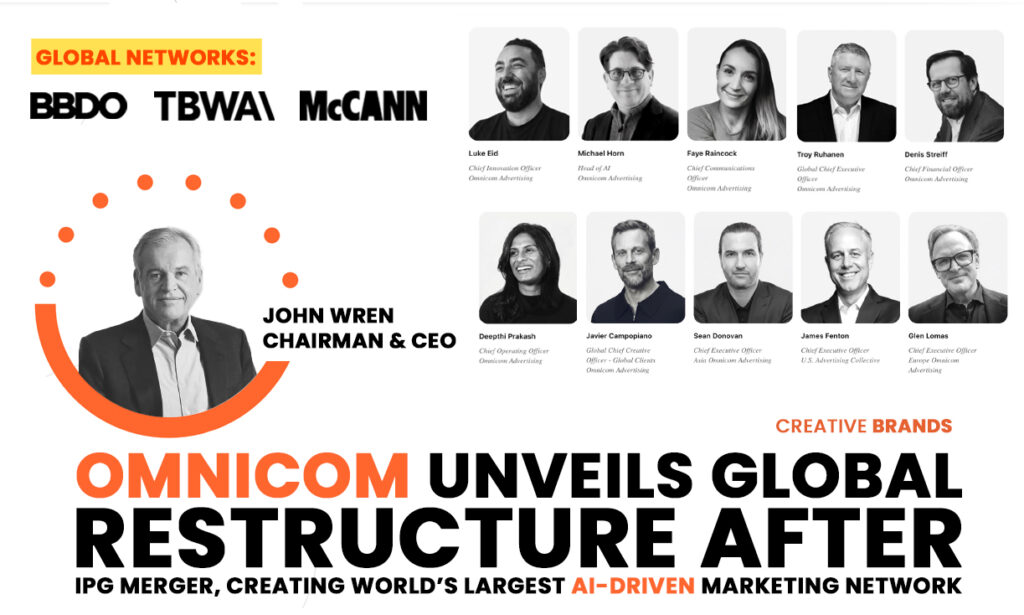
A major element of this restructuring lies in the consolidation of creative agencies. Omnicom is folding all creative operations into three global networks—BBDO, McCann, and TBWA—retiring long-established names such as DDB, FCB, and Mullen Lowe as standalone networks. Legacy brands will not disappear entirely but instead be absorbed into the larger networks, signalling a shift from a multi-brand sprawl to a leaner structure focused on scale and integrated capability. This is one of the most significant evolutions in the landscape of global advertising in decades. For example, FCB’s integration into BBDO is expected to strengthen the latter’s footprint and diversify its creative approach, while DDB and Mullen Lowe entering TBWA’s ecosystem will expand TBWA’s strategic and cultural leverage across markets. Such consolidation reflects a growing industry trend where holding companies seek to remove internal competition and redundancy in favour of unified offerings with stronger global consistency.
Omnicom Media, too, has emerged as a giant in its own right following the merger. With six global brands—OMD, PHD, Hearts & Science, UM, Initiative, and Mediahub—under its wing, it now stands as the world’s largest media organization. The retirement of IPG’s media branding signifies the end of an era but also a streamlined future where clients can expect a more cohesive, AI-enabled media strategy powered by unparalleled scale. With media planning and buying undergoing rapid transformation due to automation and precision targeting, Omnicom Media’s massive consolidated footprint positions it at a strategic advantage, offering clients enhanced efficiency, cross-market simplicity, and unified tools.
To reflect this new structure, Omnicom has refined its leadership matrix. John Wren continues to serve as Chairman and CEO, steering the unified organization through one of its boldest strategic chapters. In a move signalling continuity and collaboration, Philippe Krakowsky—IPG’s former CEO—and Daryl Simm have been appointed Co-Presidents and Chief Operating Officers. This leadership triad represents the synthesis of legacy strengths from both groups, ensuring that the strategic vision blends Omnicom’s global systems with IPG’s reputation for organizational discipline and client-centric innovation. In addition, leadership roles have been confirmed across Omnicom’s nine “Connected Capabilities,” its new operational pillars crafted to deliver end-to-end marketing and sales solutions. Among the key appointments, Troy Ruhanen has been named CEO of Omnicom Advertising, while Florian Adamski steps into the role of CEO of Omnicom Media. These leaders carry the responsibility of navigating the combined entity through an increasingly competitive, AI-driven marketplace.
Such comprehensive restructuring, however, comes with significant workforce implications. Approximately 4,000 positions—mostly in administrative and back-office functions—are being eliminated as the organization seeks to eliminate silos and create a more streamlined operational model. While job cuts on this scale inevitably spark debate and concern within the industry, Omnicom has framed the move as a necessary step to remove systemic inefficiencies, reduce overlap created by decades of acquisitions, and allow the new structure to operate with agility. The company argues that with AI now taking over many repetitive tasks, focusing human talent on strategy, creativity, and innovation is the way forward.
India, one of Omnicom’s fastest-growing markets, is witnessing a major leadership reshuffle under the new structure. Prasoon Joshi has been appointed Chairman of Omnicom Advertising India, bringing his deep creative insights and strong industry presence to the top of the organization’s Indian operations. Aditya Kanthy, known for his strategic and business leadership, has taken on the role of President and Managing Director for India. These appointments signal Omnicom’s commitment to strengthening its position in a rapidly expanding market where digital transformation, multilingual creativity, and youth-driven consumption are reshaping advertising dynamics. At the agency level, leadership has been reorganized across BBDO, McCann, and TBWA in line with the global consolidation model, ensuring India’s operations remain aligned with the broader vision while retaining local agility.
The overarching objective behind all these changes is to create a unified, data-driven, AI-enabled marketing company that operates with the speed and precision needed for modern client demands. With Omni at the centre of every offering, Omnicom aims to merge creativity with predictive intelligence, helping brands move from campaign-led thinking to continuous customer engagement and commerce-driven growth. The integration of creative, media, data, and tech capabilities under a streamlined governance model is expected to improve cross-functional collaboration and help the company compete more effectively with consultancies, digital-first companies, and independent agencies.
As the global marketing landscape becomes increasingly complex—with clients demanding more measurable outcomes, faster turnarounds, and seamless omnichannel execution—the consolidation of Omnicom and IPG may well serve as a blueprint for the next phase of holding company evolution. The focus on intelligent growth reflects not just a technological shift but an organizational realignment meant to simplify decision-making, maximize talent, and remove barriers that once existed between sister agencies.
The merged entity’s success will ultimately depend on how effectively it balances scale with creativity, automation with human insight, and global systems with local nuance. But in its new form, Omnicom is clearly signalling that the era of sprawling holding companies is giving way to a future built on integration, intelligence, and impact. The advertising world will be watching closely as this newly structured giant begins its next chapter—one that could redefine the competitive landscape for years to come.
Discover more from Creative Brands
Subscribe to get the latest posts sent to your email.