



Ogilvy has marked the start of its 2026 work year by installing a permanent portrait of creative icon Piyush Pandey at its Mumbai office entrance. Unveiled by the youngest Ogilvyites, the tribute celebrates Pandey’s enduring influence, values, and creative legacy within the agency.
Ogilvy began its 2026 work year in India not with a strategy presentation or a town hall on targets, but with an act of remembrance, gratitude, and quiet symbolism. At the entrance of its Mumbai office now hangs a portrait of Piyush Pandey—one of Indian advertising’s most influential creative leaders—marking his permanent presence in the agency he helped shape for decades. The installation is not just an image on a wall; it is a statement about values, lineage, and the enduring power of creative leadership that transcends roles and timelines.
The portrait was unveiled by the youngest Ogilvyites across departments, a deliberate and deeply symbolic choice. These are employees who may not have worked directly under Pandey during his most active years at the agency but who nonetheless inherit the culture, philosophy, and creative rigour he embedded into Ogilvy India. Their participation underscored the idea that Pandey’s influence is not confined to a particular generation or era, but continues to flow through the agency’s corridors, briefing rooms, and creative conversations.
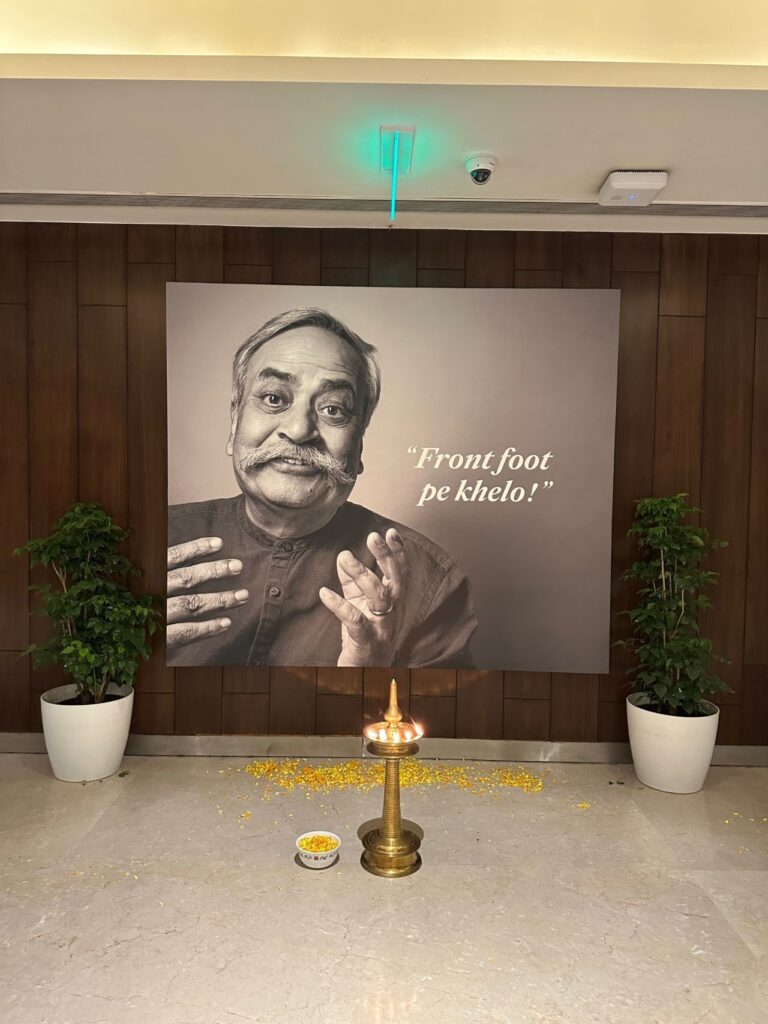
Shot by acclaimed photographer Suresh Natarajan, the portrait carries both visual gravitas and emotional resonance. Known for his ability to capture personality beyond pose, Natarajan’s lens presents Pandey not merely as an advertising legend, but as a thinker, mentor, and storyteller. The installation also features some of Pandey’s most iconic advice lines that have been repeated in classrooms, creative reviews, and late-night brainstorming sessions across the industry. These words, etched alongside his image, serve as a daily reminder of the principles that defined his work: simplicity, honesty, cultural rootedness, and respect for the consumer.
For Ogilvy, the placement of the portrait at the entrance of its Mumbai office is significant. Entrances are thresholds—spaces of arrival and departure—and Pandey’s presence there suggests continuity. Employees and visitors alike are greeted not just by a face, but by a philosophy. It signals that before one enters the workspace, one enters a legacy shaped by ideas that placed human insight above spectacle, and storytelling above gimmickry.
Piyush Pandey’s journey with Ogilvy is inseparable from the story of modern Indian advertising. As the former Global Creative Director of Ogilvy and Executive Chairman of Ogilvy India, Pandey played a defining role in transforming advertising from a functional business service into a cultural force. His work helped brands speak the language of the streets and living rooms of India, often using humour, emotion, and local idiom to build deep, lasting connections with audiences.
Campaigns created under his leadership did more than sell products; they entered popular culture. They were quoted in everyday conversation, referenced in films and media, and remembered long after media spends ended. This cultural impact was rooted in Pandey’s belief that advertising must first understand people—their lives, contradictions, joys, and anxieties—before attempting to persuade them. That belief became a cornerstone of Ogilvy India’s creative ethos.
The tribute comes at a moment when the advertising industry is navigating rapid transformation. Technology, data, and platforms are reshaping how brands communicate, while younger professionals are entering the industry with different expectations of work, purpose, and creativity. In this context, Ogilvy’s decision to honour Pandey at the start of the 2026 work year is both reflective and forward-looking. It asserts that while tools and formats may change, the fundamentals of great creativity—empathy, insight, courage, and craft—remain constant.
The involvement of the youngest Ogilvyites in unveiling the portrait was particularly resonant in this regard. It bridged generations, reminding newer employees that they are part of a larger narrative. For many of them, Pandey’s influence may be encountered through case studies, internal folklore, or lines of advice passed down by seniors. The ceremony transformed that abstract influence into something tangible, reinforcing a sense of belonging and responsibility to carry forward the standards he set.
Within Ogilvy, Pandey has long been regarded not only as a creative leader but as a mentor who encouraged individuality of thought. He famously resisted rigid formulas, urging creatives to observe life closely and trust instinct alongside discipline. His leadership style fostered confidence in young talent, often allowing ideas to evolve organically rather than forcing them into predetermined frameworks. That environment helped Ogilvy India become a breeding ground for some of the country’s most respected creative professionals.
The portrait installation also reflects Ogilvy’s broader philosophy of celebrating people, not just performance metrics. In an industry often driven by awards, rankings, and quarterly results, the tribute emphasises human contribution and cultural impact. It acknowledges that agencies are shaped as much by values and beliefs as by balance sheets, and that honouring those who define these values is essential to sustaining them.
Colleagues and industry observers view the tribute as a reminder of Pandey’s unique ability to balance global standards with local sensibilities. Under his leadership, Ogilvy India remained firmly rooted in Indian culture while earning recognition on international stages. This duality—global excellence with local authenticity—became a hallmark of the agency’s work and a benchmark for others to aspire to.
As employees walk past the portrait each morning, the words accompanying it offer more than nostalgia. They act as prompts: to listen more carefully, to simplify without diluting meaning, to respect the intelligence of audiences, and to remember that advertising, at its best, is a form of storytelling with responsibility. In a fast-paced environment where deadlines and deliverables can dominate, such reminders can quietly recalibrate priorities.
The timing of the installation, marking the start of the 2026 work year, reinforces its role as a compass for the months ahead. It sets a tone of reflection before acceleration, of grounding before growth. For Ogilvy, it is a way of saying that the future will be built not by abandoning the past, but by understanding it deeply and carrying its lessons forward.
Ultimately, the permanent placement of Piyush Pandey’s portrait at Ogilvy’s Mumbai office is less about memorialization and more about continuity. It affirms that leadership does not end with titles or tenures, and that ideas, once deeply rooted, continue to influence long after their originators step back. In honouring Pandey, Ogilvy honours a way of thinking—one that places humanity at the heart of creativity—and recommits itself to passing that way of thinking on to the generations that follow.
Discover more from Creative Brands
Subscribe to get the latest posts sent to your email.