


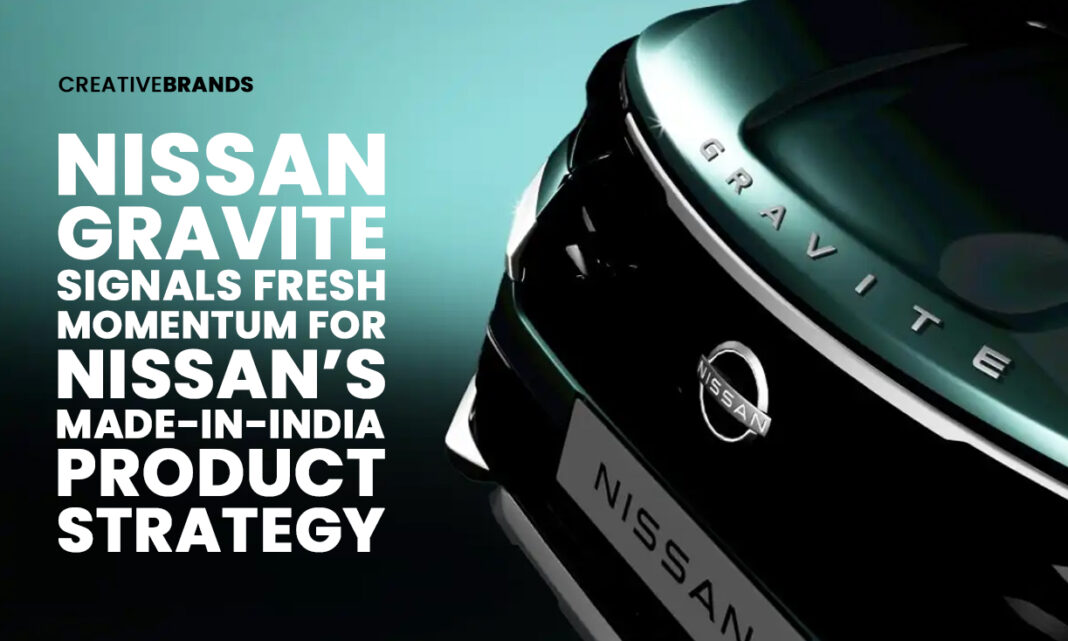
Nissan Motor India is set to debut the 7-seater B-MPV Nissan Gravite in January 2026, marking the first launch under its renewed Made-in-India line-up. Built in Chennai for Indian families, the Gravite anchors a broader product offensive spanning MPVs and SUVs through 2027.
As India’s automotive market accelerates into a new phase defined by scale, sophistication and family-focused mobility, Nissan Motor India Private Limited is preparing to make a decisive statement. The forthcoming launch of the all-new Nissan Gravite, a 7-seater B-MPV scheduled to debut in January 2026, signals more than the arrival of a new model. It marks the beginning of a refreshed, Made-in-India product strategy that seeks to realign Nissan more closely with the aspirations of Indian consumers while reinforcing the country’s role in the company’s global plans.
The Gravite is positioned as the first vehicle to emerge from this renewed approach, and its timing is significant. India remains one of the world’s fastest-growing automotive markets, with demand increasingly skewing towards versatile, value-driven vehicles that can accommodate larger families without compromising on design or comfort. The B-MPV segment, in particular, has evolved from being purely utilitarian to one where buyers expect style, technology and flexibility alongside space. Nissan’s decision to enter this space with a clean-sheet product reflects a clear understanding of how Indian preferences are shifting.
Designed specifically with Indian families in mind, the Nissan Gravite aims to balance practicality with a sense of presence on the road. Its 7-seater configuration is central to its appeal, offering the promise of adaptable interiors that can shift seamlessly between carrying people and luggage. Modularity and versatility are not mere buzzwords here, but core pillars of the vehicle’s design philosophy. In a country where a single car often serves multiple roles—from weekday commutes and school runs to long highway journeys and festive travel—the ability to reconfigure space easily can be a decisive factor.
While the Gravite is purpose-built for India, it carries unmistakable elements of Nissan’s global design DNA. The signature C-shaped front fascia, a visual cue seen across Nissan’s international portfolio, lends the vehicle a bold identity that distinguishes it from more conservative competitors. This blending of global aesthetics with local functionality underscores Nissan’s intent to offer Indian buyers products that feel contemporary and internationally relevant, without losing sight of local needs.
Manufacturing will take place at Nissan’s Chennai facility, a strategic choice that reinforces the company’s long-term commitment to India as both a key market and a global manufacturing hub. Local production not only allows Nissan to price the Gravite competitively, but also aligns with the broader “Made in India” vision that has become increasingly important in the automotive sector. Over the years, the Chennai plant has served as a cornerstone of Nissan’s operations in the region, supporting both domestic sales and exports. With the Gravite, the facility is set to play an even more central role in Nissan’s future roadmap.
The emphasis on local manufacturing also speaks to resilience and sustainability in an era marked by supply chain disruptions and economic uncertainty. By deepening its manufacturing footprint in India, Nissan is positioning itself to respond more nimbly to market demands while contributing to the local economy through jobs, skills development and supplier partnerships. This approach reflects a broader industry trend, where global automakers are increasingly viewing India not just as a sales destination, but as a strategic base for production and innovation.
The Gravite’s launch is not an isolated move, but the opening chapter of a carefully sequenced product offensive. Following the B-MPV’s debut, Nissan plans to introduce the Nissan Tekton in mid-2026, before rolling out a 7-seater C-SUV in 2027. Together, these models are expected to strengthen Nissan’s presence across high-growth segments that are currently driving the bulk of India’s passenger vehicle sales. MPVs and SUVs have consistently outperformed other categories, buoyed by consumer demand for higher seating positions, road presence and flexible interiors.
This phased rollout suggests a renewed confidence within Nissan Motor India Private Limited, after a period of consolidation and recalibration. Rather than chasing volume indiscriminately, the company appears focused on building a coherent portfolio that aligns with its brand values and long-term objectives. The Gravite, as the first expression of this strategy, carries the weight of expectation—not only as a product, but as a symbol of Nissan’s intent to re-establish itself as a serious contender in the Indian market.
For consumers, the Gravite’s arrival could add a compelling new option in a segment crowded with established players. Competition in the B-MPV space is intense, with buyers often weighing factors such as fuel efficiency, cabin comfort, after-sales support and resale value. Nissan’s challenge will be to differentiate the Gravite through a combination of thoughtful design, reliable performance and a value proposition that resonates with Indian households. The brand’s global reputation for engineering and safety will be assets, but success will ultimately depend on how well these attributes are communicated and experienced on the ground.
From a broader perspective, the Gravite’s launch reflects the evolving relationship between global automakers and the Indian market. No longer treated as a secondary priority, India is increasingly central to long-term growth strategies. Vehicles like the Gravite, conceived and built locally but informed by global expertise, represent a middle path between imported models and purely domestic designs. They acknowledge that Indian buyers are discerning, globally aware and unwilling to compromise on quality.
As January 2026 approaches, anticipation around the Nissan Gravite is likely to build steadily. More details around specifications, powertrain options and pricing will shape perceptions, but the underlying narrative is already clear. With the Gravite, Nissan is not simply adding another model to its line-up; it is laying the foundation for a renewed presence in India, backed by local manufacturing, segment-focused planning and a commitment to delivering vehicles that fit seamlessly into the lives of Indian families.
In the years ahead, as the Tekton and the 7-seater C-SUV join the portfolio, the success of the Gravite will be closely watched as a barometer of Nissan’s revival strategy. For now, it stands as a statement of intent—a Made-in-India vehicle designed to meet Indian realities, carrying a global badge that is looking to reclaim its relevance. In a market defined by momentum and competition, the Nissan Gravite represents a bold step forward, signalling that Nissan is ready to play a longer, more purposeful game in India’s automotive future.
Discover more from Creative Brands
Subscribe to get the latest posts sent to your email.