


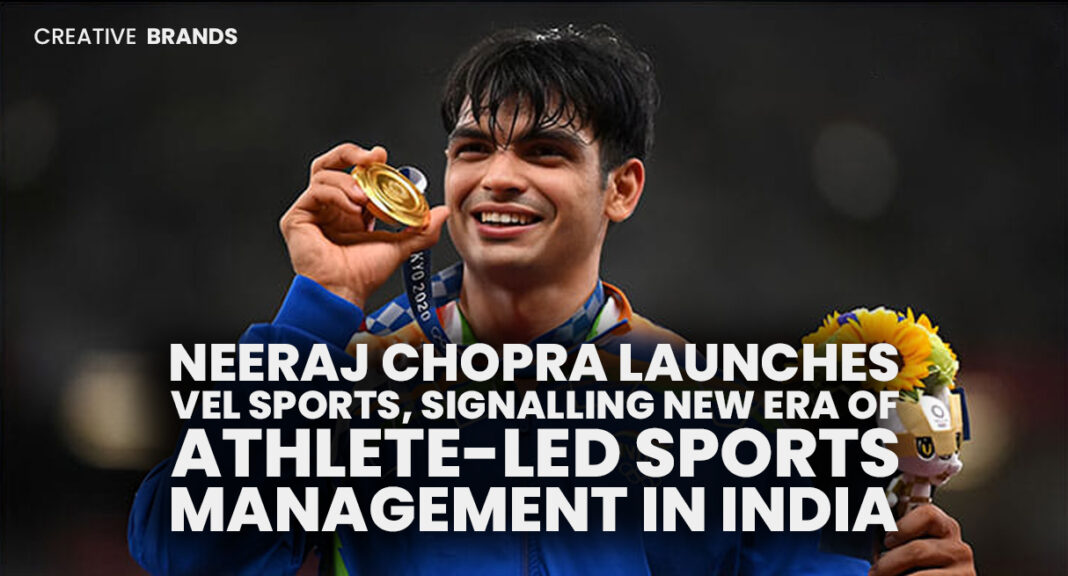
Olympic champion Neeraj Chopra has launched his own athlete management firm, Vel Sports, ending his long partnership with JSW Sports. The venture marks a strategic shift toward athlete-led sports management in India, giving Chopra greater control over his brand and enabling him to support and mentor emerging sporting talent in the country.
When Neeraj Chopra, India’s most celebrated track-and-field athlete, announced the launch of his own athlete management firm, Vel Sports, earlier this month, it was more than just another business move — it marked a symbolic evolution in the country’s sporting culture, a shifting paradigm in how elite athletes engage with their careers and influence the ecosystem around them. The 28-year-old javelin star has officially concluded his decade-long association with JSW Sports, ending a partnership that coincided with his rise from an emerging teenage talent to a global icon — and stepping into a new chapter that projects him not only as a competitor, but as a leader, mentor, and entrepreneur.
Chopra’s journey to this landmark moment is inseparable from the narrative of Indian athletics itself. When he first entered the spotlight nearly ten years ago, he was a promising young thrower from Panipat, Haryana, identified and nurtured through JSW Sports’ athlete development programmes. Over the years, under JSW’s structure and support, Chopra exploded onto the global stage — clinching India’s first ever Olympic gold medal in track and field at the Tokyo Games, capturing a World Championship title in 2023, and adding a silver medal at the Paris 2024 Olympics to his résumé. He became synonymous with excellence and consistency, carrying Indian hopes and redefining what was once considered possible for the country’s field athletes. (
Yet for all the medals and milestones, Chopra’s decision to part ways with his long-time management partner was not abrupt or contentious. On the contrary, both he and JSW Sports framed the separation as mutual, grounded in deep respect and gratitude. In official statements shared around the launch of Vel Sports, JSW Sports CEO Divyanshu Singh described working with Chopra as “an incredible experience,” emphasising the alignment between the athlete’s extraordinary success and the organisation’s philosophy of excellence and purpose. Chopra, for his part, acknowledged the critical role the partnership had played in his development, expressing heartfelt appreciation for the belief and vision that JSW brought into his journey.
But as the narrative now moves forward, Vel Sports represents a new and distinctly Chopra-driven vision — one that seeks to expand his influence beyond his own competitive career to shape the next generation of athletes. While its immediate focus is athlete management and representation, the very formation of the firm speaks to Chopra’s broader ambitions: to empower sports talent with more control over their public profiles, commercial negotiations, and strategic decisions at every stage of their careers. In an era where athletes around the world are asserting greater ownership over their brands and destinies, Chopra’s move mirrors global trends in sports business, but with a uniquely Indian inflection.
Vel Sports, structured as a Limited Liability Partnership registered in Panipat, hints at ambitions that extend well beyond administrative management. Early filings show the firm has begun modestly in capital infusion and operations, but its creation during the prime of Chopra’s competitive life — rather than as a retirement project — suggests a deliberate strategy. It positions Chopra not only as a client of the sports business world but also as a stakeholder in shaping that world. For athletes in India, whose commercial pathways have historically been narrow and contingent on external agencies or federations, this is a bold departure.
This strategic entrepreneurship is part of a broader shift in how sports professionals envision their careers. Across disciplines and continents, elite athletes are increasingly conscious of the finite nature of competitive years, leveraging their brand equity into business ventures, equity stakes, and management roles long before their final finish line. Chopra’s own trajectory offers a case study in this evolution — one where athletic peak and entrepreneurial genesis occur concurrently, enriching both the individual’s legacy and the sector’s structural possibilities.
To understand why this moment matters, it helps to trace the contours of Chopra’s influence outside the field. Beyond his medals, Chopra has become one of India’s most marketable sporting figures, with a presence in major endorsement portfolios and high visibility in media. His achievements have spurred interest in athletics across the country, inspiring youth participation in track and field events, especially javelin throw — a discipline once peripheral in the Indian sporting imagination. The reverberations of his success are visible in grassroots programmes, sponsorship deals, and a rising appetite among brands to associate with athletics as a category, not just cricket or football.
Yet despite this fame, the athlete management landscape in India has been relatively nascent, dominated by a handful of agencies and with limited homegrown alternatives. Chopra’s establishment of Vel Sports signals confidence in the maturation of that landscape and, more importantly, a belief that athletes themselves can contribute to building it. For younger competitors, having an entity led by one of their own offers a potential ally that understands not just commercial negotiation but the lived experience of elite competition, cultural nuance, and the pressures unique to sporting life.
Beyond the commercial calculus, there’s also a cultural dimension to Chopra’s move. India’s sports ecosystem has often been characterised by asymmetrical power dynamics, where athletes defer to federations, sponsors, and external agents. Chopra’s step into entrepreneurship challenges that model, positioning him as a role model not just for athletic aspiration but for career agency and strategic foresight. The symbolism of an athlete founding a firm that can nurture others resonates deeply in a country where sporting pathways are rapidly changing but have yet to fully diversify.
Of course, Chopra’s competitive ambitions remain undiminished. Reports indicate that, alongside building Vel Sports, he continues to train rigorously, recover from past injuries, and prepare for upcoming global competitions. Balancing entrepreneurial duties with elite performance demands will test any athlete, but if Chopra’s trajectory thus far is any indication, he is keenly aware of how to navigate dual roles — as a world-class performer and as a steward of a broader sports vision.
In many ways, Vel Sports may come to be seen as both a milestone and a mirror — reflecting how far Indian athletics has progressed and how much further it can go when its brightest stars channel their influence into structural innovation. Chopra’s decision to shape his own narrative — rather than simply follow established scripts — redefines what success looks like in Indian sport: not just medals and records, but legacy, leadership, and opportunity for others. As the javelin phenom embarks on this entrepreneurial chapter, the industry watches closely, recognising that this moment is more than a business announcement — it is a cultural cue that the future of sports in India may soon belong as much to athlete-founders as to athletic feats.
Discover more from Creative Brands
Subscribe to get the latest posts sent to your email.