


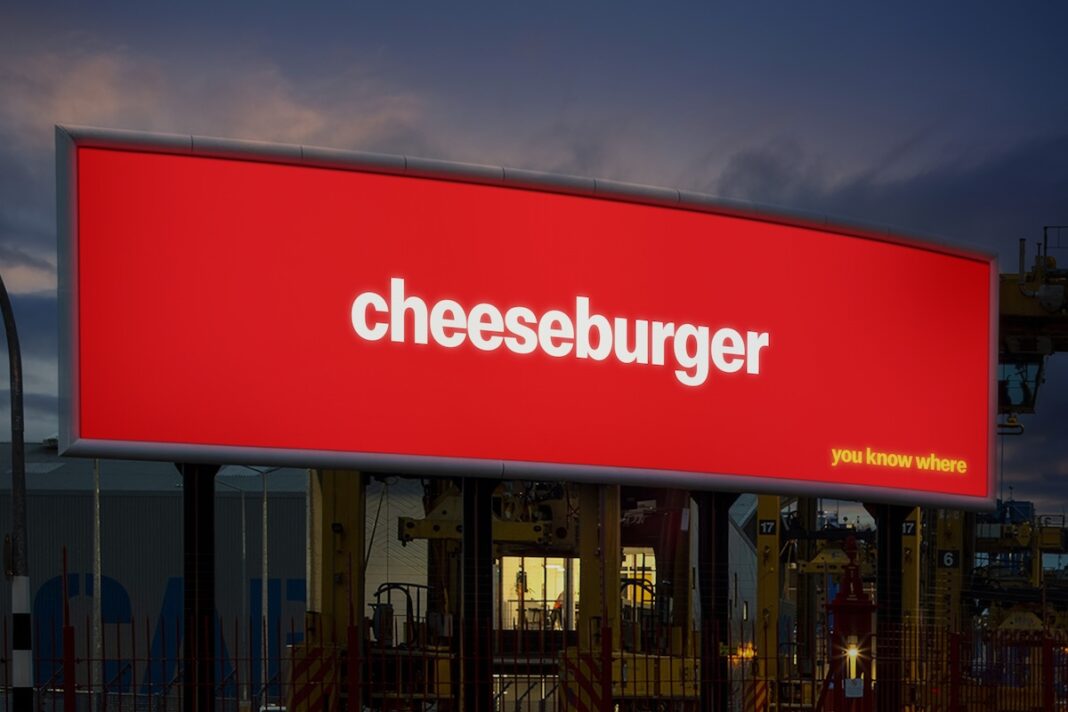
McDonald’s latest out-of-home campaign in New Zealand strips branding to its bare essentials, relying on a single word and iconic menu items to spark recognition. Conceived by McCann New Zealand, the minimalist approach demonstrates the cultural shorthand of “Macca’s” and the enduring power of brand familiarity in everyday life.
In the crowded world of advertising, where brands often jostle for attention with elaborate visuals, slogans, and logos, McDonald’s has chosen to say less—and in doing so, it has said everything. Its latest out-of-home campaign in New Zealand, created by McCann New Zealand in Auckland, is a striking exercise in restraint. The concept hinges on a simple truth: New Zealanders know exactly what “Macca’s” means, and they don’t need a golden arch or a corporate logo to remind them.
The campaign, titled “You know where,” pares communication down to a single word. Cheeseburger. Fries. Apple pie. Nuggets. Hotcakes. Sundae. Each item is presented without embellishment, without branding, and without explanation. Yet the message is unmistakable. For generations of New Zealanders, these words are shorthand for a familiar ritual, a place that has become woven into the fabric of everyday life.
It is a bold move in a marketing landscape that often prizes maximalism. Brands typically fight to be louder, brighter, and more omnipresent, but McDonald’s has leaned into the confidence of its cultural ubiquity. The campaign trusts that the audience already knows the answer to the implied question: where do you go for these things? The answer, of course, is Macca’s.
This approach is not without precedent. McDonald’s has long experimented with minimalist advertising in different markets, playing with the idea that its products and brand identity are so ingrained in popular culture that they can be recognised without overt cues. Yet the New Zealand execution feels particularly sharp. It is not just about the food—it is about the relationship between a nation and a brand that has become part of its vernacular.
The colloquial nickname “Macca’s” itself is evidence of this bond. In New Zealand, as in Australia, the affectionate shorthand has been embraced to the point where McDonald’s has officially adopted it in signage and campaigns. This latest work builds on that cultural familiarity, stripping away even the nickname and leaving only the menu items. The effect is both playful and powerful.
From an advertising perspective, the campaign demonstrates the potency of semiotics—the idea that meaning can be conveyed through signs and symbols without explicit explanation. A cheeseburger is not just a cheeseburger; it is a signifier of a brand, an experience, and a set of memories. By presenting these words in isolation, McDonald’s invites the audience to complete the thought themselves. The brand is present in absence, and that absence becomes the message.
The simplicity also reflects a growing trend in contemporary advertising towards authenticity and understatement. Consumers, increasingly sceptical of overproduced campaigns, respond to work that feels confident enough to be quiet. McDonald’s, through McCann New Zealand, has tapped into this sensibility, offering a campaign that feels less like a sales pitch and more like a wink.
It is also a reminder of the enduring power of food as cultural shorthand. In New Zealand, a sundae or hotcakes are not just menu items; they are markers of childhood treats, late-night stops, and family outings. By listing them without context, the campaign relies on the audience’s own memories to fill in the gaps. It is advertising as nostalgia, advertising as recognition.
The campaign’s success lies in its ability to balance universality with local resonance. McDonald’s is a global brand, but “Macca’s” is distinctly New Zealand. The decision to lean into that local identity, while simultaneously trusting in the global familiarity of its menu, creates a campaign that feels both intimate and expansive. It is a celebration of brand shorthand, but also of cultural shorthand.
For McCann New Zealand, the work is a testament to the power of creative restraint. In an industry where agencies are often tasked with producing ever more elaborate executions, the courage to strip everything back to a single word is significant. It requires confidence not only in the brand’s recognition but in the audience’s ability to connect the dots.
Ultimately, “You know where” is less a campaign than a cultural statement. It acknowledges that McDonald’s has reached a point in New Zealand where its products are not just items on a menu but part of a shared language. To say “fries” is to say “Macca’s,” and to say “Macca’s” is to evoke a thousand associations.
In the end, the campaign’s brilliance lies in its humility. By saying less, McDonald’s has allowed its audience to say more. The words—cheeseburger, fries, apple pie, nuggets, hotcakes, sundae—are not just descriptors; they are invitations. And the answer, as the campaign reminds us, is already known. You know where.
Discover more from Creative Brands
Subscribe to get the latest posts sent to your email.