


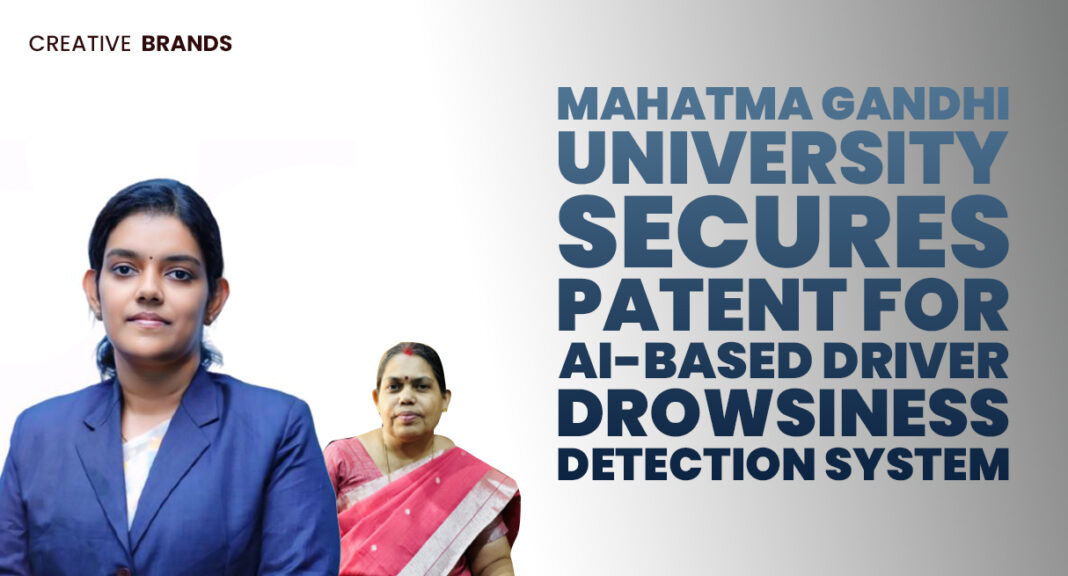
Mahatma Gandhi University has received a Government of India patent for an AI-driven drowsiness detection system developed by Dr. Vineetha Vijayan and Prof. Pushpalatha K. P. The innovation uses intelligent monitoring to detect early signs of driver fatigue, enhancing road safety and accident prevention.
Mahatma Gandhi University has added a significant milestone to its growing research and innovation portfolio with the grant of a patent for an advanced artificial intelligence–based drowsiness detection system aimed at improving road safety and preventing accidents. The patent has been awarded by the Government of India to Dr. Vineetha Vijayan, a research scholar, and Prof. (Dr.) Pushpalatha K. P. of the School of Computer Sciences, recognising their invention titled “A Drowsiness Detection System.” Registered under Patent No. 576349 with Application No. 202441041664, the innovation underscores the university’s increasing contribution to applied research with real-world impact.
The patented system addresses one of the most persistent and dangerous challenges in road safety: driver fatigue and sleepiness. According to global and national road safety studies, drowsy driving remains a major contributor to traffic accidents, particularly on highways and during long-distance travel. Despite increased awareness, existing solutions often rely on limited indicators or are too intrusive, expensive, or impractical for widespread adoption. The invention from Mahatma Gandhi University seeks to bridge this gap through an intelligent, technology-driven approach that combines artificial intelligence, computer vision, and real-time monitoring to detect early signs of driver drowsiness and issue timely alerts.
At the core of the system is an advanced AI framework capable of analysing visual and behavioural cues associated with driver fatigue. Using sensors and camera-based inputs, the system continuously monitors facial features, eye movements, blinking patterns, head posture, and other subtle indicators that precede sleepiness. These inputs are processed through trained machine learning models that can distinguish between normal driving behaviour and early warning signs of reduced alertness. By identifying risk factors before a driver fully loses focus, the system aims to intervene at a critical moment, potentially preventing accidents before they occur.
What sets this invention apart is its emphasis on early detection and practical deployment. Rather than waiting for extreme signs of fatigue, the system is designed to recognise gradual changes in driver behaviour that signal declining alertness. This proactive approach allows for timely warnings in the form of audio alerts, visual signals, or other notification mechanisms that prompt the driver to take corrective action, such as resting or stopping the vehicle. The adaptability of the AI model also means it can learn and improve over time, adjusting to different drivers, driving conditions, and environments.
The development of the drowsiness detection system reflects a strong collaboration between research scholarship and academic mentorship. Dr. Vineetha Vijayan, as the research scholar behind the work, represents the new generation of researchers translating theoretical knowledge into practical solutions. Prof. (Dr.) Pushpalatha K. P., a senior academic at the School of Computer Sciences, provided the academic leadership and guidance necessary to shape the research into a patentable, application-oriented invention. Together, their work highlights the importance of sustained research ecosystems within universities, where innovation is nurtured through collaboration, mentorship, and institutional support.
Mahatma Gandhi University, located at Priyadarsini Hills in Kottayam, Kerala, has steadily built a reputation for encouraging interdisciplinary research and innovation. The granting of this patent reinforces the university’s focus on translating academic research into technologies that address societal needs. In recent years, Indian universities have been increasingly encouraged to contribute to the country’s innovation landscape through patents, startups, and industry collaboration. This invention aligns closely with national priorities related to road safety, smart mobility, and the application of artificial intelligence for public welfare.
The timing of the patent is also significant. India continues to witness rapid growth in vehicle usage, accompanied by rising concerns over road safety. Long driving hours, commercial transport pressures, and fatigue-related accidents pose serious risks not only to drivers but also to passengers and pedestrians. An AI-driven drowsiness detection system has potential applications across private vehicles, commercial transport fleets, public buses, and even emerging mobility platforms. With appropriate industry partnerships and regulatory support, the technology could be integrated into vehicle dashboards, aftermarket safety devices, or fleet management systems.
Beyond immediate road safety benefits, the patented system demonstrates how artificial intelligence can be applied responsibly to human-centric problems. Rather than replacing human decision-making, the technology functions as an assistive system, supporting drivers by enhancing awareness and reducing risk. This approach aligns with broader discussions around ethical AI, where technology augments human capabilities while prioritising safety, privacy, and usability.
The patent grant also holds academic significance for Mahatma Gandhi University’s School of Computer Sciences. It showcases the department’s strength in areas such as machine learning, computer vision, embedded systems, and applied AI. For students and researchers, such achievements serve as motivation, illustrating that rigorous academic research can lead to nationally recognised intellectual property. It also opens avenues for further research, funding opportunities, and collaboration with industry and government agencies working in transportation and safety domains.
From an innovation perspective, the drowsiness detection system has the potential to evolve beyond its initial scope. With further development, the core AI framework could be adapted for other safety-critical applications, such as monitoring operator fatigue in industrial settings, railways, aviation support systems, or heavy machinery operations. The flexibility of AI-based monitoring means that the foundational research could form the basis for a family of safety solutions addressing human alertness in various high-risk environments.
The recognition by the Government of India through the patent process underscores the novelty and applicability of the invention. Securing a patent requires demonstrating not only originality but also industrial applicability, and the successful grant indicates that the system meets these criteria. For the inventors, it represents the culmination of years of research, experimentation, and refinement. For the university, it adds to its intellectual property assets and strengthens its standing within the national research ecosystem.
As India pushes forward with initiatives around smart transportation, digital innovation, and road safety, inventions like this drowsiness detection system play a crucial role in translating policy goals into tangible technologies. The work of Dr. Vineetha Vijayan and Prof. (Dr.) Pushpalatha K. P. illustrates how academic research can directly address everyday challenges faced by millions of people. By focusing on prevention rather than reaction, their AI-based system offers a promising step toward safer roads and more responsible use of technology.
The patent achievement is not just a personal success for the inventors but a collective accomplishment for Mahatma Gandhi University and its academic community. It reinforces the idea that universities are not only centres of learning but also engines of innovation capable of producing solutions with national relevance. As the technology moves from patent to potential implementation, it stands as a reminder of the critical role that research-driven innovation can play in improving public safety and quality of life.
Discover more from Creative Brands
Subscribe to get the latest posts sent to your email.