


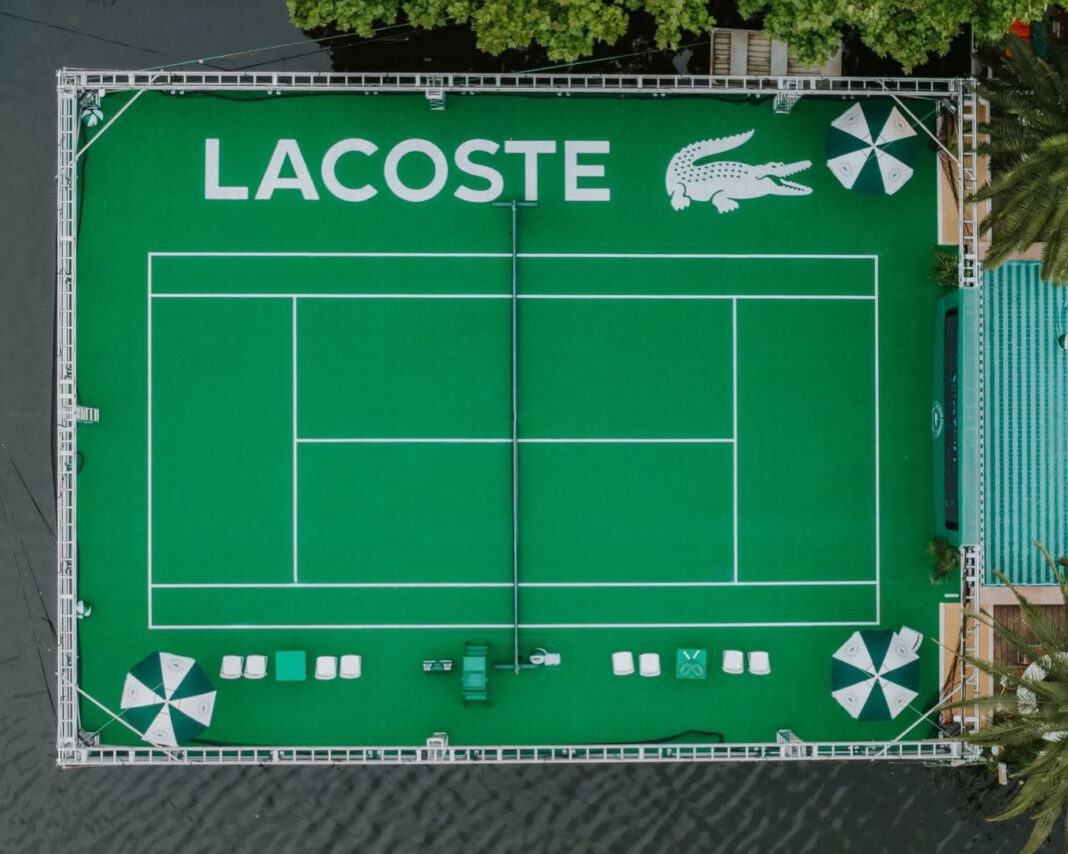
Skipping traditional ads during the Australian Open, Lacoste built a floating tennis club on Melbourne’s Yarra River. Blending sport, culture, and lifestyle without product pushes or loud messaging, the installation drew attention through experience rather than promotion, showing how brands can win by simply living where they authentically belong.
Lacoste has managed to make one of the boldest statements of this year’s Australian Open without delivering a single spoken line. The French heritage brand, best known for its crocodile emblem and longtime association with tennis, chose to forgo the familiar world of advertising slots, courtside logos, and promotional bombardment. Instead, it constructed a floating tennis club right in the heart of Melbourne, quietly drifting on the Yarra River and inviting the city—and the tennis community—to see the brand not as a sponsor shouting for attention, but as a living, breathing participant in the culture that tennis represents. The installation was equal parts sport, spectacle, and social experience, and its restraint was precisely what made it memorable.
For much of the Australian Open, the riverfront site became an unexpected point of convergence. Curious pedestrians paused along the banks to watch volleys echo across the water. Guests stepped aboard to experience the space up close, where design details and event programming played into the notion of tennis not just as a competitive sport, but as an elegant, aspirational lifestyle. Daytime brought energy and play—with matches unfolding under the sun—while evenings transitioned into a more refined atmosphere of music, conversation, and cocktails. With the skyline glowing behind it, the floating club turned the river into a canvas for Lacoste’s brand world without a single forceful message or product-centric prompt.
In a marketing environment saturated with noise, Lacoste’s decision to minimise voice in favour of presence felt almost radical. Brands ordinarily treat major sporting events as battlegrounds for visibility, outspending and outshouting one another across broadcast, digital, and physical space. The Australian Open is no exception; it is peak commercial real estate for global sportswear and lifestyle brands. Lacoste’s strategy, in contrast, embodied confidence. By declining to contribute to the ad clutter, it instead opted for cultural participation. The floating club served as a physical metaphor: the brand was in the conversation without having to interrupt it.
What made the installation particularly striking was how it embodied the values Lacoste has spent decades aligning itself with. The brand’s history in tennis is not tangential or opportunistic—it is foundational. The company traces its origins to René Lacoste, the French tennis champion of the 1920s who revolutionised both play and attire. The polo shirt, now ubiquitous in modern fashion, was born from tennis necessity before evolving into cultural currency. In that context, the Yarra River activation felt less like a gimmick and more like a return home. Rather than pushing product, it created an environment where tennis culture could flourish naturally, and that organic association is what modern marketing teams chase but rarely achieve.
There was also a spatial poetry to the idea of a floating venue. Tennis, as a sport, is deeply tied to surfaces: clay, grass, and hardcourt. Each court has its own strategic implications, its own heritage, its own aesthetic language. A floating court—unbound from the earth and set against the currents of the river—felt like an imaginative expansion of the sport’s architecture. It invited play in a new dimension and gave familiar rituals a cinematic backdrop. Even for spectators not onboard, the court became a public spectacle—something glimpsed unexpectedly during a commute or river walk, sparking curiosity and conversation. In an age driven by social media amplification, the shareability of such a scene carries its own modern currency.
Perhaps the most surprising element of the initiative was what it refused to do. There were no transactional booths demanding sign-ups, no QR codes pushing discounts, no store-like racks encouraging immediate purchase. The restraint was refreshing. Lacoste’s messaging, if it can even be called messaging, was the experience itself. People rallied, lounged, talked, observed, and absorbed. In doing so, the brand allowed people to form personal associations—ones that are usually stronger and longer lasting than scripted calls-to-action. It was brand-building through lived culture rather than leveraged attention.
From a business perspective, Lacoste’s floating club also demonstrates the evolving nature of sports marketing. For decades, brands have sought to convert tournaments and athletes into advertising horsepower. Today, that calculus is shifting. Consumers are more sensitive to overt commercialism, more attuned to authenticity, and more eager for experiential engagement. A brand’s cultural relevance is determined less by how loud it speaks and more by whether it shows up in ways that feel genuine. Lacoste’s move is a case study in that shift, illustrating how luxury and lifestyle brands increasingly prioritise immersive environments over direct product pitching.
The timing and location amplified the strategy’s impact. Melbourne during the Australian Open becomes a magnet for global tennis fans, sports professionals, media, and tourists. It is a city that prizes design, creativity, food culture, and outdoor living—making it an ideal stage for a brand that positions itself at the intersection of elegance and athleticism. By occupying the river instead of a billboard, Lacoste didn’t just join the festivities; it became part of the city’s temporary rhythm. The installation symbolised how the brand sees itself in relation to tennis: not an outsider promoting from afar, but a participant embedded in the sport’s lifestyle ecosystem.
Observers within marketing and branding circles have noted that the activation advanced a broader trend: the shift from message-first branding to place-first branding. Instead of telling audiences who they are, brands increasingly craft environments where audiences can feel who they are. These environments may last minutes or weeks, but their emotional impact often lingers far longer than a 30-second broadcast spot. The floating club served as a temporary brand world, an ephemeral but vivid representation of Lacoste’s identity.
What also emerged from the activation was a testament to the power of subtlety. In an age dominated by metrics and measurable conversions, subtlety can seem inefficient. Yet subtlety builds affinity in a manner that efficiency-driven marketing often fails to replicate. The club was not designed to close sales—it was designed to open perceptions. For a heritage brand competing with newer labels and faster hype cycles, shaping perception is arguably the more enduring victory.
By the end of the tournament period, the floating venue had accomplished something more valuable than high-frequency advertising impressions: it left a cultural footprint. People talked about it without being prompted, shared it without being incentivised, and remembered it without being reminded. The activation didn’t insist on attention; it earned it. In doing so, it reminded both the tennis community and the marketing world that brands can sometimes communicate most powerfully by letting their identity unfold in space rather than through slogans or campaigns.
In many ways, Lacoste’s floating tennis club asked a simple question: what if a brand didn’t shout? What if it merely lived where it naturally belongs—visibly, elegantly, confidently? On the waters of the Yarra River, that experiment played out in real time. And as the city watched, rallied, photographed, and mingled, the answer became clear: sometimes presence speaks louder than volume. They built a floating tennis club on Melbourne’s Yarra River. Blending sport, culture, and lifestyle without product pushes or loud messaging, the installation drew attention through experience rather than promotion, showing how brands can win by simply living where they authentically belong.
Discover more from Creative Brands
Subscribe to get the latest posts sent to your email.