


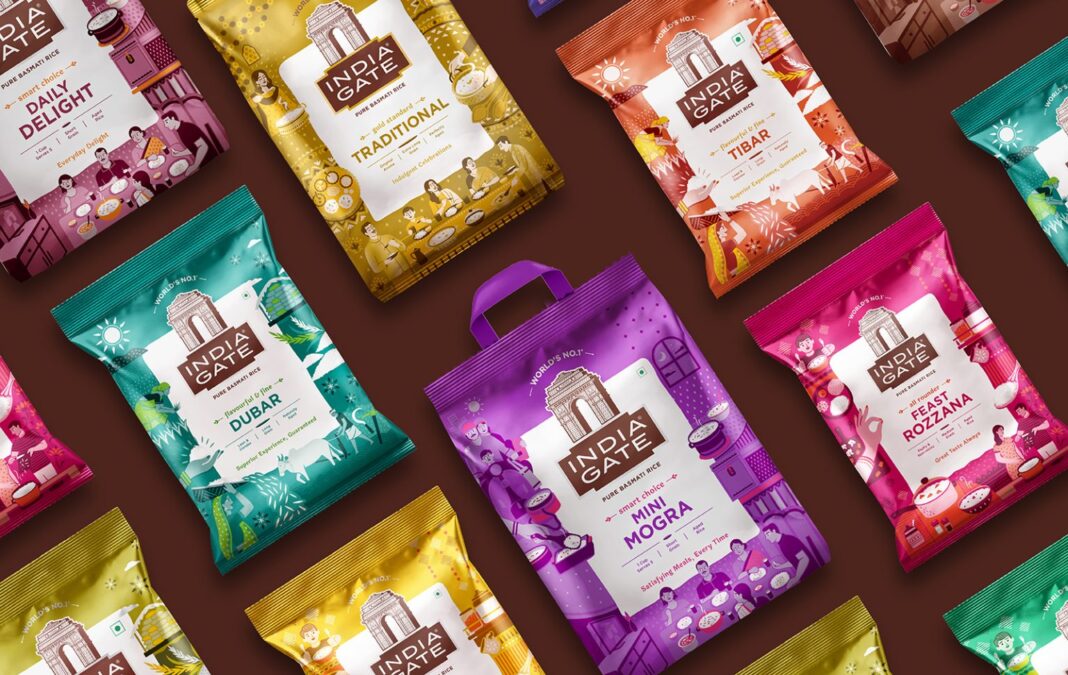
In 2025, India Gate unveiled a packaging-led transformation that goes beyond visual updates. The redesign reflects a complete portfolio re-architecture aimed at simplifying consumer choice, educating buyers, and nudging India’s rice market from price-led, loose purchases towards informed, branded staples.
India Gate quietly rolled out what appeared, at first glance, to be a long-overdue visual refresh. The new packaging carried a refined logo, cleaner typography, clearer information blocks, usage cues and, for the first time, a QR code. For a brand whose packaging had remained largely unchanged for over two decades, the update was noticeable but not radical. Yet to see the exercise as merely cosmetic would be to miss the larger strategic shift at play. Beneath the refreshed packs lies a deliberate attempt to reshape how Indian consumers engage with rice as a category, nudging them away from loose, price-driven purchases towards informed, branded choices.
For years, India Gate’s consistency had been a strength. As India’s largest basmati brand, its familiar packaging became a marker of trust on crowded shelves, particularly in traditional trade where visual change can unsettle loyal buyers. However, the context in which that consistency once worked has altered dramatically. Today’s consumer encounters brands not only in kirana stores but also across modern retail aisles, e-commerce apps, quick-commerce platforms and food delivery interfaces. In this omnichannel environment, packaging is no longer just a container; it is a primary touchpoint, often replacing the role of a salesperson. Recognising this shift, India Gate began its redesign journey as early as 2023.
Rather than starting with aesthetics, the brand adopted a category-first lens. It sought to understand what consumers actually expect from rice packaging and where the experience breaks down. Extensive research, including store observations and consumer interactions, pointed to a persistent friction point: portfolio navigation. Despite India Gate’s strong equity, shoppers often struggled to differentiate between variants or understand which rice suited which occasion. The category’s complexity—driven by grain length, ageing, aroma, cooking behaviour and regional preferences—was not being adequately decoded on pack.
Kunal Sharma, head of marketing and business head – modern trade and e-commerce at KRBL, underscores that the initiative went far beyond design. “This was not just a packaging revamp. It was a complete portfolio re-architecture, culminating in the refresh we rolled out in February 2025,” he says. The goal was not to make the packs look more contemporary for its own sake, but to bring order and clarity to a category that often leaves consumers guessing.
That confusion has real consequences. While many households develop their own heuristics for choosing rice—relying on past experience, word of mouth or price promotions—research showed that in the absence of clear guidance, price frequently becomes the default decision-maker. “While consumers had their own ways of choosing rice, there was significant confusion around what to buy. As the category leader, we felt it was our responsibility to help them choose the right rice for their needs,” Sharma explains. Allowing price to dominate, he adds, is “a concern for any brand,” particularly one that has invested heavily in quality, ageing and sourcing.
The challenge is compounded by the nature of staples themselves. Rice is a low-engagement category for most consumers; purchases are habitual, infrequent and rarely aspirational. Yet India Gate saw this as an opportunity rather than a limitation. As the market leader, the brand believed it had both the scale and the credibility to educate consumers—helping them understand why one variant might work better for everyday meals, another for biryani, and yet another for special occasions. The new packaging therefore places a strong emphasis on structured information and usage cues, guiding shoppers through the portfolio without overwhelming them.
Visually, the changes are deliberate but restrained. The refreshed logo retains recognisability while appearing sharper and more contemporary. Information is organised hierarchically, making it easier to scan both on physical shelves and on mobile screens. Colour coding and clearer descriptors help differentiate variants, addressing the navigation issue identified during research. The introduction of a QR code adds a digital layer, allowing curious consumers to access deeper content—whether that is cooking guidance, sourcing information or brand storytelling—without cluttering the pack itself.
This hybrid approach reflects a broader understanding of how modern consumers shop. In e-commerce and quick-commerce environments, where decisions are made in seconds and often based on thumbnails, clarity and differentiation are critical. A pack that once relied on familiarity now needs to work harder to communicate its value instantly. At the same time, in traditional retail, the packaging must reassure loyal buyers that the product they trust remains unchanged in quality, even as the look evolves.
The strategic intent also speaks to a larger ambition: moving the rice category from loose to branded. Despite rising incomes and urbanisation, a significant portion of rice consumption in India still happens through loose, unbranded channels, driven largely by price and habit. By simplifying choice, educating consumers and reinforcing the benefits of branded rice—consistency, quality assurance and suitability for specific uses—India Gate aims to accelerate this shift. The packaging-led transformation becomes a silent salesperson, making the case for branding at the moment of purchase.
Importantly, the brand’s decision to undertake a portfolio re-architecture acknowledges that leadership comes with responsibility. In categories where choice is opaque, the onus often falls on the largest player to set standards and simplify the experience. India Gate’s refresh positions it not just as a supplier of rice, but as a guide—helping consumers navigate a complex category with confidence.
The timing of the rollout is equally telling. By February 2025, the convergence of modern trade, e-commerce and quick-commerce had reached a point where packaging clarity could directly influence conversion rates across channels. What works on a shelf must now work on a screen, and vice versa. The new design system appears built with this duality in mind, ensuring consistency while remaining adaptable to different retail contexts.
Ultimately, India Gate’s packaging transformation is less about reinventing the brand and more about recalibrating its role in a changing marketplace. It acknowledges that even in low-engagement categories, consumers value guidance and transparency when it is offered clearly and respectfully. By rethinking its portfolio architecture and using packaging as a strategic tool, the brand is attempting to elevate everyday decision-making—one bag of rice at a time.
What looks like a visual update is, in reality, a reflection of a deeper shift in philosophy. As Indian consumers become more discerning and channels more fragmented, the brands that win will be those that simplify choice rather than add to the noise. In that sense, India Gate’s February 2025 refresh is not just a design story, but a signal of how legacy brands can evolve thoughtfully without losing the trust they have spent decades building.
Discover more from Creative Brands
Subscribe to get the latest posts sent to your email.