


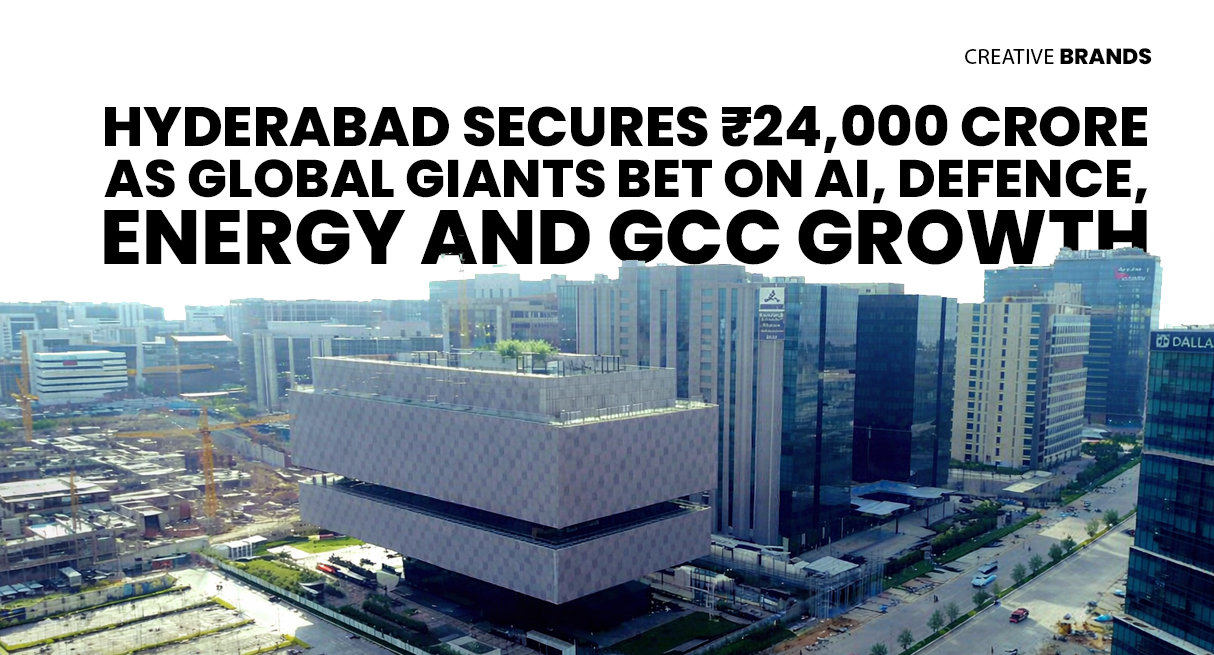
Hyderabad is cementing its position as a diversified global investment hub, drawing major commitments from L’Oréal, Apollo Micro Systems, Blaize and others at WEF 2026. With ambitions spanning AI, defence manufacturing, clean energy and GCCs, the city is rapidly evolving from a tech centre into a strategic multi-sector innovation and manufacturing destination.
Hyderabad continues to strengthen its position as one of the world’s fastest-growing technology and manufacturing destinations, with a fresh wave of investment commitments signalling confidence in the city’s capabilities across deep tech, consumer innovation, defence manufacturing, and advanced research. The latest announcements, made at the World Economic Forum 2026, reflect a broader shift in how global enterprises are recalibrating their India strategies — no longer viewing the country as merely a back-office or volume manufacturing base, but as a critical node for innovation, transformation, and next-generation global capability creation.
Among the most high-profile commitments is French beauty major L’Oréal’s decision to invest approximately ₹3,500 crore in Hyderabad to establish its first AI-powered global beauty tech hub. The centre, slated for completion by 2030, is designed to focus on artificial intelligence, generative AI, and data-driven beauty technology innovations, with targeted integration into L’Oréal’s global technology network. According to the company, the facility is expected to generate close to 2,000 advanced technology jobs — a remarkable shift for a beauty conglomerate traditionally associated with product formulation and brand marketing. With the new hub, L’Oréal signals that the future of beauty is as much computational and data-scientific as it is artistic and chemical.
“We believe that the future of beauty lies at the intersection of science, technology and creativity, so Hyderabad will now sit at the heart of our artificial intelligence and digital ambition,” said Nicolas Hieronimus, CEO of L’Oréal, underscoring a strategic reorientation for the brand globally. The message also reinforces the larger trend of consumer and FMCG majors entering AI-heavy domains such as personalised recommendations, virtual try-ons, algorithmic product customisation, and data-led dermatology solutions. For Hyderabad — already home to a significant number of global capability centres (GCCs) and a thriving AI ecosystem — the arrival of a consumer beauty giant into the tech space further diversifies the city’s sectoral landscape.
Complementing this development is Hyderabad’s continued rise as a defence and high-precision manufacturing hub. Defence manufacturer Apollo Micro Systems announced a fresh investment of ₹30,000 lakh (₹300 crore) to develop an integrated electronics and electro-mechanical manufacturing facility in the city. The new facility will cater to a wide spectrum of defence applications and aligns with India’s broader push for indigenous defence capabilities under its Make in India and Atmanirbhar Bharat initiatives. For Hyderabad, which has historically hosted several defence and aerospace clusters, this new investment strengthens its positioning as a manufacturing base for mission-critical components that require precision, reliability, and compliance with global certification standards.
Meanwhile, FMCG major Unilever is reportedly exploring the establishment of a global capability centre in Hyderabad, according to The Economic Times. Should Unilever proceed, the move would expand the city’s already notable density of GCCs operating across finance, analytics, digital supply chain, research, marketing transformation, and product innovation. Hyderabad has emerged as the fastest-growing GCC hub in India over the last five years, surpassing legacy centres such as Mumbai and matching Bengaluru’s scale in several operational categories. A potential GCC from Unilever would bring the city even deeper into global consumer goods value chains, considering Unilever’s extensive footprint across nearly every major market and product category.
California-based AI computing company Blaize also signed a memorandum of understanding with the Telangana government to scale its Hyderabad R&D centre. Blaize, which specialises in edge AI computing hardware and software, is expected to leverage Hyderabad’s talent pool to accelerate product development cycles, especially as edge AI adoption grows across automotive, mobility, industrial automation, and enterprise computing. As edge-based architectures complement cloud computing models, companies like Blaize require not just engineering talent but local ecosystems that integrate hardware, software, and testing capabilities — a combination Hyderabad has quietly developed through its defence, semiconductor, and deep-tech clusters.
These announcements collectively form part of a broader ₹24,000 crore investment haul secured by the state of Telangana on the second day of WEF 2026. According to reports, the state also signed MoUs spanning clean energy, private equity investments, AI platforms, and advanced manufacturing solutions. One of the most notable among them is a proposed ₹6,000 crore investment into a small modular reactor (SMR) project by a joint venture between Slovakia-based IQ Capital and India’s Green House Enviro. The project signals Hyderabad’s emergence as a player in advanced energy systems and nuclear-adjacent technologies — areas typically dominated by long-standing industrial centres with deep regulatory histories.
Collectively, these investments reflect a megatrend: multinational enterprises are now betting on Hyderabad not for a singular sector, but for a portfolio of capabilities that cut across digital technologies, sustainability frameworks, high-value manufacturing, consumer-tech convergence, and scientific research. Analysts point out that few Indian cities currently offer this depth of talent density, cost competitiveness, regulatory support, and institutional ecosystem alignment.
Part of Hyderabad’s rise can be attributed to deliberate state-led industrial and urban planning policies introduced over the last decade. The Telangana government successfully positioned the city as a neutral ground for global enterprises, unburdened by the legacy labour and real estate rigidities found in older metros. Ease of doing business reforms, fast-track clearance mechanisms, and sector-specific policy frameworks — particularly in electronics manufacturing, life sciences, and information technology — have significantly reduced friction for foreign entrants. Additionally, the state cultivated relationships with global corporations during diplomatic and economic missions, using platforms like Davos, Hannover Messe, and Bio Asia to sustain visibility within executive-level decision-making circles.
Infrastructure parity has also been a decisive factor. Hyderabad’s integrated clusters — from Genome Valley for life sciences to the Electronics City manufacturing cluster and the rapidly expanding AI and data center ecosystems — give multinationals turnkey environments to operate without long gestation lags. Unlike cities where industrial, academic, and residential zones evolved disparately, Hyderabad’s development has followed a more coordinated blueprint, reducing logistical overhead for both talent and operations.
Education and talent have proven to be another structural advantage. Hyderabad’s universities and engineering institutions continue to feed a steady pipeline of workforce applicants across AI, embedded systems, analytics, materials science, biotech, and mechanical engineering — disciplines directly relevant to current global investment patterns. For multinational companies seeking specialised skill sets rather than general IT capabilities, the city offers an expanding base of research-oriented talent willing to work in hybrid models that blend industry and laboratory environments.
The cost economics also remain favourable. Compared to European, Southeast Asian, or American research hubs, Hyderabad offers significant cost arbitrage across both fixed and variable operational expenditures. Yet what makes the economics compelling is that the cost advantage is paired with rising quality parity — a rare combination that allows companies to move up the value chain without abandoning fiscal efficiency. This shift is already visible in the transformation of Hyderabad from a backend IT services city into a center for AI model development, semiconductor testing, product design, material research, cloud platforms, and embedded computing.
Investment analysts also highlight Hyderabad’s relative insulation from single-sector risk. Cities like Bengaluru remain synonymous with IT and software services, Pune with automotive and manufacturing, and Mumbai with finance and consumer markets. Hyderabad, however, is diversifying horizontally across six major pillars: enterprise IT, deep tech, defence and aerospace, biopharma and life sciences, FMCG capability centers, and clean energy manufacturing. This breadth makes the city attractive to private equity funds, sovereign wealth funds, and institutional investors who assess destination stability based on sectoral diversity, regulatory predictability, and long-term growth signals.
The geopolitical context cannot be ignored either. As global supply chains undergo realignment, companies are increasingly adopting China+1 or China+2 strategies, moving portions of their research, manufacturing, and data functions to alternate geographies. India has emerged as a major beneficiary of this diversification strategy, but within India, Hyderabad has been uniquely successful in positioning itself as a neutral, non-political destination optimised for enterprise reliability and business continuity. For high-tech companies wary of geopolitical disruptions, this combination is unusually compelling.
Hyderabad benefits from a form of urban branding that blends aspiration with credibility. Unlike cities that advertise aggressively without matching underlying infrastructure, Hyderabad’s brand has been built through corporate testimonials and case studies rather than government marketing alone. Each successful investment tends to attract adjacent interest — a clustering effect visible in sectors ranging from pharma to aerospace to AI. The city’s GCC community has become one of its strongest advocates, informally marketing Hyderabad to global headquarters by demonstrating operational results and innovation outcomes.
The question emerging in policy and industry circles is no longer whether Hyderabad can attract global investment, but how far its diversification can extend. With capital now converging from consumer goods majors, defence manufacturers, energy innovators, AI companies, and sovereign investment vehicles, Hyderabad appears positioned to become one of the world’s most multi-dimensional investment destinations over the next decade.
Discover more from Creative Brands Mag
Subscribe to get the latest posts sent to your email.













Leave a comment