


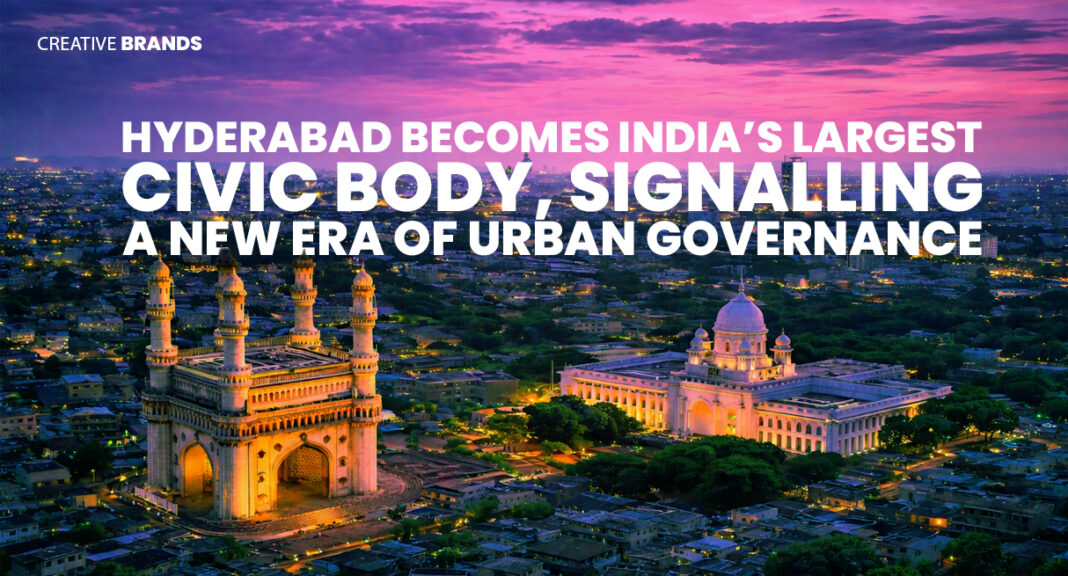
With the expansion of the Greater Hyderabad Municipal Corporation, Hyderabad has emerged as India’s largest civic body, covering nearly 2,000 sq km and serving 1.34 crore people. Beyond scale, the move reflects a forward-looking approach to urban governance, integrated planning and future-ready administration.
Hyderabad has crossed a threshold that few Indian cities have reached with such deliberation. With the expansion of the Greater Hyderabad Municipal Corporation, the city has emerged as India’s largest civic body, both in scale and administrative reach. Spread across nearly 2,000 square kilometres and responsible for a population of 1.34 crore, the reimagined GHMC now governs through 12 zones, 60 circles and 300 wards. The numbers are striking. In physical size, Hyderabad today is comparable to an entire island nation like Mauritius and nearly two-and-a-half times larger than Singapore. Yet the importance of this development lies not in the cartographic comparisons it invites, but in what it signals about the future of urban governance in India.
Cities across the country have often expanded in an unplanned, reactive manner, with municipal boundaries lagging far behind actual urban growth. As a result, infrastructure strains, service inequities and governance gaps have become familiar challenges. Hyderabad’s expansion marks a departure from this pattern. It represents a conscious decision to anticipate urbanisation rather than chase it. As residential clusters, industrial hubs and economic corridors have steadily moved beyond the city’s traditional limits, the need for a unified civic framework became unavoidable. By formally bringing fast-developing peripheral areas under the GHMC umbrella, the city has chosen coherence over fragmentation.
For residents in these newly incorporated zones, the shift is more than symbolic. Unified governance means consistent civic services, from sanitation and drainage to road maintenance and street lighting. It enables access to structured urban planning processes rather than ad hoc approvals. It also creates the foundation for equitable infrastructure investment, ensuring that growth at the edges of the city does not remain perpetually underserved. In a metropolis where daily life increasingly spills across older boundaries, aligning governance with lived reality is a crucial step.
At the heart of the expansion is a strengthened administrative architecture designed to manage complexity. The reorganisation into multiple zones and circles, each with defined leadership and responsibilities, reflects an emphasis on decentralisation. Rather than concentrating authority at a distant centre, the new structure aims to bring decision-making closer to neighbourhoods. This zonal approach acknowledges that a megacity cannot be governed effectively through a single, centralised lens. Local issues demand local responses, even as they align with a broader metropolitan vision.
Importantly, the expansion has been calibrated rather than indiscriminate. Forest lands and defence areas remain protected, underscoring the intent to balance urban growth with environmental and strategic considerations. The inclusion of newly urbanised clusters is therefore not about unchecked sprawl, but about recognising areas where urban character has already taken root. By integrating these zones into the formal civic system, the city gains the ability to plan infrastructure corridors, public transport networks and utilities in a coordinated manner.
This coordination is increasingly vital as Hyderabad’s economic footprint widens. The city has emerged as a key technology, pharmaceutical and manufacturing hub, with growth radiating outward along major highways and transit corridors. Planning such expansion at a metropolitan scale allows for better alignment between land use and economic development. Industrial zones, residential areas and commercial centres can be connected through coherent mobility plans rather than piecemeal road projects. Water supply, sewage treatment and waste management can be designed with future demand in mind, reducing the risk of crisis-driven interventions.
The expansion of the GHMC also prepares Hyderabad for the next phase of governance reforms that are likely to follow future census exercises. As population data becomes more granular and urban demographics continue to shift, having an adaptable civic framework will be critical. By scaling its governance apparatus now, the city positions itself to respond to future changes without the disruption that accompanies hurried restructuring. It signals an understanding that urban governance must evolve continuously, not episodically.
For policymakers and urban planners across India, Hyderabad’s move offers an instructive case. The tendency to view municipal expansion as a political or administrative burden has often delayed necessary reforms. Here, expansion has been framed as an opportunity to improve service delivery, enhance accountability and strengthen long-term planning. The emphasis is not merely on governing a larger area, but on governing it better. Decentralised administration, consistent standards and integrated planning form the pillars of this approach.
Challenges, of course, remain. Managing a civic body of this scale requires sustained capacity building, transparent processes and robust financial planning. Ensuring that decentralisation translates into genuine empowerment rather than bureaucratic layering will be a key test. Integrating diverse neighbourhoods with varying levels of development into a single civic culture will demand sensitivity and engagement. Yet these challenges are inherent to any city that aspires to be future-ready rather than complacent.
Hyderabad’s expansion should therefore be seen as a statement of intent rather than a declaration of arrival. It reflects a city acknowledging its trajectory and choosing to shape it deliberately. In an era when India’s urban population is set to grow dramatically, the question facing cities is no longer whether they will expand, but how thoughtfully they will do so. By aligning its civic boundaries with its economic and demographic reality, Hyderabad has taken a step toward answering that question.
India’s largest civic body is not defined by its size alone. It is defined by the ambition to be more responsive, more inclusive and more prepared for the complexities of urban life in the decades ahead. Hyderabad’s decision to scale governance alongside growth suggests a recognition that cities are living systems, requiring foresight as much as management. As the city enters this defining phase, its expanded civic framework stands as both a challenge and an opportunity: to demonstrate that big cities can also be well-governed, and that planning ahead is the most enduring form of urban leadership.
Discover more from Creative Brands
Subscribe to get the latest posts sent to your email.