



Hero MotoCorp plans to hive off its electric division, VIDA, and list it by 2030 as the brand’s sales surge past one lakh units. With rising market share, expanding infrastructure, and strong growth across V1, V2 and VX2 models, the spin-off aims to unlock valuation, boost agility, and strengthen Hero’s long-term EV strategy.
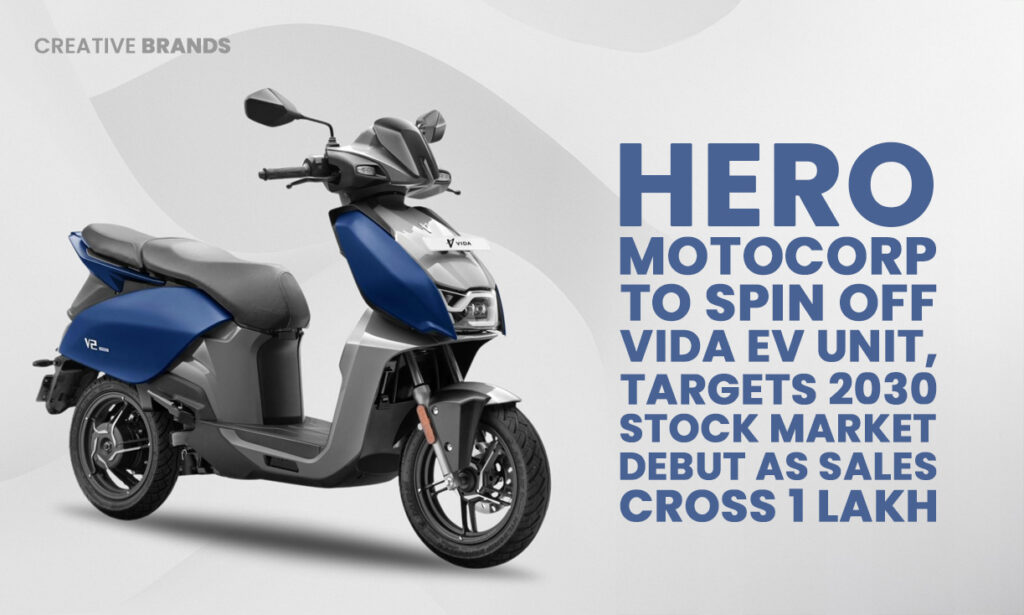
Hero MotoCorp’s electric mobility ambitions are entering a decisive new phase as the company prepares to spin off its electric vehicle division, VIDA, into a standalone entity and list it on Indian stock exchanges by 2030. The move, still not publicly confirmed by the company but widely discussed within industry circles, signals a long-term structural shift in how the two-wheeler giant wants to compete in the rapidly growing EV market. With demand for electric scooters soaring and VIDA’s sales building strong momentum across its V1, V2 and VX2 models, the separation is being viewed as a strategic effort to unlock value, increase agility and attract EV-focused investors who prefer clean mobility portfolios over legacy internal combustion engine holdings.
According to a person familiar with the ongoing discussions, Hero MotoCorp intends to wait until VIDA reaches much higher scale before proceeding with the spin-off and eventual listing. The company’s internal goal, the source said, is to ensure VIDA becomes one of the leading EV two-wheeler brands in the country before subjecting it to public-market scrutiny. “At this juncture, Hero MotoCorp is planning to scale up the volumes of its EV business. Once the company is able to gain significant volumes in the electric two-wheeler business, it will be hiving off VIDA as a separate entity. Thenceforth, it will get it listed on domestic stock exchanges,” the source told Republic Business. The company has not officially commented on the development, with emails sent by Republic Business to its spokesperson remaining unanswered.
VIDA’s recent performance helps explain why Hero is accelerating its long-term EV roadmap. In August 2025, VIDA crossed the milestone of one lakh cumulative units sold, marking an inflection point for the brand that only entered the market in October 2022. While it delivered around 43,700 units in the full calendar year 2024, it exceeded that figure in just the first seven months of 2025. Monthly sales have climbed sharply, touching nearly 16,000 units in October 2025, placing VIDA firmly among India’s top electric two-wheeler players. The brand, which held a modest market share of 4 percent in 2024, has been fluctuating in the 6–10 percent range this year, often ranking between the third and fifth positions nationally. This puts it in a competitive bracket with established names such as Ola Electric, TVS iQube, Bajaj Chetak and Ather Energy.
What makes Hero MotoCorp’s EV strategy particularly noteworthy is how it has simultaneously built VIDA and strengthened its position in Ather Energy. The company retains a significant stake in the Bengaluru-based startup and has no plans to dilute this holding, the source clarified. This dual-track strategy—growing its in-house EV division while continuing to support one of the market’s strongest independent brands—gives Hero more depth and optionality than most traditional OEMs navigating the electric transition.
Industry experts view the spin-off plan as a calculated move aligned with global patterns, where major automakers have separated their EV units to secure better valuations and strategic clarity. Mohit Yadav, Director at Altinfo, believes the timing of Hero’s move is carefully chosen for both financial and operational reasons. “The spin-off unlocks VIDA’s valuation while giving it capital flexibility to compete independently. With number four position and 11.7 percent share, the 2030 timeline allows Hero to scale profitably before public scrutiny. Likely attracts specialized EV investors who avoid dilution in legacy ICE holdings,” he said. His analysis reflects a growing sentiment that EV-focused entities perform better when freed from the constraints of broader conglomerates where resources must be split between future-facing technologies and older but still-essential combustion businesses.
Meanwhile, Hero MotoCorp has been steadily deepening VIDA’s presence across major Indian cities. From expanding its dealer network to investing in fast-charging infrastructure, digital retail models and aftersales programmes, the company is building the full ecosystem required for long-term EV adoption. Initiatives such as VIDA Advantage—an ownership programme that bundles warranties, upgrades and service plans—are aimed at reducing the friction often associated with first-time EV purchases. Hero is also preparing to widen VIDA’s product lineup into mass-market segments, a move that could significantly expand its addressable consumer base and help drive the higher volumes needed before a stock market listing.
International expansion is also part of the long-term playbook. The company has outlined plans to explore export opportunities in mature EV markets such as Europe and the UK, an ambition that aligns with its confidence in VIDA’s technology stack and product engineering. If successful, it would mark a rare instance of an Indian EV two-wheeler brand attempting to compete globally, placing Hero in a more ambitious league compared to its domestic rivals.
The spin-off, once complete, is expected to give VIDA the autonomy to make faster decisions, accelerate partnerships and invest aggressively in R&D—areas that are increasingly important as EV competition intensifies. For Hero MotoCorp, separating the EV business could also help streamline reporting structures and allow management to focus more sharply on growth areas without compromising its vast internal combustion portfolio, which continues to dominate rural and semi-urban markets. Yet, despite the clear strategic logic behind the move, the company appears keen to wait for the right moment rather than rushing into a listing before the business reaches maturity. The next few quarters are expected to bring clearer details on restructuring and potential capital injection into the standalone entity.
VIDA’s evolution is unfolding within the broader narrative of India’s electric mobility transition. While the EV two-wheeler market has grown rapidly, it remains competitive and highly sensitive to policy changes, supply chain constraints and shifts in consumer sentiment. For Hero MotoCorp, the spin-off is a bet on long-term structural change rather than short-term market cycles. It reflects confidence in VIDA’s ability to scale, differentiate and hold its ground among the country’s most influential electric two-wheeler brands.
As the 2030 horizon approaches, Hero now faces the dual challenge of growing VIDA’s volumes and preparing the company for independent public-market existence. Investors, analysts and industry observers will be watching closely as the contours of the spin-off become clearer. For now, the story is one of momentum, ambition and a deliberate recalibration of strategy. HERO MotoCorp, a company built on decades of leadership in combustion-engine motorcycles, is preparing for its next chapter—one where its electric division may stand on its own, backed by numbers, market share and a vision shaped for the future of mobility.
Discover more from Creative Brands
Subscribe to get the latest posts sent to your email.