


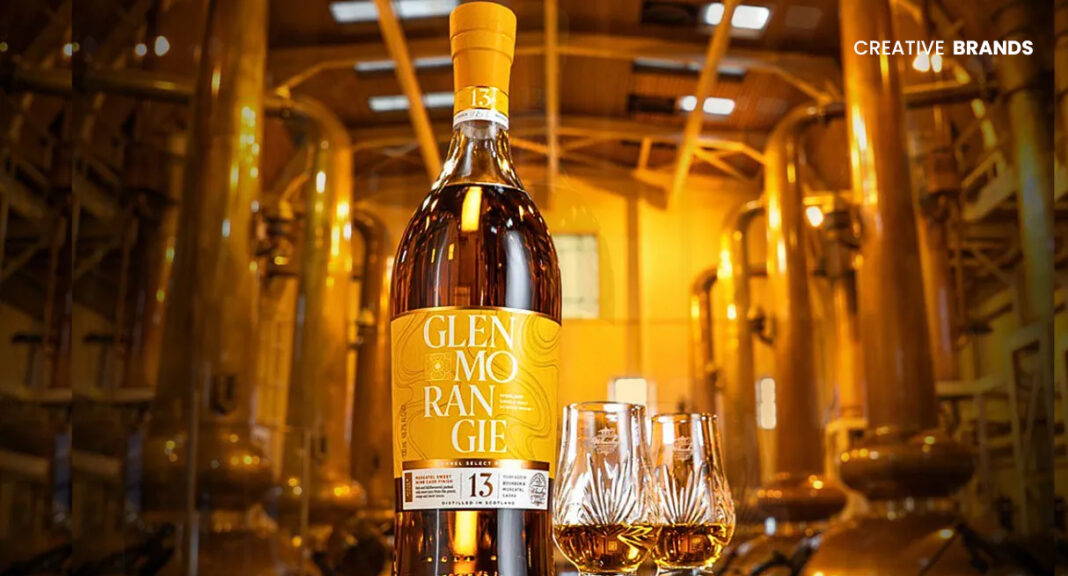
Glenmorangie has released a limited 13-year-old single malt matured in rare Moscatel dessert wine casks, available only to members of The Whisky Club in Australia and New Zealand. Bottled at 48.2% ABV, the experimental release showcases rich dessert-style flavours and will not be issued globally or re-released.
Glenmorangie has unveiled a rare and experimental new whisky designed with serious collectors and curious drinkers in mind, introducing the Glenmorangie 13 Year Old Moscatel Cask exclusively for Australia and New Zealand. The limited-edition single malt, produced in partnership with The Whisky Club, marks the first time the Highland distillery has matured spirit in Moscatel dessert wine casks — a bold stylistic departure that will not be replicated in wider global markets and one that plays directly into the rising demand for exclusive regional releases.
Owned by Moët Hennessy, Glenmorangie has spent recent years deepening its reputation for whisky experimentation by rethinking the role of wood, finishing, and secondary maturation. However, even seasoned Glenmorangie followers had no hint of the parcel of Moscatel casks quietly developing in the background. Distilled in 2009, this whisky originated as part of a discreet internal pilot programme intended to explore new interpretations of what would become Glenmorangie’s modern “dessert-led” profile. The programme was an extension of the ideas that first took form in Nectar d’Or — now released as The Nectar 16 Year Old — which was among the first whiskies in the single malt category to position dessert wine finishes as a structural influence rather than a novelty flourish.
The Moscatel casks selected for the pilot were filled at a time when Glenmorangie was publicly discussing innovation but had not yet begun revealing the more experimental workings of its warehouses. Behind the scenes, the distillery was engaging with suppliers across the dessert wine world, revisiting how residual sugars, oak treatments, and wine grape varietals might transform Glenmorangie’s inherently fruity spirit. Sherry and port finishes had long been understood in Scotch whisky making; Sauternes had been proven by Nectar d’Or. But Moscatel — celebrated in the wine world for aromatic sweetness and floral complexity — was uncharted territory.
When the distillery team evaluated the casks, they found an unexpectedly rich convergence between Glenmorangie’s signature character and the Moscatel influence. The result was liquid that felt as if it belonged to the same family as The Nectar, but that moved in softer, juicier, and more brightly perfumed directions. Whereas many dessert wine finishes can skew syrupy or overly ornate, the Moscatel trial revealed something more delicate: a whisky whose sweetness expressed itself less in sugar and more in notes reminiscent of patisserie cream, orchard fruit and confectionery spices.
Although the whisky is labeled as a 13-year-old, much of the spirit is nearing 16 years of age due to an unusually extended secondary maturation period — seven of those years spent directly in Moscatel casks. That timeline alone sets the release apart. While most dessert wine finishes in Scotch occur over a period of months or at most a few years, Glenmorangie’s approach allowed the wine influence to weave deep into the malt without collapsing it under weight. This prolonged finishing process accounts for the unexpectedly layered profile, as well as the decision to bottle the whisky non-chill filtered, at natural colour, and at 48.2 percent ABV — a strength chosen specifically to carry aromatics without sacrificing textural warmth.
The flavour profile reads like a pastry shop filtered through Highland air. Drinkers can expect pronounced notes of strawberry cream, chocolate orange, vanilla custard and baked apple, rounded by subtle floral accents and dark spice. These descriptors speak both to dessert wine character and Glenmorangie’s broader house style, famous among enthusiasts for its fragrant acidity and creamy finish. The integration between distillate and cask suggests that, had this pilot not been constrained by a small parcel of casks, Moscatel finishing might have evolved into a permanent addition. Instead, the rarity is part of the appeal.
That rarity is compounded by the decision to distribute the release exclusively through The Whisky Club in Australia and New Zealand, beginning 9 January at a price point of AU$150. Exclusive bottlings have become a competitive category unto themselves, offering drinkers access to spirits that circumvent global allocation battles, duty-free exclusives, and the scramble for limited open-market releases. For The Whisky Club, the partnership elevates its status within a landscape that has become saturated with cask-finish experiments but still hungers for genuinely first-time expressions. For Glenmorangie, it reinforces a long-running strategy: to cultivate loyalty not purely through scarcity but through distinctive flavour exploration.
Limiting the whisky to two markets also reflects how valuable collector ecosystems have become outside the traditional Scotch heartlands of Europe and the U.S. Australia and New Zealand have emerged as sophisticated whisky destinations in recent years, with strong consumer willingness to seek out and invest in bottlings that push stylistic boundaries. The region has also produced a surge of its own wine and whisky experimentation, making it a fitting home for a release that merges both traditions in one bottle.
Beyond the commercial strategy, the new release will undoubtedly generate conversation among industry watchers about the future of Moscatel finishes in Scotch. Other distilleries have experimented with sherry variants, port pipes, or fortified wines such as Madeira, but few have gone deep into dessert wine as a broader category. If Glenmorangie’s pilot programme was originally a test case for Nectar d’Or variants, the success of this bottling may inspire competitors to look beyond Sauternes for sweetness profiles that offer both aromatic lift and structural complexity. Yet, perhaps intentionally, Glenmorangie has pre-empted that possibility by stating that no further releases of this experimental cask style are planned. Once this bottling is gone, the Moscatel chapter may close permanently.
That finality also adds weight to the timing. At a moment when whisky enthusiasts increasingly debate the legitimacy, excess, and authenticity of finishing trends, Glenmorangie’s Moscatel Cask arrives as proof that there is still meaningful ground to be charted in the category — provided producers focus on integration rather than gimmick. It illustrates how dessert wine finishing can serve as a lens for enhancing a whisky’s inherent personality, rather than as a mask to cover deficiencies or generate novelty headlines.
For collectors, the release ticks multiple boxes: it is limited, region-specific, innovative, linked to a respected producer, and underpinned by a coherent creative rationale rather than simple supply scarcity. For drinkers, it offers a sensory window into a distillery quietly working through ideas that may shape future generations of the category — just as earlier experiments shaped the rise of modern finishing culture itself.
Whether or not Glenmorangie ever revisits Moscatel, the 13-year-old release serves as an intriguing time capsule from an era when dessert wine whisky finishes were still evolving, and when distilleries understood innovation less as spectacle and more as an intimate conversation between spirit and wood. As the allocation makes its way across Australia and New Zealand, those fortunate enough to secure a bottle will find themselves tasting not only a whisky, but a moment in the distillery’s creative development — one unlikely to be repeated, and perhaps all the more compelling because of it.
Discover more from Creative Brands
Subscribe to get the latest posts sent to your email.