


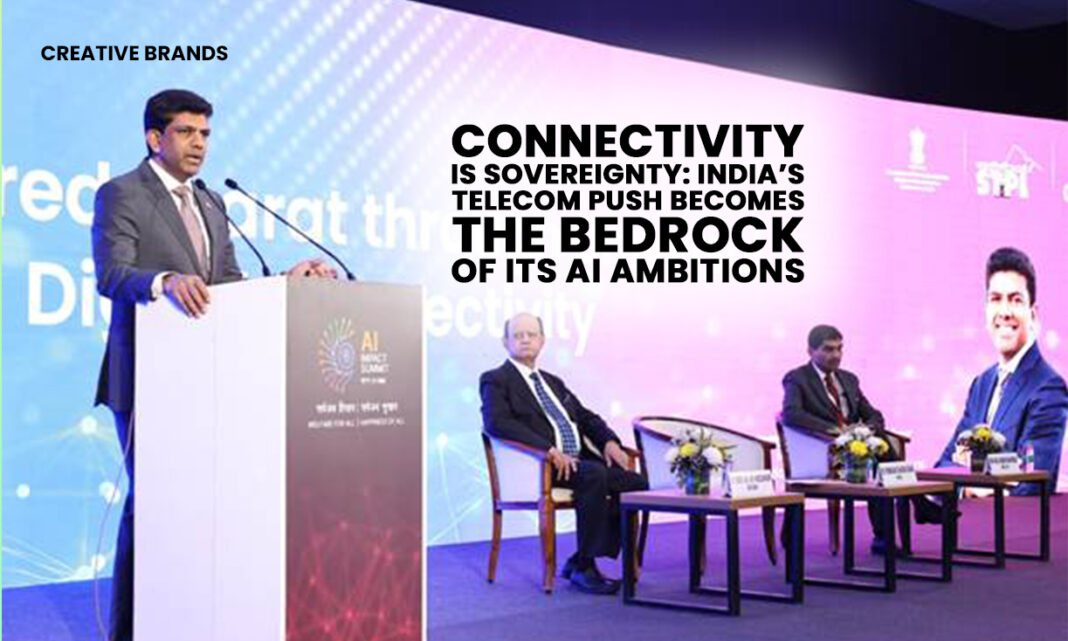
India’s Minister of State for Communications and Rural Development, Dr. Pemmasani Chandrasekhar, said telecom infrastructure is the foundational layer of India’s AI ecosystem, calling connectivity “sovereignty”. Speaking at the India AI Impact Summit, he highlighted India’s rapid broadband, fibre, 5G growth, and AI-driven security systems combating fraud and spam.
India’s AI story is often told through the language of algorithms, talent, startups, and ambitious national missions. But at the India AI Impact Summit at Bharat Mandapam, the Government’s message was clear: before India can scale intelligence, it must first scale connectivity. Delivering the keynote address at a session focused on telecom and artificial intelligence, Dr. Pemmasani Chandrasekhar, Minister of State for Communications and Rural Development, framed telecom infrastructure not as a supporting actor but as the foundational layer of India’s AI ecosystem. In a line that captured both the political urgency and strategic ambition of the moment, he declared, “Connectivity is not a luxury. Connectivity is sovereignty.”
The statement was not rhetorical flourish. It was a deliberate positioning of digital infrastructure as national capacity—something that defines India’s ability to compete, protect, and empower. In an era where AI systems increasingly shape governance, security, education, health, and commerce, the minister argued that inclusive digital connectivity is central to India’s technological leadership. In other words, if AI is the next frontier of global power, then telecom networks are the roads, ports, and railways of that future.
To underline the scale of India’s transformation, Dr. Pemmasani pointed to numbers that reflect a decade-long acceleration. Broadband subscribers, he noted, have risen from 6 crore in 2014 to 100 crore in 2025. Average monthly mobile data consumption has now crossed 24 GB per user—an indicator not only of affordability but also of behavioural change, as Indians increasingly live, work, learn, and transact through mobile networks. Fibre deployment has crossed 42 lakh route kilometres, strengthening the physical backbone required for high-speed, high-volume data movement. And India, he added, has undertaken one of the fastest 5G rollouts globally, pushing advanced connectivity beyond metro elites and into wider markets.

These achievements, however, are not being celebrated merely as milestones of telecom growth. The minister’s larger argument was that every one of these numbers directly shapes India’s ability to deploy AI at scale. AI is data-hungry and latency-sensitive. It demands stable networks, large bandwidth, and reliable backhaul. A rural telemedicine service using AI-based diagnostics, a precision agriculture model using satellite and sensor data, or an AI-driven learning platform serving a village classroom cannot function on patchy networks. The promise of AI collapses if the pipeline carrying it is weak.
That is why the minister placed special emphasis on last-mile connectivity initiatives such as BharatNet. The intent, he said, is not only to expand access but to ensure that AI-enabled services reach rural and remote areas, thereby democratising access to emerging technologies. This framing reflects a growing policy shift: the goal is no longer just to bring internet to the unconnected, but to bring capability to the underserved. In the new digital economy, connectivity is the first step; meaningful participation is the next.
According to Dr. Pemmasani, India is now transitioning from connectivity expansion to capability enhancement. This transition marks a new phase in India’s telecom-AI roadmap. Instead of focusing only on increasing subscriber numbers, the focus is moving towards building the kind of infrastructure AI applications require. High-capacity fibre backhaul is one such priority, because 5G without deep fibre is like a highway without bridges—impressive in appearance, but limited in real performance. Edge computing is another, especially for low-latency applications that require real-time processing close to users. Cloud infrastructure expansion is also being prioritised, alongside affordable access that enables startups and enterprises in Tier-2 and Tier-3 cities to innovate, rather than merely consume.
This emphasis on Tier-2 and Tier-3 innovation is significant. India’s AI ecosystem has long been concentrated in major urban centres. But if the country is to become a global AI leader, it cannot remain a story of a few technology corridors. It must become a story of distributed innovation—where entrepreneurs in smaller cities have access to the same digital building blocks as those in Bengaluru, Hyderabad, or Gurugram. Affordable and reliable telecom infrastructure becomes the silent enabler of that shift.
The minister noted that AI adoption is already accelerating across sectors, with a growing number of large enterprises deploying AI in active production environments. This point signals a move beyond pilots and proof-of-concept experiments. When enterprises deploy AI in production, they invest in systems, workflows, governance structures, and data pipelines. It becomes a long-term operational capability rather than a short-term technology trend. For the telecom sector, this enterprise shift also creates demand for better service reliability, stronger cybersecurity, and advanced network management.
But the minister’s address did not present connectivity as a purely celebratory story. He also stressed that as India expands its digital reach, trust and security must be treated as core infrastructure. In a country where hundreds of millions rely on mobile connectivity for banking, identity, and government services, the cost of fraud is not only financial—it erodes confidence in the digital system itself. That is why Dr. Pemmasani highlighted strengthened telecom security frameworks and a growing suite of AI-enabled protective systems.
Among the initiatives he cited was the AI-enabled Digital Intelligence Platform, which connects over 1,200 institutions. Such a networked approach indicates that fraud and misuse cannot be tackled by isolated interventions. Telecom security today is an ecosystem challenge, requiring coordination across service providers, regulators, banks, law enforcement, and digital platforms. The minister also pointed to the ASTR tool, which has identified and disconnected over 86 lakh fraudulent SIM cards. SIM-based fraud remains one of the most common entry points for scams and financial crimes, and the scale of disconnections signals both the size of the threat and the seriousness of the response.
He further highlighted the Financial Fraud Risk Indicator, which has prevented fraudulent transactions worth over ₹1,400 crore. These numbers matter because they show how AI is being used not only as a growth engine but as a defensive shield. As India’s digital economy expands, the attack surface expands too. AI-driven spam detection and fraud prevention systems, the minister said, are actively safeguarding citizens and strengthening digital trust. The implication is clear: in the AI era, security is not an afterthought; it is a prerequisite for adoption.
Dr. Pemmasani also placed India’s efforts in a global context, noting that the country ranks among the top AI ecosystems worldwide and is the world’s second-largest telecom market. This dual identity—AI ambition paired with telecom scale—gives India a strategic advantage. Few countries have both a massive user base and a rapidly growing innovation ecosystem. The combination enables India to build, test, and scale AI solutions domestically in ways that smaller markets cannot. At the same time, it creates policy responsibility: when India builds AI infrastructure, it sets benchmarks for inclusive deployment at population scale.
He referred to allocations under the IndiaAI Mission, positioning it as part of a larger national strategy to build a self-reliant and innovation-driven digital economy. He also pointed to significant investments in semiconductor manufacturing, signalling that the Government sees AI not only as software and services but also as a hardware-driven industrial opportunity. Telecom, cloud, AI compute, and semiconductors form an interconnected chain. If India wants to control its digital destiny, it must strengthen each link—from the chips powering servers to the fibre carrying data, to the networks enabling real-time AI services.
In concluding his address, Dr. Pemmasani offered a final reframing: telecom is no longer merely about connecting calls, but about connecting opportunities. It is a line that summarises India’s new telecom narrative—one where networks are measured not just in coverage maps, but in the opportunities they unlock for citizens, startups, and institutions. The message at Bharat Mandapam was ultimately one of convergence. Telecom is becoming the delivery system of India’s AI future, and AI is becoming the intelligence layer that makes telecom networks safer, smarter, and more responsive.
As India races to build an inclusive, secure, and AI-ready digital future, the minister’s central point lands with force: sovereignty in the 21st century will not only be defended at borders, but also built through fibre routes, edge nodes, secure SIMs, trusted platforms, and the ability to ensure that every citizen—urban or rural—can participate in the next wave of technological transformation.
Discover more from Creative Brands
Subscribe to get the latest posts sent to your email.