


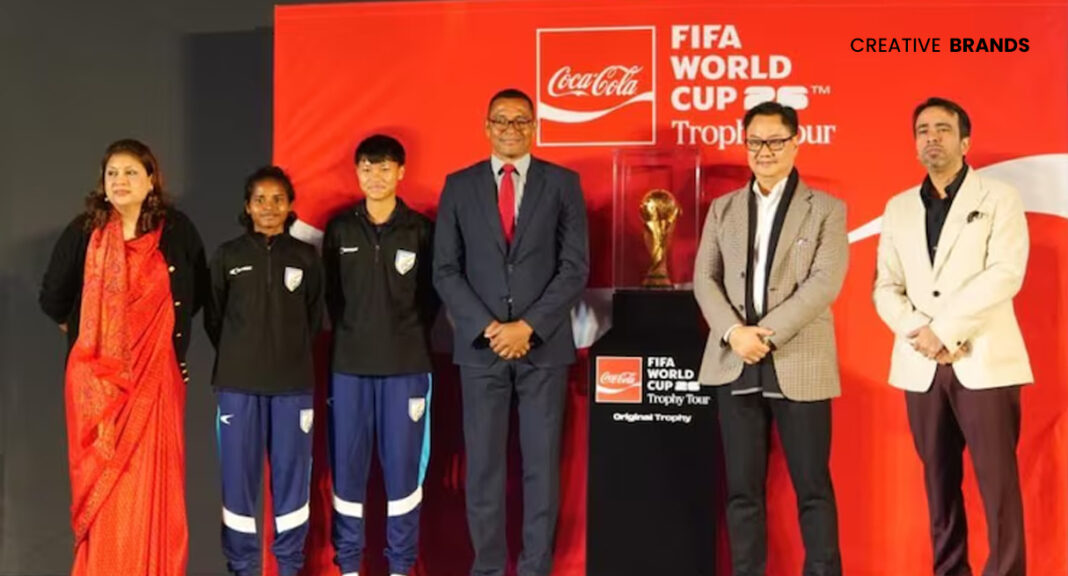
Coca-Cola’s sponsorship of India’s women’s national football teams marks a rare and meaningful corporate investment in the women’s game. With support for international coaching and exposure trips, including European training for U-17 players, the partnership could reshape grassroots development and strengthen India’s competitiveness ahead of major AFC tournaments.
Corporate backing in Indian football has historically tilted towards men’s tournaments, marquee events and broadcast-friendly spectacles. But the gesture that unfolded at the Coca-Cola FIFA World Cup Trophy Tour event in New Delhi carried a different weight — one that spoke of long-term vision rather than fleeting promotional value. At the event, the All India Football Federation (AIFF) announced that Coca-Cola would sponsor the Indian Women’s National Football Team for the next three years, marking one of the most meaningful and potentially transformative collaborations for the women’s game in India.
The timing is significant. Indian women’s football is enjoying an unprecedented period of momentum, having qualified for the AFC Asian Cup by merit across all three categories — U-17, U-20 and senior — a feat that underlines the programme’s upward trajectory. These qualifications were not courtesy invitations or continental quotas, but earned through performance, discipline and tactical evolution. Yet, progress in women’s football does not flourish in a vacuum. It requires infrastructure, exposure, international coaching, and above all, patient investment. For decades, that combination has been difficult to secure in India.
The association with Coca-Cola could change that. AIFF president Kalyan Chaubey, speaking at the event, articulated the stakes clearly. “Women’s football has huge scope to grow,” he told the audience. “It requires support, especially support from the corporate sector.” Chaubey’s statement was both an acknowledgement of history and a plea for continuity. Indian football has endured periods of drift and uncertainty, he noted, even when trying to establish top-tier leagues. With the Sports Ministry offering stability and now a global corporate player committing three years of support, the women’s game finds itself at an inflection point.
The partnership goes beyond mere sponsorship logos or ceremonial gestures. Coca-Cola has pledged support that translates into practical football gains: hiring an international coach, organising exposure trips and ensuring professional training environments. These elements form the lifeblood of modern player development. Without them, young athletes plateau early; with them, they compete, adapt and evolve. “From year one to year three, Coca-Cola will support Indian women’s football to ensure proper arrangements so that these women do not fall behind due to lack of support,” Chaubey said, emphasising the importance of global exposure in closing the competitive gap.
The most compelling dimension of the move is its grassroots impact. Coca-Cola’s involvement with the U-17 women’s team, including efforts to send players to Europe for training, signals a decisive shift from symbolic support to developmental investment. Young Indian footballers rarely receive European training blocks at formative ages, and when they do, it is often through isolated short-term initiatives. Here, the backing comes with a potential three-year runway, allowing the country’s best emerging players to refine technique, match fitness and tactical intelligence against higher standards ahead of major tournaments such as the AFC U-17 Asian Cup.
If executed well, these exposure trips will do more than offer competitive scrimmages — they could alter expectations. For a generation of girls who once viewed football as an afterthought, a recreational escape, or at best a state-level pursuit, the European stint signals that there is now a system willing to invest in their dreams. It is no coincidence that this phase arrives as India seeks to join the broader global surge in women’s football participation and fandom, fuelled by packed stadiums in Europe, rising media interest worldwide and record-breaking Women’s World Cup audiences.
Corporate participation in sports development often draws scepticism, particularly when it appears driven by marketing utility. Yet this partnership carries a different undertone. Women’s football in India currently offers no grand commercial returns, no guaranteed broadcast spikes, no star-driven celebrity economies. Backing it requires intent. That intent was acknowledged by Chaubey, who publicly thanked Sanket Ray, Coca-Cola South West Asia’s President, for choosing to invest in the national team. The risk for the company lies in the timeline — genuine football development takes years, not quarters — but the opportunity lies in shaping a legacy and possibly catalysing competitive success at a continental level.
Should India’s U-17 team make history at the AFC U-17 Asian Cup or deliver a breakthrough performance, it will not just be a sporting accomplishment — it will validate an ecosystem shift built on patient support. That is where Coca-Cola’s involvement could become path-breaking. If one major global company can prove that grassroots women’s football is worth sustained investment, others may follow. The infusion of resource, expertise and visibility would then grow from one partnership into a new norm.
For now, the announcement offers something Indian women’s football has long lacked: hope with structure. The country has no shortage of raw athletic talent or ambition among young girls who want to play, train, and compete. What they have lacked is a bridge between aspiration and opportunity. With a global brand stepping into that role, the bridge no longer feels imaginary. It feels like the beginning of a new chapter.
Discover more from Creative Brands
Subscribe to get the latest posts sent to your email.