


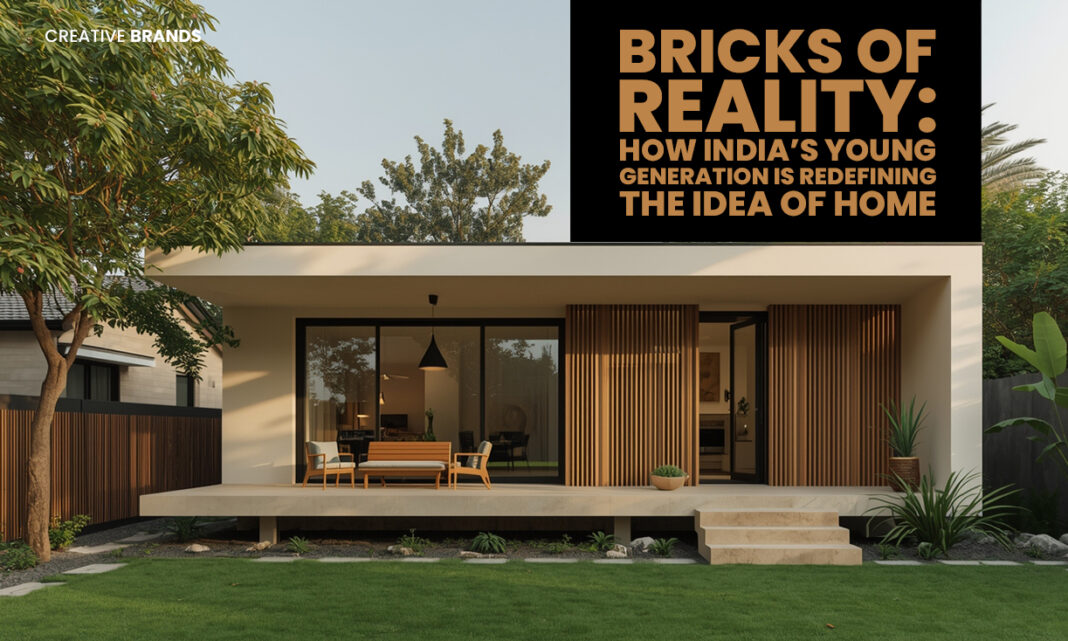
India’s younger generation is redefining the idea of home by prioritising simplicity, affordability, and flexibility over size, grandeur, and legacy. Millennials and Gen Z are choosing smaller, functional homes built without long-term loans, using local materials and sustainable designs. With work-from-home spaces, compact kitchens, open outdoor areas, and tech-enabled planning, homes are now shaped around present needs rather than future inheritance—reflecting intentional, debt-free, and practical living.
Building a home has long been considered one of the most cherished dreams for Indians. It’s not just about having a roof over one’s head—it’s about security, stability, pride, and legacy. Across rural villages and bustling metros, the act of building a house has symbolised a rite of passage, particularly for those entering middle age. But in a nation evolving at the pace of its growing cities, changing family structures, and new digital lifestyles, the very definition of “home” is undergoing a silent transformation.
Gone are the days when families aspired to construct grand mansions with sprawling courtyards, guest bedrooms, ornate kitchens, and balconies facing the street. That dream, passed down through generations like a sacred tradition, is slowly being reshaped by a younger generation that sees life—and homeownership—through a very different lens.
Instead of thinking in terms of grandeur or permanence, many young Indians today are prioritising simplicity, function, and freedom from debt. The result? A revolution in homebuilding that is less about luxury and more about living.
Dreams Rewritten, Designs Rethought
For decades, the formula was well-known. People would spend their youth earning, saving, and eventually taking out home loans to build houses that would not only shelter them but also serve as a generational asset. The house symbolised status, permanence, and often, a culmination of one’s hard work. These were homes meant to last lifetimes and beyond, built with the assumption that children and grandchildren would continue living in them.
But India’s younger generation doesn’t necessarily think that way anymore. They see a home not as a timeless monument, but as a temporary solution—tailored to current needs rather than some imagined future. For them, it’s not about how big the house is, but how intelligently it is built.
A growing number of millennials and Gen Z Indians are opting to build homes in their late 20s or early 30s. But instead of splurging on multi-storied bungalows with complex architecture, they are turning toward more practical, single-story homes made with regionally available materials and minimalist designs. Their motivations are deeply rooted in financial pragmatism and a realistic understanding of what lies ahead.
“We always thought about building a house one day, but not in the way our parents did,” says 30-year-old Prakash Nambiar, a freelance graphic designer in Kozhikode. “We didn’t want to get stuck with a massive EMI that controlled every decision of our lives for the next 20 years. So we decided to build small, build smart, and stay debt-free.”
A Home Without the Burden
The decision to avoid long-term home loans is at the heart of this movement. Traditional Indian homeownership often came with a significant financial burden. Home loans spanning 15–30 years became the norm. People lived their entire working lives under the shadow of repayment.
But today’s generation is less willing to mortgage their freedom for bricks and cement. Instead, they are choosing to live within their means—constructing affordable houses with the money they have or can save within a short period.
This financial approach is more than just risk-averse; it reflects a shift in life priorities. The modern homeowner is often more interested in travel, career fluidity, personal time, and even potential migration. A massive mortgage restricts such flexibility.
“There’s a saying now in our circles—‘Don’t let your house own you,” laughs Megha K., a school teacher from Thrissur who, along with her husband, built a modest 1,000-square-foot home using local clay tiles and laterite bricks. “We built our house in eight months using our savings. No loan. No regrets.”
Functional Living Spaces
The architectural changes in these new homes reveal a lot about evolving lifestyles. One noticeable feature is the increasing demand for study-cum-office rooms. The COVID-19 pandemic and the rise of Work From Home (WFH) culture have left a permanent mark on how living spaces are designed.
Unlike older homes that barely reserved space for home offices, newer designs incorporate them as central elements. In some homes, especially among dual-income couples, there are even two separate study rooms—one for each partner.
“Our WFH routines collided every day during the pandemic,” says Arun and Sneha, an IT couple from Bengaluru. “So when we built our house, we created separate workspaces with good lighting and sound insulation. It’s helped our mental peace and productivity.”
These workspaces are often compact, well-ventilated, and tech-enabled—designed not for show but for utility. Their prominence in home design underscores how work-life dynamics have shifted in the last five years.
Kitchens Shrinking, Dining Expanding
Perhaps the most culturally intriguing shift is happening in the kitchen. In Indian households, the kitchen was historically considered the heart of the home—large, buzzing with activity, and symbolically sacred. It was where family traditions played out in the form of recipes passed down through generations.
Today, however, many new homeowners are opting for smaller, more efficient kitchens. The reason? Food delivery services like Swiggy and Zomato.
“It’s not that we don’t cook, but we don’t cook every day,” says Keerthi Varma, a digital content creator from Hyderabad. “With food delivery apps, we’re no longer tied to the stove every night. Our kitchen is compact, and we’ve put that saved space into a larger dining room where we enjoy our meals together—whether they’re homemade or ordered.”
The dining area, meanwhile, is taking on greater importance as a shared family zone—a place to eat, converse, host friends, or even do casual work. Functionally, it’s becoming the new heart of the house.
Open Spaces and Outdoor Freedom
While homes are becoming smaller inside, they are growing in openness outside. Young builders are increasingly choosing to leave a significant portion of their plots unbuilt. The preference is for open yards, small gardens, courtyards, or tiled outdoor spaces that serve various purposes.
This is a distinct reversal of earlier trends, where every inch of land was built upon to maximise interior space. The pandemic again played a big role in this shift—people who were cooped up indoors began to appreciate the value of fresh air, sunlight, and space to stretch their limbs.
“After being stuck indoors for months, we wanted our daughter to have space to play outside safely,” says Roshan, a father of two from Kochi. “We gave up an extra room to have a grassy backyard. Best decision ever.”
Some homeowners use the open space for home gardening, yoga, exercise, or just a morning cup of tea under the sky. It’s a return to simplicity, a form of luxury that doesn’t come with a price tag.
Regional Materials, Local Wisdom
Environmental consciousness is also influencing the materials used in construction. The focus has shifted to regionally sourced, sustainable materials that are not only cheaper but also better suited to local climates.
Laterite stones in Kerala, exposed bricks in Tamil Nadu, terracotta tiles in Karnataka, fly ash bricks in the North—young builders are tapping into these materials both for aesthetic charm and ecological responsibility.
“Local materials age better, blend with the surroundings, and reduce our carbon footprint,” says architect Tanvi Sharma from Pune. “Clients want homes that are beautiful but not damaging to the planet. This wasn’t the case a decade ago.”
Some even choose partially open structures, rainwater harvesting systems, or solar panels as part of the home plan—not as trendy add-ons, but as essential design features.
The End of the ‘Family Mansion’ Dream
Perhaps the most radical shift is philosophical. The younger generation is increasingly refusing to view homes as multi-generational projects. Instead of building for posterity, they are building for the present.
They believe the next generation will have their own tastes, requirements, and perhaps a new location in mind. So why chain them to an old structure?
“My father built our ancestral house, thinking we’d live there forever. But we had to break it down,” says Vineeth, a journalist from Palakkad. “That hurt him. I won’t do the same to my kids. Let them build what they want.”
This realism marks a break from a deeply embedded cultural value. Earlier, a big house was a symbol of success. Now, for many, it’s just a symbol of upkeep, expense, and sometimes, isolation.
Community and Individualism
This homebuilding trend also echoes a broader shift in Indian society—from collective family units to nuclear and even individualistic living. As joint families fragment, homes are becoming more personal.
But that doesn’t mean community is disappearing. Many younger homeowners are choosing to build near like-minded people, forming micro-communities that value quiet, shared resources, or even co-operative child-rearing.
Gated communities of small homes, shared workspaces, or even eco-villages are beginning to sprout. In these pockets, modern Indians are building not just houses, but ecosystems.
Technology and Transparency
Technology is making this transformation smoother. Online architectural templates, budget calculators, 3D rendering tools, and home design apps allow people to plan with precision. The younger generation is more hands-on with the building process, often managing it without a middleman.
They follow YouTube DIY videos, attend free architecture webinars, and read Reddit threads to learn from others. Even communication with masons and contractors has moved to WhatsApp and Google Sheets.
It’s a digital, empowered, self-aware way of homebuilding—where knowledge is not hidden behind experts but shared among peers.
Building for the Now
The Indian dream of owning a home is far from dead. If anything, it’s more alive—but it has evolved. For today’s young Indians, homebuilding is no longer about grandeur, inheritance, or legacy. It’s about necessity, clarity, and intentional living.
They want homes that reflect their real lives—not imagined ideals. Homes that allow them to breathe, work, play, rest, and grow—without draining their savings or tying them to a future they cannot control.
They are building not castles, but cocoons. Not monuments, but memories. And in doing so, they are redefining what it means to “have a home” in India.
Not less meaningful. Just more real.
Discover more from Creative Brands
Subscribe to get the latest posts sent to your email.