


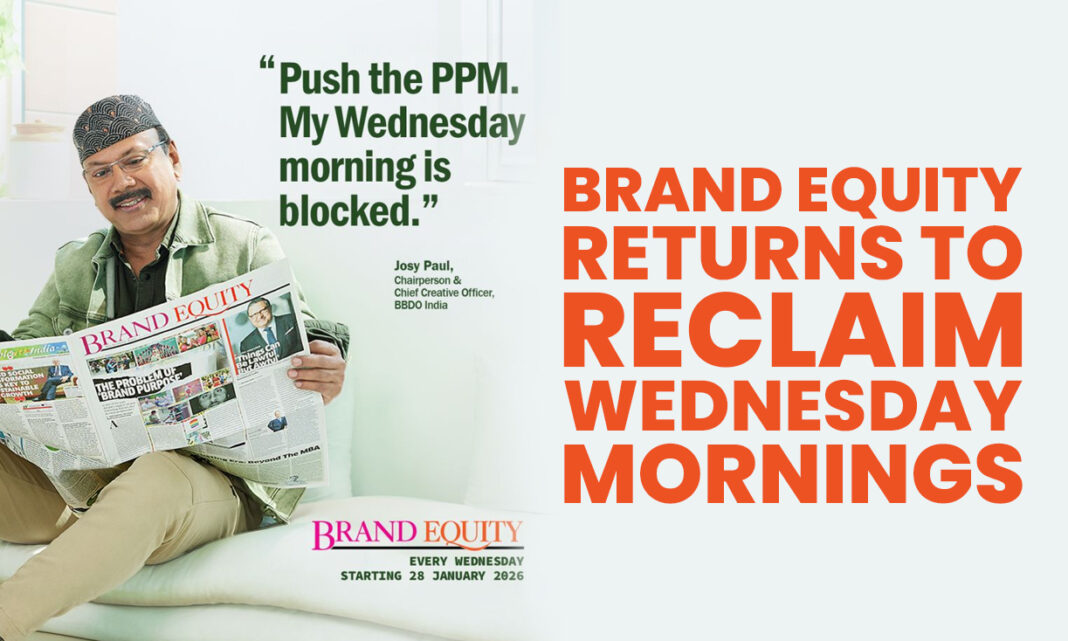
Brand Equity is set to return on 28 January with The Economic Times in a refreshed, sharper avatar curated by Sonali Krishna. Promising bold opinions, compelling stories and deeper marketing insights, the comeback has already energised the advertising fraternity — and declared that Wednesday mornings now belong to Brand Equity.
When Paul Josy blocks his Wednesday morning, it is rarely by accident. In a world where marketing calendars churn at breakneck speed and news cycles reset before the coffee cools, such a dedicated pause sends a signal: something worth paying attention to is about to return. And this time, that “something” is Brand Equity — coming back in a fresh new avatar, armed with sharper insights, bolder opinions, and stories shaped by the voices that define the business of brands in India.
For years, Brand Equity was more than a weekly section in The Economic Times; it was a ritual for marketers, media planners, agency leaders, CMOs, students of the craft, and anyone navigating the unpredictable geometry of brand-building. It decoded trends before they hardened into buzzwords. It contextualised campaigns before they became case studies. It treated marketing not as a sideshow to business, but as a strategic discipline that shapes consumer behaviour, corporate value, and cultural expression. When it went on pause, the silence was not merely editorial — it was emotional.
That makes its comeback significant. Scheduled for every Wednesday with The Economic Times starting 28 January, the revived Brand Equity arrives not as a nostalgic reprise but as a reboot for an industry in flux. Budgets are being interrogated, channels are multiplying, attention spans are splintering, measurement is under scrutiny, and the line between creativity and commerce is thinner than ever. The return is timed to meet a moment when marketers need perspective, not just data; clarity, not just dashboards.
Driving the relaunch is the ever-fabulous Sonali Krishna, who is curating a refreshed Brand Equity designed to decode the evolving reality of marketing. The positioning is deliberately contemporary: sharper insights, bolder opinions, compelling stories. In other words, less reporting from the sidelines and more reportage that cuts through the noise and clutter that now defines the marketing discourse. The ambition is not just to chronicle the industry, but to challenge it — to engage with its contradictions, call out its blind spots, and showcase its breakthroughs.
The early reaction to Brand Equity’s return has been telling. At merely the mention of the idea, the advertising and marketing community responded with enthusiasm that bordered on celebratory. CMOs, agency heads, strategists, content leads, media buyers, founders, and brand custodians — a group famously difficult to please — have offered vocal support for the reboot. Many of them have lent their faces, time, and mindspace to the campaign, while many more have been unofficial cheerleaders, urging the platform to return stronger, faster, and sharper. Such goodwill does not materialise out of thin air; it is earned over years of credibility, critique, and curiosity.
The campaign itself plays cleverly on habit formation — a marketer’s favourite lever. The idea is simple: clear your Wednesday morning. If you already have something scheduled, cancel it. Your Wednesday mornings are now spoken for. A weekly appointment with Brand Equity is framed not as a passive read but as an active ritual, a moment of pause, reflection, and recalibration in an industry that rarely affords such luxury. It is a wink to the calendar discipline that C-suite executives swear by and a nod to the idea that good marketing is not born out of chaos but out of clarity.
There is also a subtle strategic lesson buried in this comeback story. While media narratives today are dominated by daily feeds, infinite scroll, real-time trends, and “always on” publishing, Brand Equity is leaning into the weekly cadence—slower by comparison, but richer by design. A weekly format allows for digestion, not just distribution. It gives space for opinion, not just information. It encourages deeper thinking, not just faster reactions. In choosing the form, the platform is making a statement: for all the technological acceleration around us, the marketing industry still needs room to think.
The timing is serendipitous. The marketing landscape is being redefined by a triad of forces: consumer shifts, tech disruption, and economic uncertainty. AI is rewriting workflows from media buying to creative development. The battle for attention has gone cross-platform, stretching marketing budgets across screens, surfaces, influencers, ecosystems, and retail environments. Meanwhile, brand loyalty is under threat from a generation of consumers who are less impressed by legacy and more compelled by value, authenticity, and cultural alignment. These shifts demand a nuanced understanding, and they demand a platform willing to interrogate them instead of merely reporting them.
Brand Equity’s return also gestures toward community — a word that has become fashionable in marketing circles but carries weight here. The advertising and marketing fraternity in India has always been tightly networked yet intellectually independent, capable of fierce competition during pitches and equally fierce camaraderie over critique. By reviving a shared forum, the reboot restores a common language for debate, inspiration, and professional self-reflection. It is no coincidence that some of the platform’s earliest champions are the same leaders shaping the industry’s current trajectory.
And yet, amid the buzz, the comeback is not framed as triumphalist. It arrives with humility and a tip of the hat to the ecosystem that enabled it. There is gratitude to those who showed up for the idea, those who lent their voices to the campaign, and those who continue to champion platforms that treat marketing as a discipline that deserves depth. It takes a certain self-awareness to acknowledge that a publication’s value is not merely in its editorial judgment but in the community that reads it, engages with it, and debates it.
For the broader media landscape, the revival carries another implication: specialised journalism in India is regaining momentum at a time when fragmentation seemed irreversible. Niche beats — whether in marketing, technology, policy, or culture — matter because they produce knowledge rather than noise. They build archives, shape discourse, and cultivate expertise. In bringing Brand Equity back, The Economic Times is making a bet on the enduring value of expertise in a world drowning in commentary.
As the first issue approaches its January 28 release, curiosity is high about what form the editorial voice will take. Will it be more analytical? More provocative? More culturally attuned? Early signals suggest a blend — a platform willing to critique with generosity, explain with rigour, and storytell with flair. If the marketing industry’s response is any indication, appetite for that combination is strong. After all, good marketing thrives on insight, but great marketing thrives on perspective.
Which brings us back to Paul Josy’s blocked Wednesday morning. His decision is not merely about a publication returning to print; it is about reinstating a ritual that helps professionals make sense of their own industry. And that, ultimately, is what Brand Equity is promising. If you have something planned for Wednesday morning, the advisory stands: cancel it. Brand Equity is back. Starting 28 January, your Wednesday mornings are spoken for.
Discover more from Creative Brands
Subscribe to get the latest posts sent to your email.