


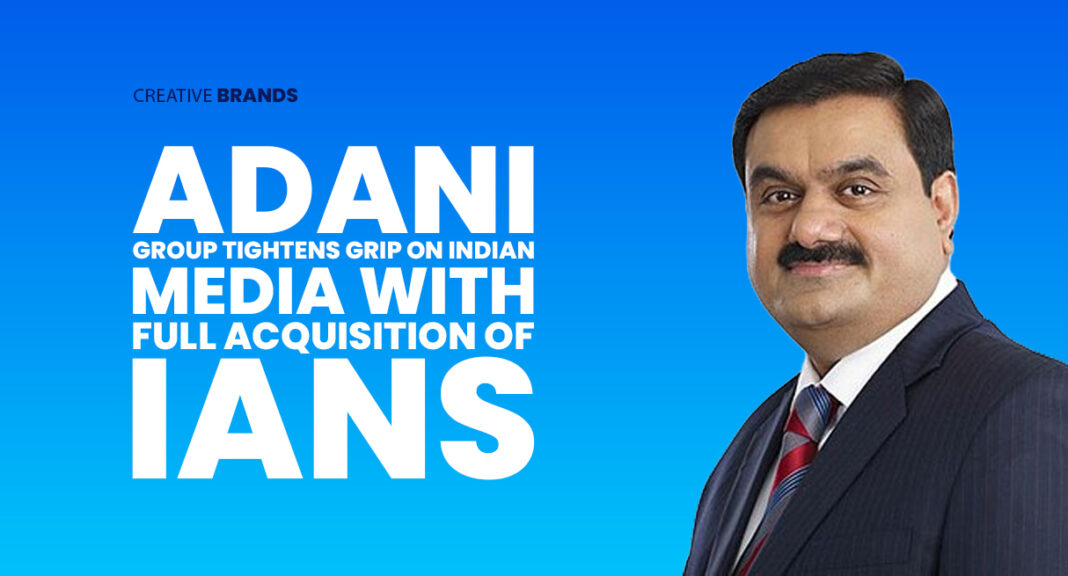
The Adani Group has taken complete ownership of Indo-Asian News Service (IANS) through AMG Media Networks, cementing its growing influence in India’s media sector. With NDTV and Quint Digital already under its umbrella, the conglomerate’s move highlights intensifying consolidation as corporate giants expand control over news distribution and digital reach.
In a move that underscores the accelerating consolidation of India’s media industry, the Adani Group has assumed full ownership of Indo-Asian News Service (IANS), one of the country’s oldest and most widely syndicated news agencies. The acquisition, executed through its media arm AMG Media Networks, marks a decisive escalation in the conglomerate’s ambitions to dominate the nation’s information ecosystem. By moving from majority shareholder to complete owner, Adani has secured not only the editorial reins but also the operational command of a news agency that has long been a staple provider of content to newspapers, television channels, and digital platforms across India and abroad.
The deal represents more than just a corporate transaction. It signals the growing appetite of India’s largest business houses to extend their influence beyond traditional sectors like infrastructure, energy, and logistics into the realm of information dissemination. For Adani, whose media portfolio already includes NDTV and a significant stake in Quint Digital, the acquisition of IANS provides a strategic advantage in content syndication, enabling the group to feed a steady stream of news across multiple platforms while shaping narratives in an increasingly competitive and politically sensitive environment.
Founded in 1986, IANS has built a reputation as a reliable wire service, supplying news in English and Hindi to a wide range of clients. Its coverage spans politics, business, entertainment, lifestyle, and international affairs, making it a versatile source for media outlets that lack the resources to maintain extensive reporting networks. By taking full control, Adani gains access to this distribution infrastructure, which can be leveraged to amplify the reach of its existing media properties and ensure a consistent flow of content aligned with its strategic vision. In an era where digital consumption is surging, the ability to syndicate across platforms is a powerful tool, and Adani’s move reflects a keen understanding of this dynamic.
The acquisition also raises questions about the future of editorial independence in India’s media landscape. Corporate ownership of news outlets is not new, but the pace and scale of consolidation in recent years have heightened concerns about diversity of voices and the robustness of democratic discourse. Adani’s growing media empire, now spanning television, digital, and wire services, places significant influence in the hands of a single corporate entity. Critics argue that such concentration risks narrowing the spectrum of perspectives available to the public, particularly in a country where media plays a pivotal role in shaping political and social narratives. Supporters, however, contend that corporate investment brings much-needed financial stability to struggling media houses, enabling them to modernize and compete in a rapidly evolving digital environment.
From a business standpoint, the acquisition of IANS complements Adani’s broader strategy of vertical integration. Just as the group has sought to control supply chains in sectors like ports, energy, and logistics, its media investments reflect a desire to own the pipelines of information. By consolidating NDTV’s broadcast reach, Quint Digital’s online presence, and IANS’s syndication network, Adani is building a multi-pronged media apparatus capable of influencing audiences across demographics and geographies. This holistic approach positions the conglomerate to compete not only with traditional rivals in the Indian media space but also with emerging digital-first platforms that are reshaping how news is consumed.
The timing of the acquisition is also significant. India’s media industry is undergoing a profound transformation, driven by the rise of smartphones, social media, and streaming platforms. Traditional print circulation is declining, television viewership is fragmenting, and digital platforms are becoming the primary source of news for younger audiences. In this context, owning a wire service like IANS offers strategic flexibility. It allows Adani to feed content into both legacy outlets and new-age digital platforms, ensuring relevance across the spectrum. Moreover, as global players eye India’s vast market, domestic conglomerates are keen to consolidate their positions before international competition intensifies.
For IANS itself, the acquisition could mean greater financial backing and technological investment. Wire services worldwide have struggled to adapt to the digital age, with declining subscriptions and increasing competition from real-time social media feeds. Under Adani’s ownership, IANS may gain the resources to modernize its operations, expand its digital footprint, and experiment with new formats such as multimedia storytelling and data-driven journalism. Whether this transformation will preserve the agency’s editorial ethos or reshape it to align with corporate priorities remains to be seen.
The broader implications of the acquisition extend to India’s democratic fabric. Media ownership has always been intertwined with questions of influence and accountability. As conglomerates like Adani expand their control, the challenge lies in ensuring that journalistic integrity is not compromised by corporate or political interests. Regulatory frameworks in India have traditionally been limited in addressing media concentration, and the rapid pace of acquisitions has outstripped the ability of watchdogs to respond effectively. This raises the prospect of a media landscape where a handful of powerful players wield disproportionate influence over public discourse.
At the same time, the acquisition reflects global trends. Around the world, media consolidation has become a defining feature of the industry, with tech giants, hedge funds, and conglomerates acquiring traditional outlets to secure content pipelines and advertising revenues. In India, where the advertising market is expanding and digital penetration is deepening, the stakes are particularly high. Adani’s move to acquire IANS is thus part of a broader narrative of media becoming a strategic asset, not just a business venture. Control over information flows is increasingly seen as essential to shaping consumer behavior, political outcomes, and societal debates.
For audiences, the impact of such consolidation may be subtle but profound. The stories they read, the headlines they encounter, and the narratives that dominate public discourse are all influenced by the ownership structures behind media outlets. As Adani integrates IANS into its portfolio, the challenge will be to balance commercial imperatives with the responsibility of providing diverse, accurate, and independent journalism. The credibility of IANS, built over decades, will be tested in this new era of corporate ownership.
In the coming months, industry observers will watch closely how Adani leverages its new acquisition. Will IANS continue to operate as a neutral wire service, or will its content increasingly reflect the priorities of its parent company? Will the agency expand its digital offerings to compete with global players, or will it focus on reinforcing its traditional syndication model? These questions will shape not only the future of IANS but also the trajectory of India’s media industry as a whole.
Ultimately, the acquisition of IANS by the Adani Group is emblematic of a larger shift in India’s media landscape. It reflects the growing recognition of news as a strategic resource, the intensifying competition for audience attention, and the blurring lines between business interests and journalistic endeavors. As corporate giants consolidate their control, the challenge for India’s democracy will be to ensure that the media remains a space for diverse voices, critical inquiry, and independent thought. For Adani, the acquisition is a bold step toward building a media empire. For India, it is a reminder of the delicate balance between commerce and conscience in the world of news.
Discover more from Creative Brands
Subscribe to get the latest posts sent to your email.