


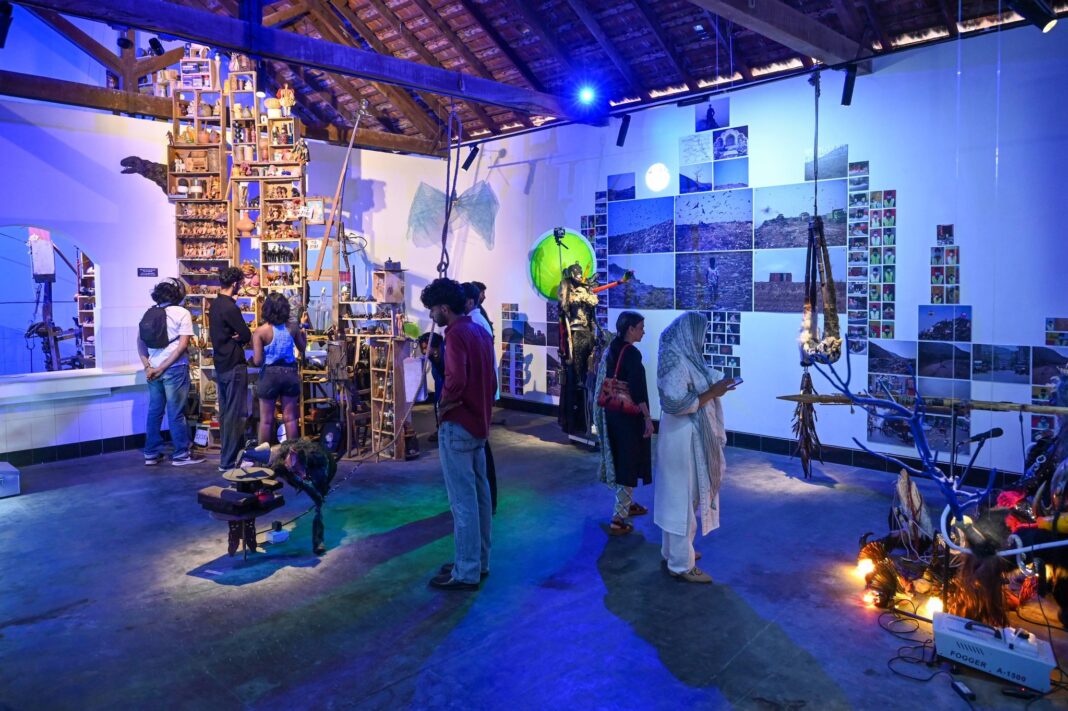
Delhi-based artist Niroj Satpathy transforms landfills into living archives through his multimedia installation Dhalan (2025). Drawing on his experience in municipal waste management, Satpathy reimagines discarded matter as sculptures, collages, and kinetic assemblages, interrogating late-capitalist hierarchies, ecological collapse, and the precarious entanglements of humans and more-than-humans in toxic terrains.
In the sprawling urban fabric of Delhi, where the city’s landfills rise like mountains of neglect, artist Niroj Satpathy has found both his subject and his medium. His latest installation, Dhalan (2025), is not merely an exhibition but an excavation of meaning from the detritus of modern life. For Satpathy, waste is not an end point but a beginning—a repository of stories, systems, and suppressed truths. His practice, rooted in the acts of collecting, segregating, and assembling discarded objects, positions landfills as crucial databases and habitats, eclipsed by the bureaucratic glare that usually renders them invisible.
Satpathy’s relationship with waste is not abstract. For five years, he worked as a night supervisor with the Solid Waste Management Department at the Municipal Corporation of Delhi. That experience, steeped in the rhythms of disposal and the hierarchies of labour, informs his art with a rare authenticity. He witnessed first-hand the management processes that govern the city’s waste, and in his installations, he extends those processes into a realm of critique and imagination. Organic and inorganic matter gleaned from dumps and nearby markets are reconstituted as sculptures, collages, archives, and drawings. Each object carries insights into the brutal dynamics of late capitalism, where care for shared environments collapses and humans, alongside more-than-humans, are thrust into precarious relationships with toxicity.
In Dhalan, Satpathy evokes the restlessness of landfills, endowing refuse and its marginalised inhabitants with agency. The installation is enveloped in an eerie glow, its kinetic sculptures, videos, and informational repositories integrating the poetic and conceptual potential of assemblages. Here, objects are not inert but active participants in rethinking the relationship between economic progress and the cultural-political connotations of value and valuelessness. Rising like spectres from the embers of waste, mutants and mythical creatures personify different sites and subjectivities, exuding an abyssal expressiveness that unsettles viewers.
Among these figures is a demonic presence, composed of taxidermic, skull-like remains, holding a tablet that plays videos. It resembles a politician delivering an address, striking a spear-turned-microphone at onlookers. The figure is a chilling reminder of how hate speech and vitriol gain political currency, weaponising rhetoric in ways that mirror the violence embedded in waste economies. Nearby, a feminine, branched figure entangled in wires symbolises the last tree on Earth. She safeguards seeds stolen from capitalist, toxic terrains, prompting reflection on the dispossession of agricultural lands as corporate players tighten their grip.
The installation’s sensorial and machinic cacophony is supplemented by photographs on walls, infographic corners, and an irregularly gridded column rising to the ceiling. These elements invoke the on-ground realities of unregulated dumping, exhausted capacity, and the sprawling consequences of unchecked consumption. Brimming with diverse objects collected over years—from American Barbie dolls to miscellaneous Chinese electronics—the artefacts compress time, encoding global production and distribution networks that shape consumerism. Satpathy’s landfill is not local but global, a nexus where the flows of capital and culture converge in discarded form.
A miniature model of the SMS Hall, the former gathering space where Dhalan is sited, houses official documents and discreet experiential records. These records evidence the conglomerations shaping landfill processes, while fragments of covered-up violence and illegal dealings lurk in the heap’s folds. Assembled forms and fragmented objects bear witness to histories that bureaucracies prefer to conceal. In this way, Satpathy’s installation becomes an archive of suppressed narratives, a counter-database that resists erasure.
The mutants and mythical creatures that populate Dhalan are not fantastical diversions but allegorical embodiments of systemic realities. They rise from the landfill’s embers to confront viewers with the abyssal expressiveness of waste. The demonic politician figure, with its grotesque mimicry of authority, underscores the toxic entanglement of politics and dispossession. The feminine tree figure, entangled yet resilient, embodies ecological resistance in the face of capitalist extraction. Together, they stage a theatre of waste where meaning, matter, site, and gaze are unsettled.
Satpathy’s work is deeply sensorial, enveloping audiences in machinic cacophony and visual overload. Yet beneath the spectacle lies a rigorous interrogation of hyper-materialism and extractive labour conditions. Waste, in his hands, becomes a tool to examine the repercussions of a society caught in the stupor of capital. The installation awakens viewers to ambient hazards—the slow violence of toxicity, the collapse of care, and the precarious entanglements that define our shared environs.
What distinguishes Satpathy’s practice is its refusal to romanticise waste. Instead, he confronts its brutal hierarchies and systemic neglect. His assemblages are not nostalgic but critical, compressing time and space to reveal the global networks of production and distribution that culminate in consumer detritus. The Barbie dolls and Chinese electronics are not curiosities but evidence—artefacts that encode the flows of capital and the dispossession they entail.
In Dhalan, the landfill is not a passive backdrop but an active protagonist. It is restless, spectral, and expressive, demanding recognition as a site of agency. Satpathy’s installation insists that waste is not valueless but laden with meaning, capable of unsettling the categories through which we understand progress and decline. By positioning landfills as databases and habitats, he challenges viewers to rethink their relationship with objects, environments, and the hierarchies that govern them.
The installation’s power lies in its ability to compress multiple registers—poetic, political, ecological, and economic—into a single immersive experience. It is at once a critique of bureaucratic apparatuses, a meditation on ecological collapse, and a reconstitution of waste as archive. Satpathy’s practice, informed by his years in municipal waste management, bridges the worlds of labour and art, bureaucracy and imagination. His works are not detached commentaries but lived engagements with the systems they critique.
As Delhi grapples with the mounting crisis of waste, Dhalan offers a lens through which to confront its realities. It is not a solution but a provocation, unsettling viewers into recognition of the ambient hazards that define late-capitalist existence. In the spectral figures, the cacophony of machines, and the archives of suppressed violence, Satpathy stages a confrontation with the collapse of care. His installation insists that waste is not peripheral but central, a mirror held up to society’s toxic entanglements.
In the end, Dhalan is less about the landfill itself than about what it reveals: the hierarchies of labour, the flows of capital, the dispossession of land, and the collapse of ecological care. Satpathy’s art transforms refuse into revelation, demanding that we see in waste not only what is discarded but what is concealed. His installation is a call to reckon with the abyssal expressiveness of waste, to confront the toxic terrains we inhabit, and to imagine, however precariously, the possibility of care amidst collapse.
Discover more from Creative Brands
Subscribe to get the latest posts sent to your email.