


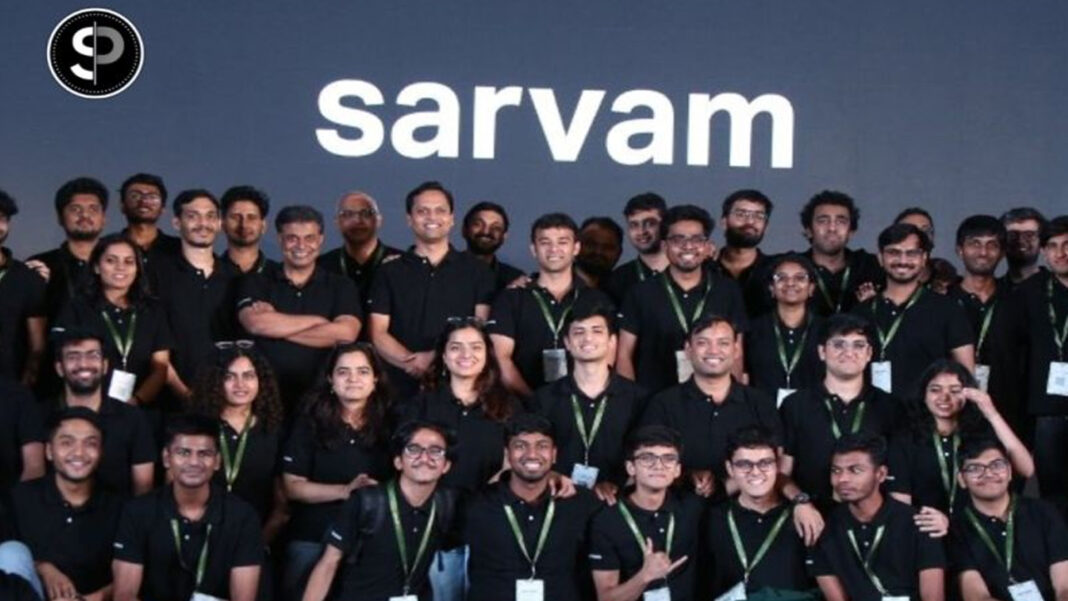
Bengaluru-based startup Sarvam AI has launched two large language models—a 30-billion-parameter system and a 105-billion-parameter system—at the India AI Impact Summit in Delhi. Built from scratch with mixture-of-experts architecture, the models mark a major stride in India’s pursuit of sovereign AI capabilities, promising efficiency and advanced reasoning.
At the India AI Impact Summit in Delhi, Bengaluru-based startup Sarvam AI announced the release of two new large language models, a 30-billion-parameter system and a 105-billion-parameter system, in what is being hailed as a defining moment in India’s quest for sovereign AI capabilities. The unveiling, led by cofounder Pratyush Kumar, underscored the company’s ambition to position India as a serious contender in the global race for advanced artificial intelligence infrastructure.
Kumar emphasised that both models were trained entirely from scratch, a feat that signals not only technical prowess but also independence from foreign datasets and frameworks. The models employ a mixture-of-experts (MoE) architecture, a design that allows for greater efficiency by activating only a fraction of the parameters at any given time. This approach, Kumar explained, enables the systems to deliver strong reasoning, programming, and tool-use capabilities without incurring prohibitive computational costs.
The first of the two models, branded as Sarvam 30B, is built with 30 billion parameters but activates only 1 billion per token. This selective activation dramatically reduces inference costs, making the model more efficient in handling reasoning-heavy workloads. Sarvam 30B supports a 32,000-token context window, allowing it to process and retain vast amounts of information in a single sequence. It was trained on an impressive 16 trillion tokens, a scale that reflects the company’s commitment to building robust, versatile systems capable of addressing diverse tasks.
The second model, a 105-billion-parameter MoE system, represents an even more ambitious leap. It activates 9 billion parameters per token and supports a 128,000-token context window, a capacity that dwarfs many existing models globally. This extended context window is particularly significant for applications requiring long-form reasoning, complex programming tasks, or sustained dialogue, where retaining coherence across large volumes of text is critical.
The announcement comes at a time when India is intensifying its focus on sovereign AI capabilities. With global debates around data privacy, technological dependence, and geopolitical competition shaping the AI landscape, India’s move to develop homegrown models reflects both strategic foresight and national ambition. Sovereign AI, in this context, is not merely about technological independence but also about ensuring that the country’s digital future is shaped by its own priorities, values, and economic imperatives.
Sarvam AI’s unveiling is likely to resonate strongly across India’s technology ecosystem, where startups, research institutions, and government bodies have been increasingly vocal about the need to reduce reliance on foreign AI systems. The models’ scale and sophistication suggest that India is ready to stake a claim in the global AI conversation, moving beyond being a consumer of imported technologies to becoming a producer of cutting-edge systems.
For Kumar and his team, the emphasis on efficiency is as important as scale. By adopting the MoE architecture, Sarvam AI has sought to balance the demands of high-parameter models with the practical constraints of computational resources. Inference costs have long been a barrier to widespread adoption of large language models, particularly in regions where access to high-end hardware is limited. Sarvam 30B’s ability to activate only 1 billion parameters per token, despite its overall size, could make it more accessible to enterprises and institutions seeking advanced AI capabilities without prohibitive expenses.
The 105B model, meanwhile, signals Sarvam AI’s readiness to compete with some of the largest models globally. Its 128,000-token context window is among the most expansive in the industry, enabling it to handle tasks that require deep contextual understanding over extended sequences. This feature could prove invaluable in domains such as legal analysis, scientific research, and complex programming, where the ability to process and retain large volumes of interconnected information is essential.
Industry observers note that Sarvam AI’s announcement is not just about technical specifications but also about symbolism. By training the models from scratch, the company has demonstrated that India can build foundational AI systems independently, without leaning on pre-trained models developed elsewhere. This independence is crucial in the broader narrative of sovereign AI, where control over datasets, architectures, and deployment strategies is seen as a matter of national importance.
The India AI Impact Summit provided an apt stage for the unveiling, bringing together policymakers, technologists, and entrepreneurs to discuss the country’s AI trajectory. Sarvam AI’s announcement added weight to the discourse, offering tangible proof of progress in an area often dominated by global giants. For India, the emergence of such models could catalyse further investment in AI research and infrastructure, encouraging other startups and institutions to pursue ambitious projects.
While the models’ real-world applications will take time to unfold, the potential is vast. From enhancing enterprise productivity to supporting government initiatives in education, healthcare, and governance, large language models like Sarvam 30B and the 105B system could play a transformative role. Their efficiency-focused design also raises the possibility of broader adoption across sectors that might otherwise be deterred by high computational costs.
Kumar’s emphasis on reasoning, programming, and tool-use capabilities reflects a recognition of the practical needs of users. In a landscape where AI is often criticised for producing fluent but shallow outputs, Sarvam AI’s focus on depth and utility could set its models apart. The ability to handle complex reasoning tasks, generate reliable code, and integrate with tools positions the models as more than just conversational systems—they are engines for problem-solving and innovation.
The announcement also aligns with India’s broader digital ambitions, including initiatives such as Digital India and the push for indigenous technology development. As the country seeks to harness AI for economic growth and social impact, the availability of homegrown large language models could provide a crucial foundation. Sovereign AI, in this sense, is not only about independence but also about shaping technologies that reflect India’s unique challenges and opportunities.
Sarvam AI’s journey is still unfolding, and the models will undoubtedly face scrutiny and testing in the months ahead. Questions around scalability, deployment, and integration will need to be addressed, as will the broader challenge of ensuring ethical and responsible use. Yet, the unveiling of Sarvam 30B and the 105B system marks a milestone that cannot be overlooked. It signals that India is ready to move from aspiration to action in the realm of advanced AI.
For the global AI community, the announcement serves as a reminder that innovation is no longer confined to a handful of countries or corporations. As startups like Sarvam AI demonstrate, the future of AI will be shaped by diverse voices and perspectives, each bringing unique priorities and strengths to the table. In this evolving landscape, India’s contribution is poised to grow, driven by ambition, ingenuity, and a determination to chart its own course.
In Delhi, as the summit drew to a close, the unveiling of Sarvam AI’s models left a clear impression: India’s AI story is entering a new chapter, one defined by scale, efficiency, and sovereignty. For Kumar and his team, the journey ahead will be challenging, but the foundation has been laid. With Sarvam 30B and the 105B system, India has signalled that it is ready to build, innovate, and lead in the age of artificial intelligence.
Discover more from Creative Brands
Subscribe to get the latest posts sent to your email.