



Since 1960, Fabindia has been India’s largest platform connecting artisans with consumers through handcrafted, environmentally sensitive products. By blending traditional craft with modern design, Fabindia sustains rural livelihoods while celebrating India’s cultural heritage. Its diverse offerings span clothing, home décor, and wellness, embodying a mission of sustainable, inclusive growth.
In the story of modern India’s retail landscape, few names resonate with as much cultural depth and social impact as Fabindia. Founded in 1960 by John Bissell, an American who came to India to work on rural development projects, Fabindia began as a modest export house. Its mission was simple yet profound: to bring India’s rich craft traditions to global markets while ensuring artisans and craftspersons could sustain their livelihoods. Over six decades later, Fabindia has grown into India’s largest private platform for products made by artisans, with more than 55,000 craft-based producers across the country contributing to its collections.
At its core, Fabindia is more than a retail brand—it is a movement that bridges India’s heritage with contemporary lifestyles. The company’s philosophy rests on three pillars: authenticity, sustainability, and inclusivity. Every product sold under the Fabindia label carries with it the story of rural artisans, their communities, and the centuries-old traditions they uphold. When a customer buys a Fabindia kurta, a handwoven rug, or a piece of pottery, they are not merely purchasing an item of clothing or décor; they are investing in the preservation of India’s cultural identity and supporting sustainable rural livelihoods.
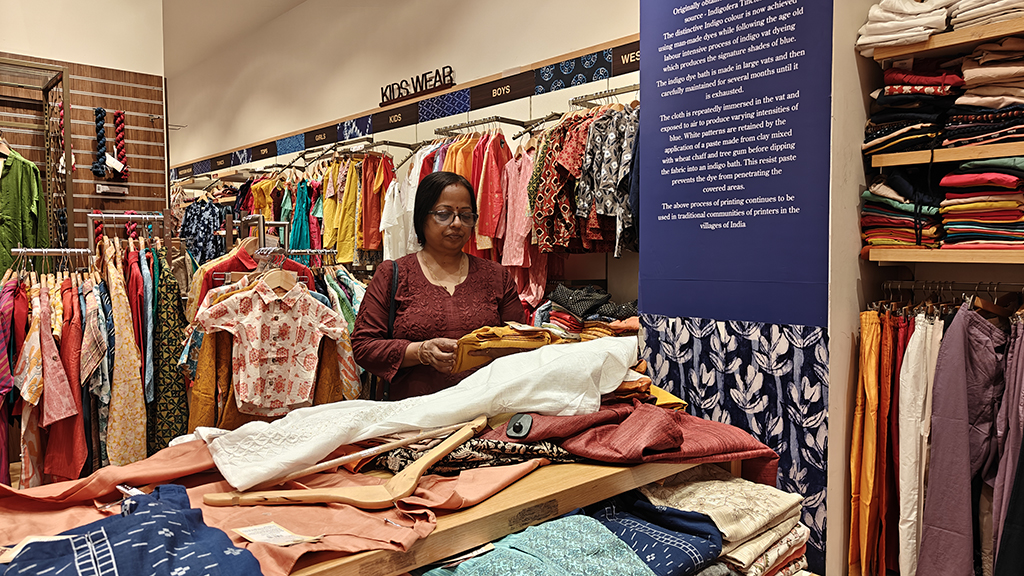
Fabindia’s product range is vast and diverse, reflecting the breadth of India’s craft traditions. Its clothing line is perhaps the most recognisable, offering elegant kurtas, sarees, tunics, and jackets for women, alongside men’s kurtas, shirts, and Nehru jackets. The brand has also expanded into children’s wear, ensuring that the ethos of handcrafted clothing is passed on to younger generations. Beyond apparel, Fabindia’s home and lifestyle collections include handwoven textiles, furniture, lighting, and kitchenware, each piece designed to blend traditional craftsmanship with modern utility. The company’s wellness line, featuring organic foods, skincare, and personal care products, further reinforces its commitment to environmentally sensitive living.
What sets Fabindia apart is its unique business model. Unlike many retail giants that rely on mass production, Fabindia’s supply chain is deeply rooted in rural India. The company collaborates directly with artisans, weavers, and craftspersons, providing them with design inputs, training, and access to markets. This partnership ensures that traditional skills are not lost to mechanisation and that artisans receive fair compensation for their work. Over the years, Fabindia has created a network of community-owned companies, where artisans hold equity, thereby sharing in the brand’s success. This model has been hailed as a pioneering example of inclusive capitalism.
Environmental sensitivity is another cornerstone of Fabindia’s philosophy. The brand emphasises natural fibres, organic materials, and eco-friendly production processes. Cotton, silk, wool, and jute form the backbone of its textile offerings, while dyes and finishes are often derived from natural sources. In an era where fast fashion dominates, Fabindia’s commitment to slow, sustainable fashion stands out as both ethical and forward-looking.
The cultural resonance of Fabindia lies in its ability to make traditional crafts relevant to contemporary consumers. Its stores, spread across India and abroad, are curated spaces that celebrate India’s diversity. Walking into a Fabindia outlet is akin to stepping into a living museum of Indian craftsmanship, where each product narrates a story of heritage and innovation. The brand’s tagline, “Celebrate India,” encapsulates this ethos, inviting consumers to embrace the richness of India’s culture in their everyday lives.
Fabindia’s impact extends beyond commerce. By sustaining rural livelihoods, the company has played a significant role in reducing migration from villages to cities. Artisans who might otherwise abandon their crafts for low-paying urban jobs find dignity and stability in continuing their traditions. This has ripple effects on rural economies, strengthening communities and preserving cultural practices.
Over the years, Fabindia has also adapted to changing consumer preferences. While its foundation remains rooted in craft, the brand has embraced contemporary design sensibilities, ensuring its products appeal to urban, global audiences. Collaborations with designers, innovations in cuts and silhouettes, and the introduction of fusion wear have kept Fabindia relevant across generations. Its digital presence, through an e-commerce platform, has further expanded its reach, making handcrafted products accessible to consumers worldwide.
Yet, Fabindia’s journey has not been without challenges. Balancing tradition with modernity, scaling up while remaining true to its ethos, and competing in a market dominated by fast fashion and global brands have tested its resilience. However, the company’s unwavering commitment to artisans and sustainability has enabled it to carve a niche that is both commercially viable and socially impactful.
Today, Fabindia stands as a testament to the power of purpose-driven business. It demonstrates that profitability and social responsibility need not be mutually exclusive. By weaving together threads of heritage, sustainability, and inclusivity, Fabindia has created a fabric that is uniquely Indian yet universally appealing.
As India continues to evolve, Fabindia’s role in shaping consumer consciousness becomes even more significant. In a world grappling with climate change, cultural homogenisation, and economic inequality, Fabindia offers a model of how businesses can be agents of positive change. Each handcrafted product is a reminder that behind the beauty of design lies the labour of artisans, the wisdom of tradition, and the promise of sustainability.
For consumers, choosing Fabindia is not just about aesthetics—it is about making a statement. It is about celebrating India’s rich culture and heritage while contributing to a future where rural communities thrive, crafts endure, and sustainability is more than a buzzword. In the quiet elegance of a Fabindia kurta or the rustic charm of a handwoven rug lies a story of resilience, creativity, and hope. And that story continues to unfold, one artisan, one product, and one consumer at a time.
Discover more from Creative Brands
Subscribe to get the latest posts sent to your email.