


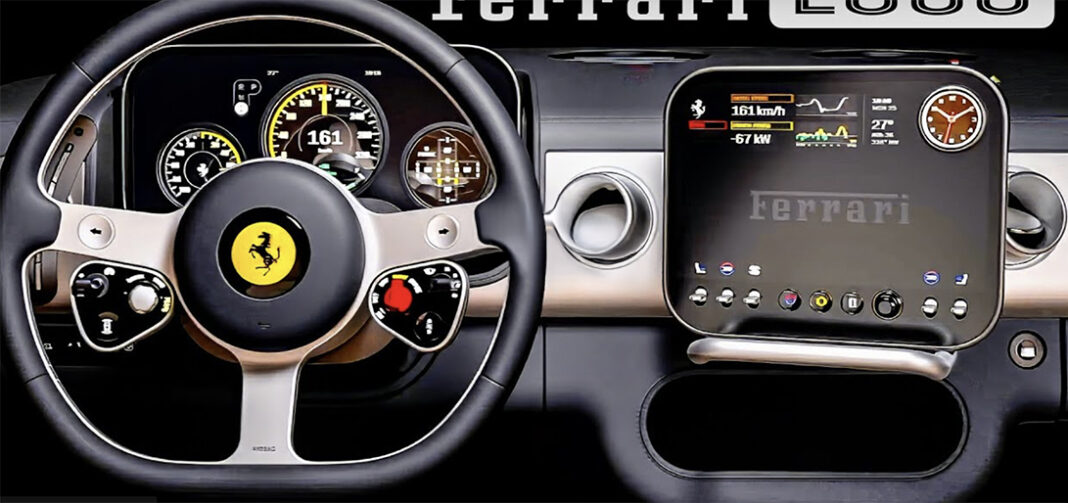
Ferrari’s upcoming electric vehicle, the Luce, is the result of a rare collaboration between Ferrari and LoveFrom, the design studio founded by Jony Ive and Marc Newson. Early access reveals a vehicle rich in tactile, human-centered design that reimagines the relationship between digital interfaces, materiality, and performance.
When Jony Ive left Apple in 2019, the design world speculated endlessly about what he would do next. His first major client turned out to be Apple itself. His second was far more surprising: Ferrari.
Years later, that quiet collaboration is beginning to surface in physical form. The Ferrari Luce — meaning “light” in Italian — will be the marque’s first fully electric vehicle. And while the world has yet to see its full interior or exterior, a recent visit to LoveFrom’s San Francisco studio offered a rare preview into the thinking, materials, and obsessively detailed components that define it.
Over two days of conversations with Ive, Marc Newson, Ferrari CEO Benedetto Vigna, Chief Design Officer Flavio Manzoni, and several members of LoveFrom, a clear picture emerged: the Luce is not just Ferrari’s first EV. It is a statement about how electric vehicles should feel.
Not how they should look. How they should feel.
It’s impossible to ignore the presence of the designers who shaped the golden age of Apple products. Precision CNC-machined anodized aluminum. Gorilla glass. Tolerances measured in microns. Surfaces that invite touch. But what’s remarkable is how those materials — so familiar in the context of laptops and phones — take on an entirely new life when translated into a high-performance automobile.
In the Luce, these materials are no longer about minimalism or sleekness for its own sake. They become instruments of tactility and feedback, deployed to solve a problem that has quietly plagued the EV category: the collapse of physical experience into flat screens.
Modern electric vehicles, most notably Tesla, have aggressively pursued screen-first interfaces that often sacrifice human factors for sci-fi aesthetics. LoveFrom and Ferrari have taken the opposite path. The Luce is filled with dozens of bespoke physical components, each designed from scratch, each with its own weight, resistance, travel, and sound.
There are more than a dozen unique buttons and switches inside the vehicle, all of them prototypes of a new philosophy. These are not generic automotive parts. They are objects of industrial design in their own right.
One of the most striking details is the key. Rather than a traditional fob or smartphone proxy, the Luce features an e-ink key — a quiet, almost poetic object that subtly changes as the car awakens. It doesn’t scream technology. It whispers it.
Then there is the binnacle, the instrument cluster ahead of the driver. Rather than a single screen, it is constructed from layers of lenses and displays, creating depth and dimensionality rarely seen in automotive interfaces. Information feels embedded rather than projected.
At the center of the cabin sits a tablet-like display, but this is not another slab of glass demanding constant attention. Surrounding it is a suite of what Ive describes as “eyes-free controls” — tactile elements that allow drivers to operate core functions without looking away from the road. The digital interface is supported, not replaced, by physicality.
This approach reflects a deep discomfort Ive and Newson share with the direction many EV interiors have taken. During the discussions, there was no shortage of criticism aimed at what Ive described as the “sci-fi human factors nightmare” of screen-dominated cabins. The Luce, by contrast, is a deliberate return to touch, to memory, to muscle learning.
Perhaps the most theatrical example of this thinking is the Luce’s Launch Mode. Instead of tapping a screen or pressing a button, the driver must pull on a pneumatic handle. Only then does the cabin glow orange before the car surges forward. It’s a ritual, a moment of drama, a reminder that performance can be emotional, not merely technical.
This theatricality is intentional. Ferrari understands performance as theatre. LoveFrom understands interaction as choreography. The Luce sits at the intersection of both.
What’s emerging from this collaboration is not simply a new car, but a new philosophy for EV design — one that resists the flattening effect of software-first thinking. In the Luce, digital flexibility coexists with analog richness. Technology is present, but it recedes behind sensation.
The obsession with detail is unmistakable. Each switch has a unique tactile signature. Each surface has been reconsidered. Even the choice of materials — anodized aluminum, glass, layered composites — is about longevity, wear, and the way objects age under human touch.
It’s also about lightness, true to the vehicle’s name. Not just physical lightness, but visual and cognitive lightness. Interfaces are designed to reduce mental load, not add to it.
For Ferrari, this collaboration signals something larger. The brand’s first EV could have been a technological statement. Instead, it has become a design statement about the future of driving itself.
And for Ive and Newson, the Luce represents a continuation of a lifelong pursuit: removing friction between humans and the objects they use, whether those objects sit on a desk or travel at high speed down a highway.
We still haven’t seen the full interior. We haven’t seen the exterior at all. The Luce won’t be revealed publicly until October. But from this early access to its components and the thinking behind them, it’s clear that this vehicle will challenge assumptions about what electric cars should be.
Not silent machines run by screens, but deeply tactile environments shaped around human senses.
In an industry racing toward autonomy, software, and abstraction, the Ferrari Luce makes an unexpected argument: the future of electric vehicles might lie not in more screens, but in more touch.
Discover more from Creative Brands
Subscribe to get the latest posts sent to your email.