


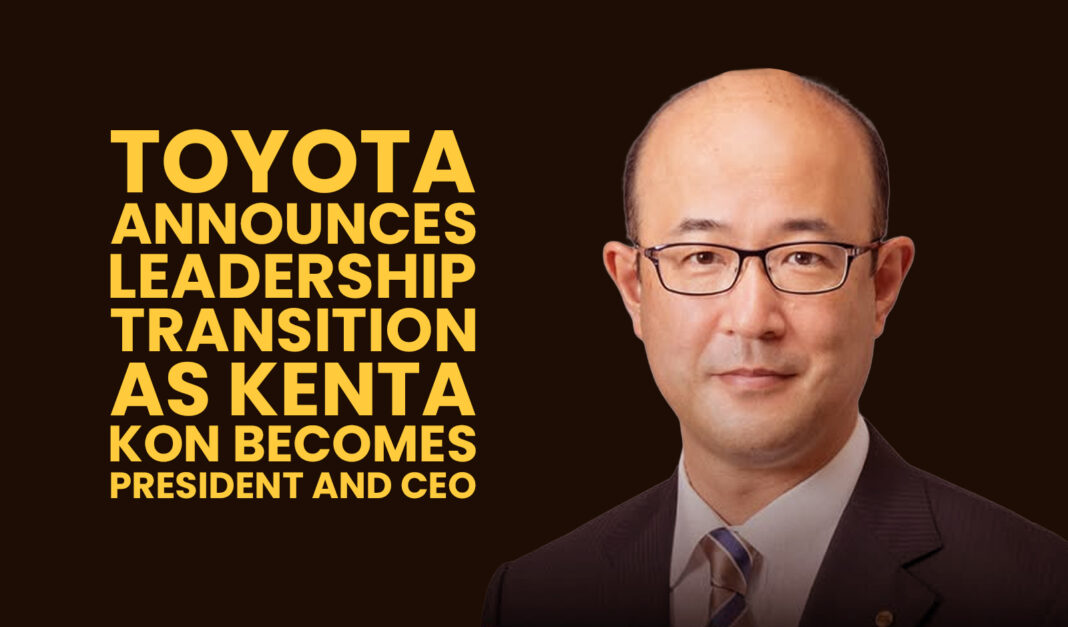
Toyota Motor Corporation has unveiled a major leadership reshuffle effective April 1. Kenta Kon, currently Operating Officer, will succeed Koji Sato as President and CEO. Sato will move into the newly created role of Vice Chairman and Chief Industry Officer, focusing on broader industry strategy while Kon steers internal management.
Toyota Motor Corporation, one of the world’s most influential automotive companies, has announced a significant change in its executive leadership structure, marking a new chapter in its long history of innovation and global expansion. Effective April 1, Kenta Kon, currently serving as Operating Officer, will assume the role of President and Chief Executive Officer. Koji Sato, who has been President and a Member of the Board of Directors, will transition to the newly established position of Vice Chairman and Chief Industry Officer (CIO).
This restructuring signals Toyota’s intent to sharpen its focus both internally and externally, with a dual leadership model designed to balance operational management and industry-wide engagement. Kon will oversee the company’s internal management as President and CEO, while Sato will concentrate on broader industry strategy, guiding Toyota’s role within the evolving global automotive landscape.
The announcement comes at a time when the automotive industry is undergoing profound transformation. With electrification, autonomous driving technologies, and sustainability imperatives reshaping the sector, Toyota’s leadership changes reflect a deliberate effort to position the company at the forefront of these shifts. By creating the CIO role, Toyota acknowledges the need for a dedicated executive to engage with industry-wide challenges and opportunities, ensuring the company remains agile and responsive to external dynamics.
Kenta Kon’s appointment as President and CEO represents a generational shift within Toyota’s leadership. Known for his operational expertise and deep understanding of Toyota’s internal systems, Kon is expected to bring a steady hand to the company’s management. His focus will be on strengthening Toyota’s internal processes, driving efficiency, and ensuring that the company’s vast global operations remain cohesive and resilient. For a corporation that employs hundreds of thousands worldwide and operates across diverse markets, this emphasis on internal management is critical.
Koji Sato’s move to Vice Chairman and CIO underscores Toyota’s recognition of his strategic vision and industry acumen. Sato has been instrumental in steering Toyota through recent challenges, including the acceleration of electrification and the company’s push into hydrogen fuel cell technology. In his new role, he will be tasked with engaging stakeholders across the automotive ecosystem, from regulators and industry partners to technology innovators. His remit will extend beyond Toyota itself, reflecting the company’s ambition to shape the future of mobility on a global scale.
The timing of this leadership transition is notable. Toyota has faced increasing competition from electric vehicle (EV) manufacturers, particularly Tesla and emerging Chinese automakers, while also navigating regulatory pressures in key markets such as Europe and North America. At the same time, Toyota has maintained its reputation for reliability and innovation, continuing to invest in hybrid technologies and exploring alternative fuels. The new leadership structure appears designed to ensure that Toyota can both defend its core strengths and adapt to new realities.
Industry analysts have observed that Toyota’s dual leadership model could serve as a blueprint for other global corporations grappling with similar challenges. By separating internal management from external industry engagement, Toyota aims to create clarity of focus at the highest levels of its leadership. Kon’s operational oversight will ensure that Toyota’s sprawling operations remain efficient and profitable, while Sato’s industry-facing role will allow Toyota to influence and adapt to broader trends without losing sight of its internal priorities.
The creation of the CIO role is particularly significant. Traditionally, automotive companies have relied on their CEOs to balance internal and external responsibilities. By formalising a position dedicated to industry engagement, Toyota is acknowledging the complexity of today’s automotive environment. Issues such as supply chain resilience, environmental regulation, and technological collaboration require sustained attention, and Sato’s appointment suggests Toyota intends to play a proactive role in shaping these debates.
For employees and stakeholders, the leadership transition offers both continuity and change. Kon’s rise from within Toyota’s ranks ensures that the company’s internal culture and values remain intact, while Sato’s new role signals a willingness to innovate at the structural level. Together, they represent a leadership team designed to balance tradition with transformation.
Toyota’s announcement also reflects its broader corporate philosophy, which has long emphasised adaptability and long-term vision. From its pioneering work in hybrid technology with the Prius to its current investments in hydrogen and autonomous driving, Toyota has consistently sought to anticipate industry shifts. The new leadership structure is another example of this forward-looking approach, positioning the company to navigate the uncertainties of the next decade.
As April 1 approaches, the automotive world will be watching closely to see how Toyota’s leadership transition unfolds. The company’s ability to balance internal management with external industry engagement will be critical in determining its success in an era defined by technological disruption and environmental urgency. For Toyota, the appointment of Kenta Kon as President and CEO, alongside Koji Sato’s new role as Vice Chairman and CIO, marks not just a change in personnel but a strategic reimagining of how leadership itself is structured.
In the coming years, Toyota’s dual leadership model may prove to be a defining innovation, shaping not only the company’s trajectory but also influencing how other global corporations approach the challenges of a rapidly changing world. For now, the message is clear: Toyota is preparing for the future with a leadership team designed to meet both the demands of today and the opportunities of tomorrow.
Discover more from Creative Brands
Subscribe to get the latest posts sent to your email.