


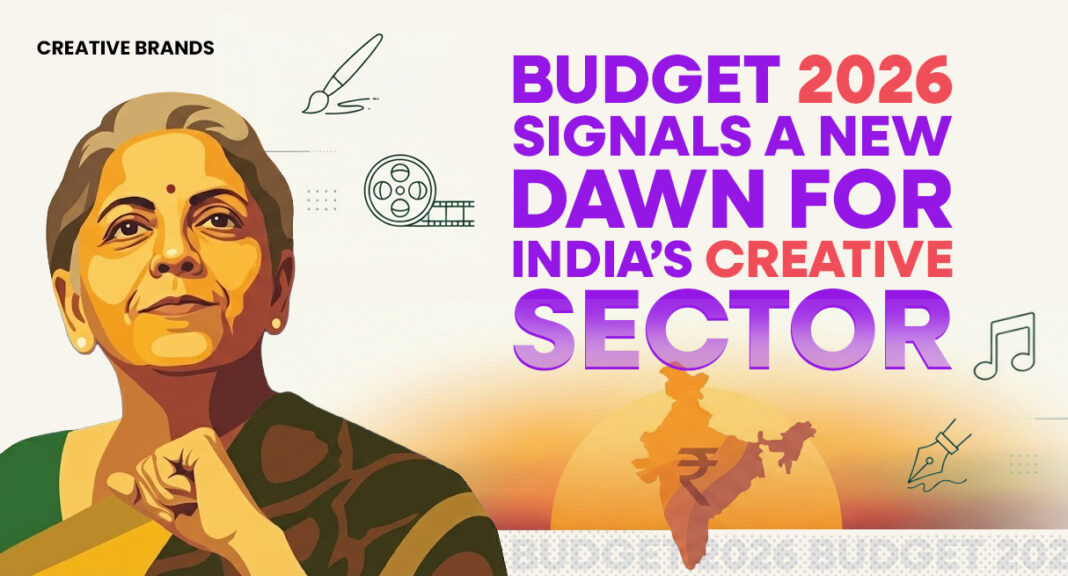
Finance Minister Nirmala Sitharaman’s latest Union Budget marks a turning point for India’s creative economy. By acknowledging the “Creative Sector” and proposing initiatives in design education, animation, gaming, and integrated university townships, the Budget positions creativity as vital economic infrastructure, linking education, enterprise, and innovation for future growth.
For years, India’s creative community has waited for its moment of recognition in the corridors of economic policymaking. That moment arrived today when Finance Minister Nirmala Sitharaman, in her Union Budget speech, finally uttered the words “Creative Sector.” It was a brief mention, but one loaded with significance. For designers, educators, and creative entrepreneurs, this acknowledgment signals a shift in how the nation perceives creativity—not as a peripheral pursuit, but as a core component of economic infrastructure.
The Budget’s proposals, though not explicitly framed around design, carry important implications for those working in creative education and practice. The emphasis on Animation, Visual Effects, Gaming, and Comics (AVGC) is particularly noteworthy. By proposing creator labs in schools and colleges, the government has recognized that creativity today is inseparable from technology, storytelling, and digital production. These labs, if implemented effectively, could nurture talent from an early age, equipping students with skills that are both imaginative and market-ready. In a world where digital entertainment and immersive experiences are rapidly expanding, India’s investment in AVGC education could position the country as a global hub for creative technology.
Design education thrives on proximity to real-world problems, live projects, and interdisciplinary collaboration. Traditional classrooms often struggle to replicate the dynamism of professional practice, leaving students with theoretical knowledge but limited exposure to practical challenges. The Budget’s proposal for integrated university townships linked with industry addresses this gap directly. Such ecosystems could enable meaningful interaction between design, technology, business, and enterprise, creating fertile ground for innovation. Imagine a township where design students collaborate with engineers, entrepreneurs, and social scientists on projects that tackle urban mobility, sustainable housing, or digital inclusion. The potential for cross-pollination of ideas is immense, and the outcomes could redefine how design education contributes to national development.
Equally significant is the Budget’s emphasis on connecting education with employment and enterprise. This resonates strongly with design pedagogy, which has always embraced fluidity across roles. Designers are not confined to studios; they move seamlessly between being professionals, entrepreneurs, and creators of intellectual property. By formally acknowledging this continuum, the government opens up space for more flexible, practice-led, and outcome-oriented education models. Students could be encouraged to develop startups, patent innovations, or create cultural products while still in the university system, blurring the lines between learning and enterprise.
The recognition of creativity as economic infrastructure is more than symbolic. It reflects a growing awareness that India’s future competitiveness will depend not only on manufacturing and services but also on its ability to generate ideas, narratives, and experiences. In global markets, design and creativity are increasingly seen as drivers of value. From user-friendly digital platforms to sustainable packaging, from immersive entertainment to cultural exports, creativity shapes consumer choices and business strategies. By embedding creative education into the national agenda, the Budget acknowledges that India must cultivate this capacity systematically.
Of course, the success of these proposals will depend on implementation. Creator labs in schools and colleges must be more than token installations; they need to be equipped with cutting-edge technology, staffed by trained mentors, and integrated into curricula meaningfully. University townships must avoid becoming isolated enclaves and instead foster genuine collaboration with industry and community. Policies linking education with enterprise must be designed to encourage risk-taking and innovation, not burden students with bureaucratic hurdles. The creative sector thrives on freedom, experimentation, and diversity—qualities that policy frameworks must enable rather than constrain.
The Budget also raises questions about inclusivity. Creativity is not the preserve of elite institutions; it flourishes in grassroots communities, informal networks, and regional cultures. For India’s creative economy to be truly transformative, policies must ensure access across geographies and socio-economic backgrounds. Rural schools, small-town colleges, and community organizations should also benefit from creator labs and industry-linked townships. The richness of India’s cultural diversity is its greatest creative asset, and nurturing it requires broad-based support.
Another dimension worth considering is the global context. Nations around the world are investing heavily in creative industries, recognizing their potential for job creation, cultural influence, and economic growth. South Korea’s investment in K-pop and digital entertainment has yielded global dividends. The UK has long positioned its design and creative industries as central to its economy. India’s recognition of the creative sector comes at a time when global demand for creative content and design solutions is booming. With its vast talent pool and cultural heritage, India has the opportunity to carve out a distinctive space in this global landscape.
For students and educators in design, the Budget offers both hope and responsibility. Hope, because the government has finally acknowledged their sector as vital to the economy. Responsibility, because the creative community must now rise to the occasion, demonstrating how design and creativity can contribute to national priorities. This means engaging with real-world challenges, building enterprises, and creating intellectual property that has both cultural and economic value.
The Budget also invites reflection on the evolving definition of creativity. No longer confined to art and aesthetics, creativity today encompasses problem-solving, innovation, and storytelling across domains. A designer working on sustainable packaging is as much a creative professional as a filmmaker crafting digital narratives. By embedding creativity into education and enterprise, the government is broadening the canvas of what it means to be creative in contemporary India.
In the long run, the recognition of the creative sector could reshape India’s educational landscape. Curricula may evolve to integrate design thinking, digital storytelling, and entrepreneurial skills across disciplines. Schools may encourage students to pursue creative projects alongside traditional subjects. Universities may foster startups and cultural enterprises as part of their academic ecosystem. Industry may collaborate more closely with educational institutions to co-create solutions. The ripple effects could be profound, influencing not just the creative community but the broader economy and society.
For now, the creative sector has reason to celebrate. The Union Budget has placed creativity on the national agenda, signaling that India is ready to invest in imagination as much as infrastructure. The journey ahead will require careful planning, inclusive policies, and sustained commitment. But the first step has been taken, and it is a significant one.
In the Finance Minister’s speech, the mention of the “Creative Sector” may have seemed fleeting. Yet for those who have long advocated for recognition, it was a moment of validation. Creativity has finally entered the lexicon of economic policy, and with it, the promise of a future where imagination is valued as much as industry.
India’s creative community now stands at the threshold of a new era. The challenge is to transform policy intent into practice, to build ecosystems that nurture talent, and to demonstrate the economic and cultural power of creativity. If successful, this Budget could be remembered not just for its fiscal measures, but for heralding the dawn of India’s creative economy.
Discover more from Creative Brands
Subscribe to get the latest posts sent to your email.