


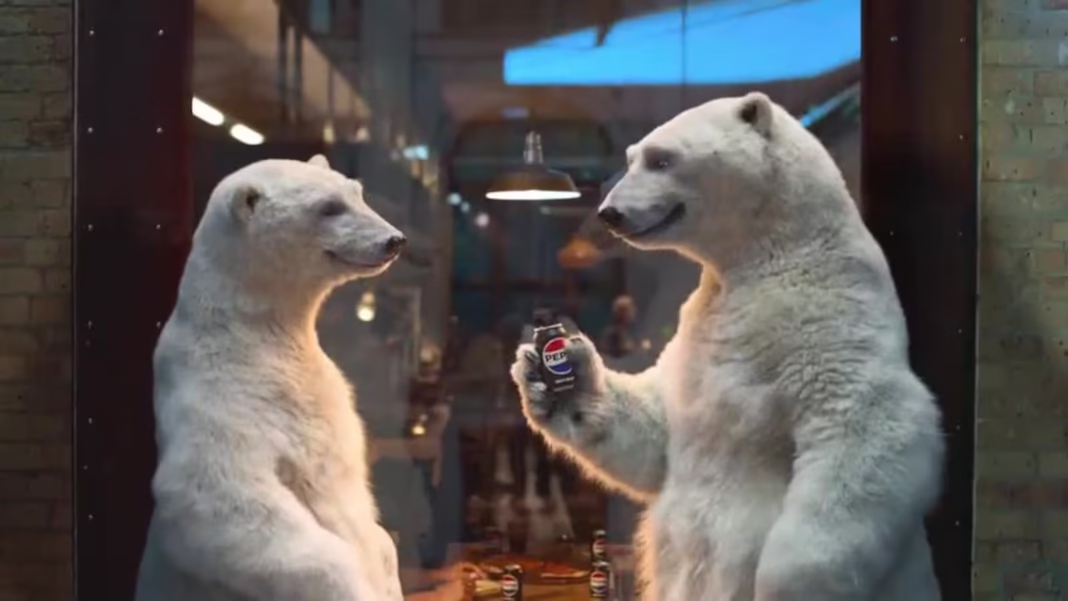
PepsiCo has revived its iconic Pepsi Challenge with a bold Super Bowl ad for Pepsi Zero Sugar. Featuring a conflicted polar bear that nods to Coca-Cola without naming it, the campaign, led by BBDO Worldwide, insists taste—not rivalry—is the ultimate battleground, positioning Pepsi as the factual choice.
PepsiCo is poking the bear again, quite literally. In its latest Super Bowl spot, the beverage giant has chosen a conflicted polar bear as the unlikely protagonist of a campaign that revives one of its most storied marketing gambits—the Pepsi Challenge. The ad, titled “The Choice,” is a cheeky, taste-driven narrative that positions Pepsi Zero Sugar as the victor in blind sampling, while slyly evoking the imagery of its rival Coca-Cola without ever uttering the name.
The polar bear, long associated with Coca-Cola’s holiday campaigns, is reimagined here as a creature caught between loyalty and curiosity. In the ad, the bear hesitates, sniffs, and ultimately succumbs to the allure of Pepsi Zero Sugar, a dramatization of the brand’s claim that taste is the most persuasive argument it can make. It is a playful provocation, a wink to decades of cola wars, but also a statement of intent: Pepsi wants to shift the conversation from rivalry to reality.
The campaign is the work of BBDO Worldwide in collaboration with the Pepsi Content Studio, and it marks a significant moment in Pepsi’s marketing trajectory. The Pepsi Challenge, first introduced in the 1970s, was a cultural phenomenon, inviting consumers to participate in blind taste tests that often ended with Pepsi declared the winner. By reviving the program in 2025, Pepsi has sought to reclaim that heritage, grounding its brand promise in empirical experience rather than abstract loyalty.
“This is not about cola wars,” Gustavo Reyna, Pepsi’s vice president of marketing, insists. “This is about cola facts.” His statement underscores the brand’s strategy: to frame Pepsi Zero Sugar not as a challenger brand but as the factual choice, validated by taste tests and consumer experience. In an era when marketing often leans on emotional storytelling, Pepsi is doubling down on the tangible, the measurable, and the demonstrable.
The Super Bowl, with its unparalleled reach and cultural cachet, provides the perfect stage for such a declaration. Advertising during the game is not just about visibility; it is about staking a claim in the national conversation. By choosing this moment to spotlight the Pepsi Challenge, Pepsi is signaling confidence in its product and its message. The polar bear, goofy yet symbolic, becomes a vehicle for both humor and provocation, ensuring the ad resonates beyond the thirty-second slot.
The decision to feature Pepsi Zero Sugar is equally telling. As consumer preferences shift toward healthier options, zero-sugar beverages have become a critical battleground. Pepsi’s emphasis on taste is designed to counter the perception that sugar-free means flavor-free. By dramatizing the bear’s reluctant but decisive choice, the brand is reinforcing the idea that Pepsi Zero Sugar delivers on taste without compromise.
The campaign also reflects Pepsi’s broader marketing philosophy over the past year. Since reviving the Pepsi Challenge, the company has invested in real-world activations, inviting consumers to participate in taste tests at events, festivals, and retail locations. These activations have served as both research and reinforcement, providing Pepsi with data to back its claims while engaging consumers in memorable experiences. The Super Bowl ad is the culmination of that effort, a mass-market amplification of a message tested in smaller arenas.
Of course, the shadow of Coca-Cola looms large. The polar bear is an unmistakable nod to Coke’s iconic mascot, a symbol that has graced holiday campaigns for decades. By appropriating the imagery without direct reference, Pepsi is engaging in a form of brand jujitsu—leveraging its rival’s equity to make its own point. It is a risky move, one that could be seen as antagonistic, but Pepsi frames it as playful rather than combative. The bear is not vanquished; it is conflicted, curious, and ultimately persuaded.
The ad also taps into the cultural nostalgia of the cola wars, a rivalry that has defined the soft drink industry for generations. Yet Pepsi’s insistence that this is about “cola facts” suggests a desire to move beyond the binary. The brand is not asking consumers to choose sides in a war; it is asking them to trust their taste buds. In doing so, Pepsi is reframing the narrative from competition to conviction.
Industry observers will note that the campaign arrives at a time when both Pepsi and Coca-Cola are navigating shifting consumer landscapes. Health consciousness, sustainability concerns, and evolving beverage categories are reshaping the market. In this context, taste becomes a powerful differentiator, a reminder that amid all the noise, the core product experience still matters. Pepsi’s gamble is that consumers, when given the choice, will side with flavor.
The Super Bowl ad is likely to spark conversation, not only among consumers but also within the marketing community. It is a case study in brand strategy, a blend of heritage and humor, provocation and persuasion. By reviving the Pepsi Challenge and dramatizing it through a polar bear, Pepsi is asserting that the old playbook still has relevance, provided it is updated for contemporary sensibilities.
Whether the campaign succeeds in shifting perceptions remains to be seen. Taste is subjective, and loyalty is deeply ingrained. Yet Pepsi’s willingness to poke the bear—literally and figuratively—demonstrates a brand unafraid to take risks. In the crowded arena of Super Bowl advertising, where spectacle often overshadows substance, Pepsi has chosen to bet on the simple, enduring power of taste.
For PepsiCo, “The Choice” is more than an ad. It is a statement of identity, a reaffirmation of its belief that the Pepsi Challenge is not just a marketing stunt but a truth worth retelling. And if a conflicted polar bear can help deliver that message, then perhaps the brand has found the perfect symbol for its playful yet purposeful campaign.
Discover more from Creative Brands
Subscribe to get the latest posts sent to your email.