



Saatchi & Saatchi and Mondelēz International have unveiled Born of Two Icons, a witty campaign introducing the OREO Creme Egg Cookie through the lens of Britain’s “nepo-baby” discourse. With humour, cultural fluency, and omnichannel flair, the collaboration shows how iconic brands can harness shared codes to stay relevant and loved.
The British cultural imagination has always been quick to embrace the absurd, the cheeky, and the slightly self-mocking. It is precisely this space—a blend of satire, pop commentary, and confectionery delight—that Saatchi & Saatchi and Mondelēz International have targeted with their latest campaign, Born of Two Icons. Its star is the OREO Creme Egg Cookie, a hybrid product cheekily framed as the confectionery world’s newest “nepo baby.” In a cultural moment when lineage, privilege, and inherited fame have become a national meme, positioning a cookie as a celebrity offspring lands with both affection and sly critique.
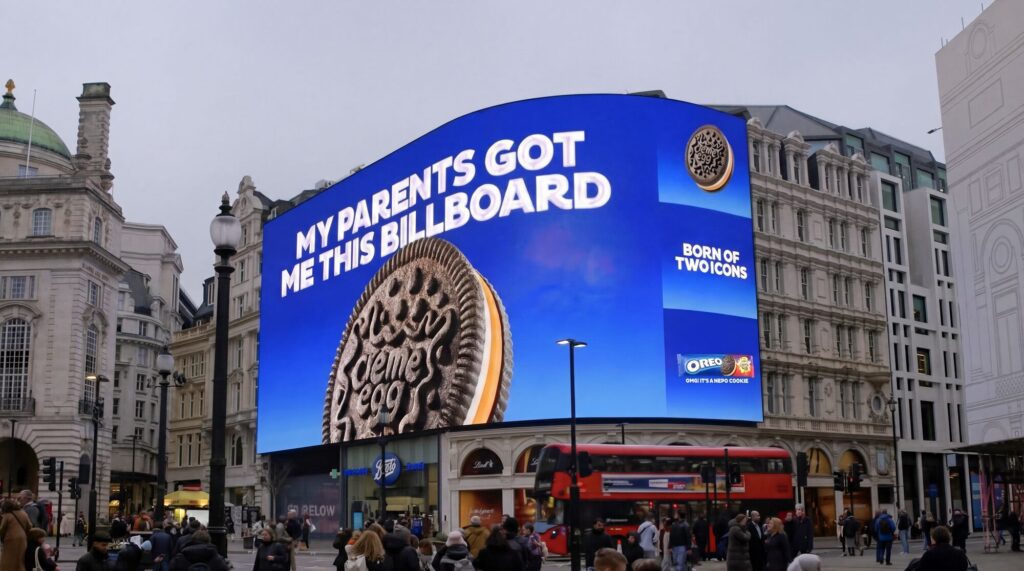
The advertising idea works because it doesn’t ignore the cultural noise around it—rather, it joins the conversation. The UK’s ongoing fascination with celebrity dynasties, offspring of media power couples, and the satirical currency of the term “nepo baby” provides fertile ground for a brand to poke fun at itself while demonstrating how legacy can be both an advantage and a burden. By casting the OREO Creme Egg Cookie as the lovechild of two established icons, the campaign uses humour to defuse potential cynicism about brand mash-ups while evoking the reality that cultural products, much like celebrity careers, often depend on heritage and name recognition.
Saatchi & Saatchi’s creative execution leans into this premise with confidence. From omnichannel storytelling to meme-literate cues, the campaign understands that modern advertising is no longer about instructing people what to love but allowing them to decode meaning through shared cultural references. The humour is not merely garnish; it is the connective tissue. The choice to adopt the “nepo baby” discourse also signals a willingness to interact with contemporary audiences on equal footing, acknowledging their media literacy rather than talking down to them.
For Mondelēz, the campaign shows how global confectionery brands maintain cultural standing in a cluttered market. When every supermarket shelf is an arena for novelty and every digital feed is an endless loop of snackable content, the task is no longer only to announce something new, but to ensure that newness has a story worth repeating. OREO and Cadbury Creme Egg are independently familiar, nostalgic, and commercially robust brands. Yet combining them could easily have been treated as a mere seasonal stunt. Framing it instead as an offspring narrative taps into celebrity culture’s obsession with lineage and the question of whether the children of icons can become icons in their own right.
This cultural resonance is reinforced by the campaign’s omnichannel execution, which stretches from social platforms to out-of-home placements and media environments where cultural commentary thrives. The “nepo-cookie” conceit, in particular, is designed for shareability; it performs well in formats where humour, recognition, and micro-narratives drive engagement. It’s a reminder that advertising success today is measured not only in reach but in the willingness of audiences to repeat and remix the narrative themselves.
The campaign also demonstrates a broader lesson for brands navigating contemporary pop culture: relevance does not require solemnity. In fact, levity can be a highly effective strategic tool when deployed with awareness and respect for audience intelligence. By nodding to a cultural moment instead of merely capitalising on it, Born of Two Icons walks the line between satire and sincerity. The cookie gets to be both punchline and product: a novelty worth sampling and a narrative worth retelling.
More subtly, the campaign invites reflection on how cultural language travels between domains. “Nepo baby,” once a term used to critique Hollywood dynasties and elite creative circles, becomes a device for consumer storytelling. This transference illustrates how brand discourse increasingly intersects with social commentary. The boundary between entertainment journalism, social media vernacular, and commercial communication is porous; the winners in this new landscape are often those who can navigate its nuances without appearing opportunistic.

In the end, the OREO Creme Egg Cookie’s arrival on the British stage suggests that pop culture and product innovation are not separate spheres but mutually reinforcing tools of attention. Whether Britons ultimately adopt the confection as a seasonal treat, a novelty collectable, or a social meme, the campaign’s achievement lies in making that choice culturally visible. In a market saturated with limited-edition food mash-ups and nostalgia-driven partnerships, its success will not rest solely on flavour but on the cultural script that accompanies it.
By leaning into the nation’s fondness for irony, lineage gossip, and culinary experimentation, Born of Two Icons delivers a fresh case study in how iconic brands can maintain momentum without losing self-awareness. If every generation of stars must face the question of whether they can live up to their parents’ legacy, the OREO Creme Egg Cookie now joins the ranks of Britain’s most delightfully unserious kin—famous by birth, loved by choice, and destined to spark both chatter and cravings.
Discover more from Creative Brands
Subscribe to get the latest posts sent to your email.