


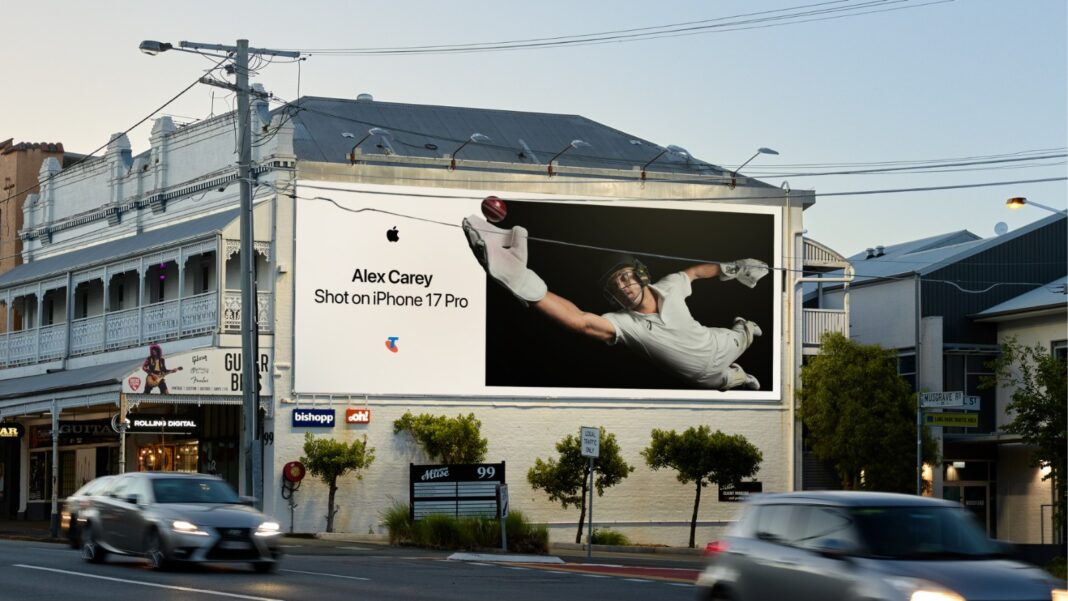
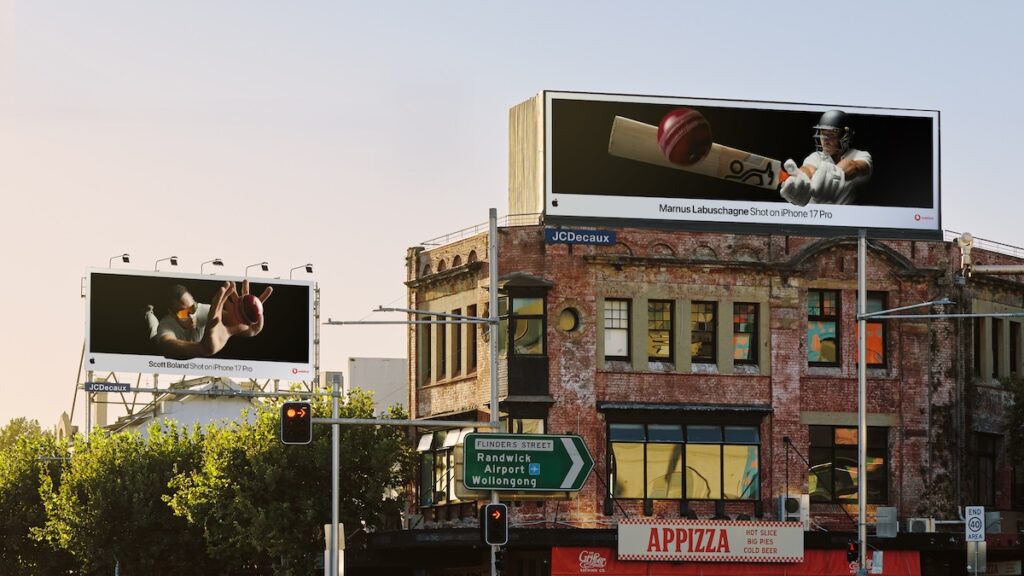
Apple has launched a new ‘Shot on iPhone’ campaign via TBWA\ Media Arts Lab Sydney, featuring cricketers Marnus Labuschagne, Scott Boland and Alex Carey. Timed to Australia’s cricket season, the work showcases the iPhone 17 Pro’s advanced camera system, capturing cricket’s power, detail and cultural significance through social, OOH and digital executions.
Apple has turned its lens toward one of Australia’s most deeply cherished national passions—cricket—unveiling a new “Shot on iPhone” campaign that blends sport, culture, and technology into a cinematic showcase. Created by TBWA\ Media Arts Lab’s Sydney office, the campaign stars three widely admired figures from the Australian cricket landscape: Marnus Labuschagne, Scott Boland, and Alex Carey. But while the players anchor the work, the real protagonist is the camera system on the iPhone 17 Pro, whose 48MP rear array becomes a vehicle for bringing spectators closer to the action than ever before.
The campaign unfolds across multiple touchpoints, with a focus on social and out-of-home placements as well as Apple’s Australian website and the brand’s global Instagram channel. The images and micro-films are unified by a lingering, almost tactile proximity to the subject matter: sweat, turf, movement, impact, concentration, and the poetic violence of leather-on-willow. In doing so, the work reframes how cricket is visually depicted, moving away from the distant, stadium-wide vantage points typical of sports photography and toward something more intimate—almost auteur-like in its framing and rhythm.
Cricket has always been as much a cultural phenomenon as a sport in Australia. It occupies a space in the national consciousness reserved for institutions that shape identity, family memory, and collective summer rituals. By leaning into this cultural gravitas, Apple casts the iPhone not as a gadget but as a tool capable of preserving and elevating the stories that unfold on fields across the country. Timing the campaign with the height of Australia’s cricket season reinforces that positioning, inviting both fans and casual observers to witness the sport anew.
What distinguishes this effort from previous sports partnerships is its insistence on staying close—almost uncomfortably close—to its subject. The three 48MP Fusion rear cameras, powered by an 8x optical-quality zoom, enable visual compositions that would traditionally require bulky professional rigs or field-side accreditation. The footage highlights micro-details: the flick of Labuschagne’s wrist during a cover drive, the torque in Boland’s delivery stride, the flicker of concentration in Carey’s stance behind the stumps, and the grainy dust kicked up from a cracked pitch under a low summer sun. These are the tactile fragments of cricket that fans know exist but rarely get to study at length.
In addition to showing off the computational might of the rear array, the campaign also features the iPhone 17 Pro’s 18MP Center Stage front camera equipped with Dual Capture. This allows players to record their own expressions and reactions while simultaneously tracking the action in front of them. The result is a dual narrative—athlete and arena—stitched together without losing the immediacy of the scene. Cricket becomes not just a spectator sport but an experiential one, lived from the point of view of those inside the boundary rope.
The broader “Shot on iPhone” initiative has long been Apple’s bridge between its technology and cultural storytelling, from wildlife in Kenya to skating in Los Angeles. But what makes the Australian cricket installment feel distinctive is its blending of athleticism with national character. Cricket’s stature in Australia is both historical and familial; it is an anchor of summer holidays, backyard rituals, and sporting folklore. Apple leans into this cultural architecture—without sentimentality—by capturing its subjects in a way that balances heroism with authenticity. There is no glossy artifice; the sweat lands in sharp focus, the muscles tighten, and the breath hangs in the air.
From a production standpoint, the campaign’s restraint is notable. There is no high-concept narrative, no fictional macro-storyline, no flashy editing for the sake of spectacle. Instead, the work adopts a documentary naturalism that trusts the sport’s inherent drama. The speed of the ball, the tension of a delivery, the vulnerability of a batsman facing pace bowling—these are storylines that require no additional embellishment. The technology steps back at the precise moment it steps forward, demonstrating capability by refusing to overcomplicate the moment.
For Apple, the cricket campaign also plays an important strategic role. It demonstrates the filmmaking credibility of the iPhone 17 Pro not through traditional brand claims, but through immersion in a category where camera performance genuinely matters. Sports are unforgiving environments for imaging: fast motion, harsh lighting, rapid transitions, distance challenges, and unpredictable subjects. To meet these demands with a device that fits in a pocket strengthens Apple’s argument that its flagship phone remains not just a consumer device but a filmmaking instrument. At a time when social and vertical video content dominate cultural communication, that proposition carries weight well beyond sports marketing.
The choice of Labuschagne, Boland, and Carey is equally deliberate. Each represents a different facet of the sport’s public persona: Labuschagne, often seen as the analytical and meticulous batsman; Boland, the unassuming but deadly fast bowler whose spellbinding performances have imprinted themselves on recent Ashes lore; and Carey, the composed and strategic wicketkeeper whose role balances reflex and game intelligence. Together, they offer a cross-section of cricketing disciplines that allow the iPhone to demonstrate a range of cinematic possibilities—close-range batting sequences, long-range bowling arcs, and behind-the-stumps dual framing.
The multi-platform architecture of the campaign ensures that it encounters audiences in lived environments, from digital social feeds to public spaces. Out-of-home placements leverage large-format imagery to accentuate the hyper-detailed stills captured by the device, while social executions are designed to promote motion, emotion, and proximity. The Apple Australia website functions as the informational anchor, offering a more deliberate walkthrough of the device’s capabilities. Instagram, where younger audiences engage heavily with sports content, acts as the cultural amplifier.
What emerges from the campaign is not just a promotional exercise for a device but a subtle reframing of how sports media can be produced and consumed. Apple positions the iPhone 17 Pro as a democratizing tool—one that reduces the gap between amateur spectators and professional filmmakers. Where legacy broadcast equipment requires permission, budget, and expertise, the smartphone suggests immediacy and agency. Anyone could, theoretically, shoot cricket like this—not just players and production crews, but fans, families, and future storytellers.
In a country where cricket carries the emotional weight of memory and identity, that democratisation is significant. It implies that the moments Australians care about most—their teams, their heroes, their backyard games—can now be captured with a fidelity that honors their importance. Apple’s campaign, at its core, understands that sport is more than entertainment; it is how a culture records itself.
Discover more from Creative Brands
Subscribe to get the latest posts sent to your email.