


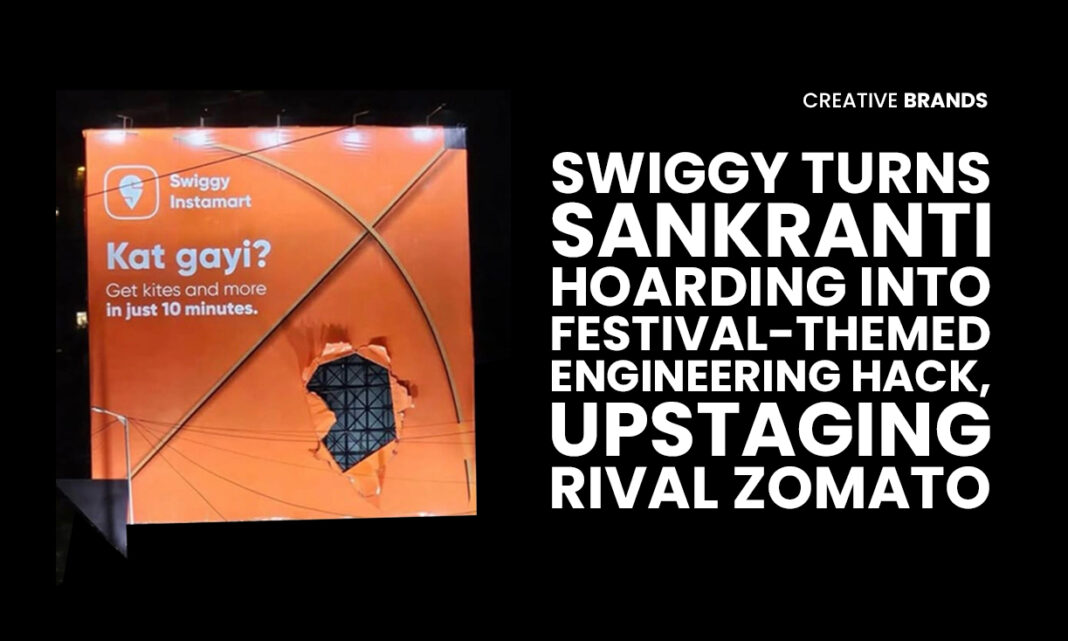
Swiggy’s Sankranti hoarding doubled as a clever engineering solution, using mandatory wind-pressure holes as kite details in its festive design. The creative move impressed the advertising industry, earning praise for turning a logistical constraint into an idea. The campaign sparked chatter that Swiggy has edged past Zomato in outdoor creativity this season.
Swiggy’s latest Sankranti hoarding may have looked like a clever festive nod to the season, but it turned out to be far more than that. What initially appeared to be just another brand attempting to tap into the cultural calendar revealed itself to be a masterclass in outdoor advertising design, engineering awareness and creative problem-solving — one that instantly sparked comparisons with its closest rival, Zomato, and reignited the conversation around innovation in India’s fiercely competitive food delivery space.
Sankranti, celebrated across India with varying rituals and names, is synonymous with harvest, new beginnings and, in many regions, the colourful sight of kites soaring across winter skies. This imagery has long been fertile ground for advertising, especially for consumer-facing brands that rely on cultural moments to stay relevant. But Swiggy’s take this year did more than decorate the skyline with thematic motifs. It made the medium itself — the hoarding — an integral part of the idea. And in doing so, it solved a real-world logistical headache that most pedestrians and drivers never think about, but every outdoor advertising professional must contend with: how to stop massive billboards from being ripped apart by the wind.
Large-format hoardings in India, particularly those installed at considerable heights and exposed to open air, routinely require discreet perforations — small, engineered holes that allow air to pass through and reduce the wind pressure that can build up against the surface. Without these invisible escape routes, hoardings risk billowing, tearing, toppling or destabilising their frames, creating hazards and forcing premature replacements. For decades, the challenge has been to hide these perforations so that the creative layout is not visibly disrupted. Most advertisers simply work around them, positioning the holes in areas where they will go unnoticed, or printing darker hues to camouflage them.
Swiggy’s Sankranti campaign flipped that convention on its head by making those holes the centre of the creative idea itself. The hoarding depicted a vibrant assortment of festive kites — and instead of treating the required perforations as blemishes, Swiggy used them as the kites’ punctured tear points, the tiny holes that in reality help a kite catch and balance wind. What would otherwise have been engineering necessities suddenly became visual features, enhancing the festive illusion while quietly solving the very problem they existed for. The brand didn’t just acknowledge the presence of holes; it legitimised them in the language of Sankranti and kite flying.
For outdoor industry insiders, the execution felt like a rare blend of wit and practicality. For Swiggy, the payoff was two-fold: a campaign that festival-goers found charming and relatable, and a billboard that functioned smoothly under real weather conditions. And for everyone who spends time in India’s advertising trenches, it was a fresh reminder that constraints can sometimes be the best creative brief.
The market did not take long to place this innovation within a larger narrative — the one that has defined Swiggy and Zomato for years. Their rivalry, which has evolved from discounts and delivery speeds to brand perception and cultural cachet, has turned outdoor advertising into a battleground where each brand attempts to outsmart the other through humour, timing or tactical placements. Zomato has historically been credited with dominating OOH punchlines, especially through its puns, one-liners and visual simplicity. But in the last two years, Swiggy has quietly deepened its creative arsenal, experimenting with ambient ideas, interactive installations and sharper contextual thinking.
With the Sankranti hoarding, industry voices began openly declaring that Swiggy had outsmarted Zomato — at least in this round — not through wordplay, but through engineering literacy and design fluency. Where Zomato has typically leaned on messaging, Swiggy leaned on medium intelligence. It was a reminder that outdoor advertising does not only compete for attention; it competes with the environment itself. Billboard creativity, unlike digital banners or social media carousels, must negotiate structural safety, municipal regulations, print tolerances, material costs, weather variability and sight-line physics. It exists not on a screen, but in the wind, sunlight and pollution of real cities. A campaign that works at the drawing board must also survive the real world.
And this is where Swiggy’s Sankranti entry demonstrated maturity. It took the most stubborn constraint in the medium and integrated it elegantly into the visual story, making the final output stronger rather than compromised. The campaign’s success also reflects a broader shift in Indian OOH advertising, which has been undergoing a creative resurgence over the past five years. Traditional hoarding-led deployments have been infused with new ideas driven by environmental awareness, real-time triggers, playful interactivity and innovations in printing and fabrication. Brands are no longer content with simply occupying physical space; they want to inhabit it meaningfully.
The timing of the campaign during a culturally charged festival also helped. Unlike the Western advertising calendar, which orbits Christmas, Thanksgiving, Halloween and Black Friday, the Indian calendar is densely packed with festivals that offer narrative and visual springboards. Sankranti is one of the earliest festivals of the year, and by activating its OOH strategy in January, Swiggy positioned itself as a brand that intends to remain visually loud and culturally plugged in through 2026. The kites, the colours and the seasonal symbolism allowed the brand to distance the campaign from transactional messaging and instead align itself with the lived rhythms of Indian households.
Public reception was organic and enthusiastic. Social media users shared photos of the hoarding, praising its cleverness without needing any brand-sponsored amplification. Designers and advertising professionals dissected the details. Outdoor vendors and planners exchanged notes on how the design solved a longstanding operational nuisance. An idea that could have been dismissed as a mere visual gimmick instead made people appreciate an often overlooked fact: even the most mundane infrastructural choices in urban advertising can become opportunities for creativity when a brand is willing to look closer.
Underlying all this, however, is the reality that advertising — especially for consumer tech brands — is increasingly judged not just on reach or recall, but on cultural sharpness. Swiggy and Zomato are, in many ways, no longer fighting to be the fastest or cheapest delivery option; they are fighting to be the most loved. In an era where delivery apps exist on nearly every smartphone, differentiation lives in tone, wit and presence. Outdoor campaigns allow these brands to be part of the city’s physical theatre, and Swiggy’s Sankranti strategy became another scene in that ongoing performance.
In a marketplace where attention is engineered and competition is unrelenting, Swiggy managed to win not through louder messaging, but through smarter design. And in doing so, the brand reminded its category peers — and its biggest rival — that innovation does not always demand expensive technology, complex installations or flashy spectacle. Sometimes, all it takes to outsmart the competition is the willingness to reimagine a hole in a hoarding as a kite in the sky.
Discover more from Creative Brands
Subscribe to get the latest posts sent to your email.