


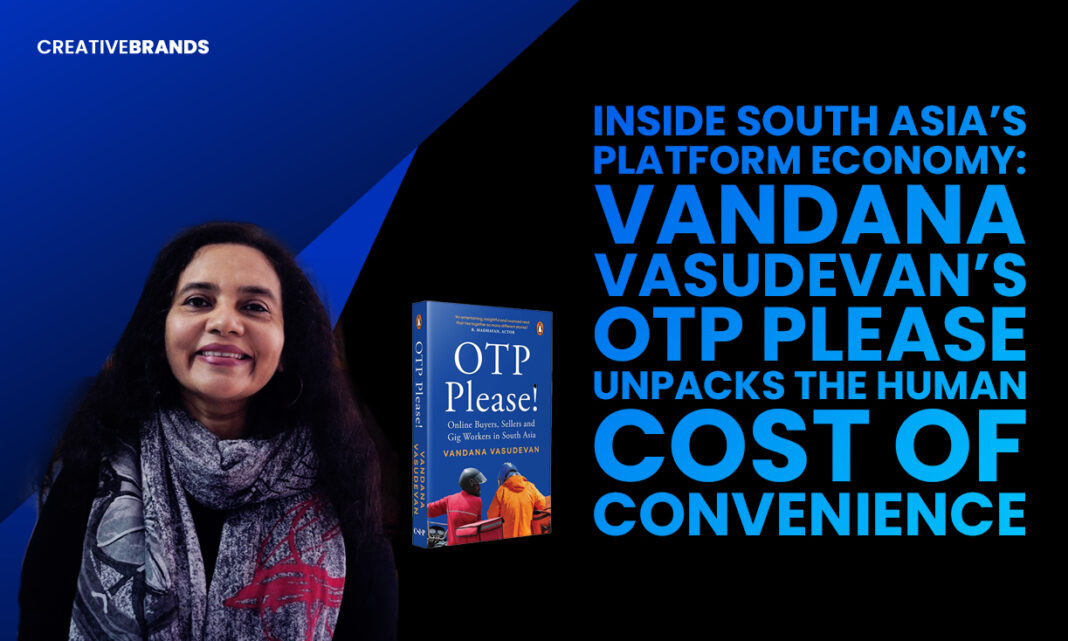
Vandana Vasudevan’s OTP Please explores South Asia’s platform economy through the lived experiences of online buyers, sellers and gig workers. Drawing stories from across the region, the book reveals the hidden emotional, economic and policy implications behind seamless digital convenience.
A quiet but consequential transformation is reshaping everyday life across South Asia. From how meals arrive at doorsteps and groceries are stocked without stepping outside to how livelihoods are stitched together through apps and algorithms, technology platforms have embedded themselves into the rhythms of modern living. In this fast-changing landscape, Vandana Vasudevan’s book OTP Please: Online Buyers, Sellers and Gig Workers in South Asia arrives as both a chronicle and a critique, capturing the human stories behind the seamless interfaces that now mediate commerce, work and consumption.
Vasudevan, a PhD and PGP graduate from IIM Ahmedabad, brings to the subject a rare blend of academic rigour and narrative clarity. An author of three books and a researcher focused on mobility, gender and transport, urban development, and the intersections of technology and society, she is also a columnist and TEDx speaker. These multiple vantage points inform OTP Please, which reads not as a distant academic treatise but as a grounded exploration of how digital platforms are reordering lives across borders, cities and social classes.
The premise of the book rests on a paradox familiar to millions. Platforms such as Swiggy, Amazon and Uber in India, Foodpanda in Pakistan, and Pathao in Bangladesh and Nepal have eased the pressures of modern life in undeniable ways. They promise speed, convenience and choice, delivering everything from late-night snacks to last-minute essentials with a few taps on a screen. They free up time for consumers, generate income opportunities for workers, and offer small sellers access to markets that were once unreachable. In a region marked by infrastructural gaps and demographic pressures, the rise of the platform economy has often felt like a technological leapfrog.
Yet Vasudevan urges readers to look beyond the dazzle of digital efficiency. The smoothness of these systems, she argues, often conceals layers of opacity and imbalance. Gig workers, celebrated in marketing campaigns as “partners” and symbols of flexibility, frequently inhabit precarious economic realities. Internet retailers and small sellers operate under the shadow of powerful global platforms whose rules can change overnight. Consumers, while enjoying unprecedented convenience, are left wondering whether instant gratification and frictionless living come with hidden social and economic costs.
OTP Please takes its title from a phrase that has become emblematic of this new economy. The one-time password, a small numerical code exchanged at the doorstep, represents trust, transaction and transfer in a digitised world. It is the final step that completes an online purchase, but also a moment of human interaction in an otherwise automated chain. For Vasudevan, it becomes a metaphor for the fragile, negotiated relationships between buyers, sellers and workers in the platform ecosystem.
What distinguishes the book is its geographical and cultural breadth. Drawing on deeply researched fieldwork across South Asia, Vasudevan connects stories from Peshawar to Patna, and from Colombo to Kathmandu. These narratives reveal how global platforms are adapted, resisted and reinterpreted in local contexts. In bustling Indian cities, delivery workers navigate congested roads and algorithmic incentives. In Pakistan and Bangladesh, food delivery and ride-hailing platforms intersect with different labour norms and urban challenges. In Nepal and Sri Lanka, smaller markets offer insights into how platform models scale down—and where they falter.
Rather than treating these countries as isolated case studies, Vasudevan weaves them into a regional tapestry. South Asia’s shared histories of informality, migration and economic aspiration shape how platform work is experienced and understood. The book captures the emotional dynamics at play: the pride and anxiety of a gig worker chasing incentives, the frustration of a small seller grappling with commissions and visibility, the guilt and dependence of a consumer accustomed to on-demand convenience. These emotions, Vasudevan suggests, are not incidental but central to how the platform economy sustains itself.
The narrative also probes the inner workings of technology companies, demystifying how algorithms, ratings and incentives structure behaviour. Decisions that appear neutral or purely technical often have profound social consequences. A change in delivery radius, a tweak in commission rates, or an opaque deactivation policy can ripple through livelihoods and neighbourhood economies. By situating these mechanisms within lived experiences, OTP Please makes visible the power dynamics that are otherwise hidden behind dashboards and data.
Policy implications form a crucial undercurrent of the book. As governments across South Asia grapple with regulating platform work, Vasudevan’s research highlights the gaps between law, practice and lived reality. Traditional labour protections struggle to accommodate gig work that is neither fully formal nor entirely informal. Urban planning and transport policies often lag behind the realities of app-driven mobility. Consumer protection frameworks are tested by cross-border e-commerce and complex supply chains. The book does not offer simplistic solutions but insists on the need for nuanced, context-sensitive policy responses that recognise the diversity of actors involved.
Despite the gravity of its themes, OTP Please is described as breezily narrated, making complex ideas accessible without diluting their significance. Vasudevan’s voice moves fluidly between analysis and storytelling, allowing readers to grasp both the scale of the transformation and the intimacy of individual lives affected by it. This balance reflects her broader body of work, which consistently bridges academia and public discourse.
The timing of the book is significant. As platform economies mature, the initial novelty of app-based services has given way to questions about sustainability, equity and accountability. Strikes by gig workers, debates over data ownership, and concerns about market concentration are becoming more frequent across the region. OTP Please enters this conversation not as a polemic but as a carefully observed account of an extraordinary digital age that South Asia is helping to shape.
For readers seeking to understand what lies beneath the convenience of their screens, the book offers both insight and reflection. It asks what kind of work is being created, who bears the risks of innovation, and how technology reshapes social relationships. In doing so, it challenges the idea that progress is purely technical, reminding us that every digital transaction is anchored in human effort and expectation.
As South Asia continues to urbanise, digitise and integrate into global technology networks, the questions raised by Vandana Vasudevan’s work will only grow more urgent. OTP Please stands as essential reading for anyone interested in the future of commerce, labour and everyday life in the region—an invitation to pause, look behind the interface, and consider the true cost and promise of living in a platform-driven world.
Discover more from Creative Brands
Subscribe to get the latest posts sent to your email.