


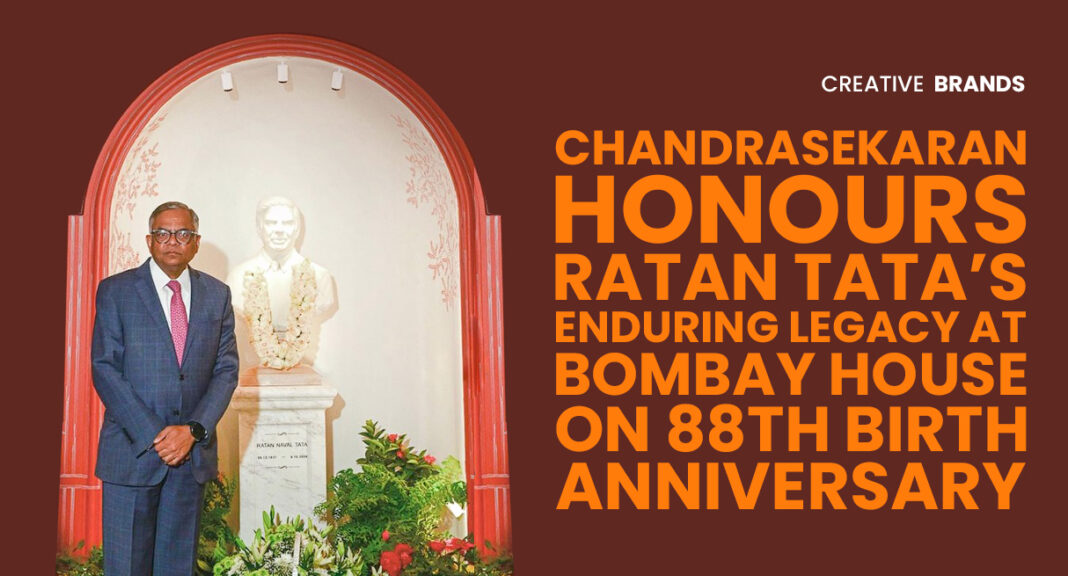
Tata Sons Chairman N. Chandrasekaran paid tribute to Ratan N. Tata at Bombay House on his 88th birth anniversary, reflecting on his transformative leadership and values. The homage highlighted continuity in Tata leadership, linking Ratan Tata’s ethical vision with Chandrasekaran’s future-focused stewardship.
Bombay House, the century-old headquarters of the Tata Group in Mumbai, wore a quiet solemnity as N. Chandrasekaran, Chairman of Tata Sons, paid his respects to Ratan N. Tata on what would have been the legendary industrialist’s 88th birth anniversary. The moment was marked not by grandeur or spectacle, but by reflection—an understated homage befitting a leader whose influence reshaped Indian industry while remaining rooted in humility, integrity and a deep sense of national purpose.
For the Tata Group, Bombay House is more than an administrative nerve centre. It is a symbolic space where the past, present and future of one of India’s most respected conglomerates converge. Chandrasekaran’s tribute there underscored the continuity of values that bind successive generations of Tata leadership. In remembering Ratan Tata, Chandra, as he is widely known, acknowledged a mentor figure whose vision continues to inform the group’s strategic and ethical compass long after his active stewardship.
Ratan Tata’s life and legacy occupy a unique place in India’s corporate and social history. As Chairman of Tata Sons from 1991 to 2012, and again briefly in 2016–17, he presided over a period of profound transformation. Under his leadership, the Tata Group expanded from a largely India-centric enterprise into a global conglomerate, marked by landmark acquisitions such as Tetley Tea, Corus Steel and Jaguar Land Rover. Yet, beyond balance sheets and boardrooms, Ratan Tata was admired for humanising capitalism, insisting that business success must be inseparable from social responsibility.
Chandrasekaran’s gesture on the birth anniversary resonated as an affirmation of that ethos. Having assumed the chairmanship of Tata Sons in 2017, following a distinguished three-decade career at Tata Consultancy Services, Chandra represents a new generation of professional leadership within the group. His journey from a young recruit at TCS straight out of university to the chairman of India’s most influential business house mirrors, in many ways, the Tata belief in nurturing talent from within and rewarding merit over pedigree.
At TCS, Chandrasekaran’s leadership coincided with the company’s emergence as India’s most valuable firm and the largest private sector employer in the country. He steered the IT major through rapid technological change, global expansion and organisational scale, reinforcing its reputation for stability and innovation. Those years shaped his approach to leadership—data-driven yet people-centric, ambitious yet anchored in long-term thinking—qualities that have since defined his stewardship of Tata Sons.
In paying homage to Ratan Tata, Chandrasekaran was also reflecting on a leadership legacy that blends moral clarity with strategic courage. Ratan Tata was known for taking bold decisions at pivotal moments, whether it was opening the group to global competition in the post-liberalisation era or backing ventures driven by national pride, such as the Tata Nano. While not all initiatives met commercial expectations, they reflected a willingness to think beyond immediate profit and engage with broader societal aspirations.
Chandrasekaran has often spoken about the responsibility that comes with leading an institution like the Tata Group, where public trust has been built over more than a century. That responsibility extends beyond shareholders to employees, communities and the nation at large. This belief is also evident in his thought leadership. As the author of Bridgital Nation, Chandrasekaran articulates a vision for India’s future at a time of accelerating technological disruption. He argues that artificial intelligence and digital technologies, rather than being threats to employment, can be harnessed to create new opportunities and bridge long-standing socio-economic divides if guided by thoughtful policy and inclusive intent.
The book reflects an intellectual continuity with Ratan Tata’s worldview—an insistence that progress must be inclusive and that technology and industry should ultimately serve human aspirations. Chandrasekaran’s emphasis on blending the physical and digital, the “bridgital,” echoes the Tata philosophy of adapting to change without losing sight of foundational values.
Beyond corporate leadership, Chandrasekaran’s influence extends into academia, global policy forums and scientific institutions. As Chairman of the Indian Institute of Management Lucknow and President of the Court at the Indian Institute of Science, Bengaluru, he plays a role in shaping India’s next generation of leaders and researchers. His presence on the International Advisory Council of Singapore’s Economic Development Board and as Co-Chair of the India-US CEO Forum places him at the intersection of global economic dialogue, where India’s growth story is increasingly central.
His election as an international member of the United States National Academy of Engineering and his role on the Board of Governors of the New York Academy of Sciences underline the respect he commands in global scientific and technological circles. These engagements reflect a belief, shared with Ratan Tata, that India’s future competitiveness lies in knowledge, innovation and global collaboration.
Chandrasekaran’s recognition with the Padma Bhushan in 2022 for his contributions to trade and industry was widely seen as acknowledgment of this multifaceted leadership. Yet, those who know him often point to his personal pursuits as windows into his character. An avid photographer and long-distance runner who has completed the Abbott World Marathon Majors, Chandrasekaran embodies discipline, endurance and a reflective temperament—qualities essential for navigating the complexities of leading a vast and diverse conglomerate.
The tribute at Bombay House thus carried layers of meaning. It was not merely an act of remembrance, but a reaffirmation of continuity—of values passed down, responsibilities inherited and visions renewed. In honouring Ratan Tata on his birth anniversary, Chandrasekaran stood as both a custodian of legacy and an architect of the future, conscious that the Tata name represents more than commercial success.
As India charts its course through rapid economic change, technological disruption and global uncertainty, the Tata Group’s leadership transitions hold broader significance. The quiet moment at Bombay House served as a reminder that institutions endure when leadership is grounded in purpose, humility and service. Ratan Tata’s influence remains deeply etched into the DNA of the group, and through leaders like N. Chandrasekaran, that influence continues to shape decisions that reach far beyond corporate walls.
In remembering a visionary who believed that industry must ultimately uplift society, Chandrasekaran’s tribute echoed a simple yet powerful truth: that the measure of leadership lies not just in growth or scale, but in the values that guide them—and in the lives they touch along the way.
Discover more from Creative Brands
Subscribe to get the latest posts sent to your email.