


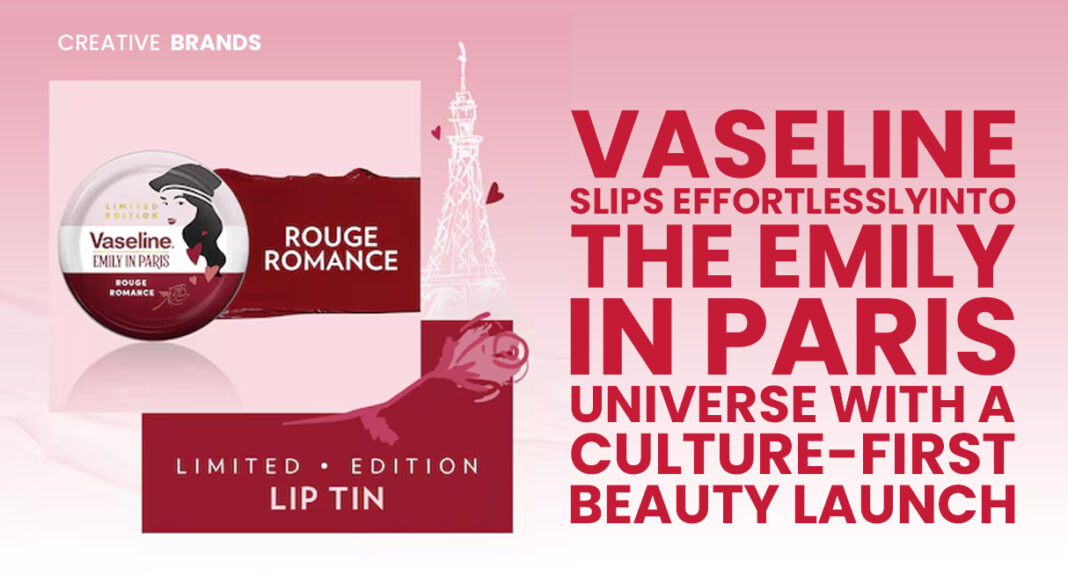
Timed with Netflix’s new season of Emily in Paris, Vaseline’s global lip oil launch redefines brand integration by prioritising cultural belonging over visibility. Drawing on Parisian beauty codes and sensorial appeal, the collaboration has already surpassed targets, signalling how heritage brands can win by feeling authentic, not promotional.
Today, as Netflix releases a new season of Emily in Paris, one of the world’s most recognisable beauty brands steps quietly but confidently into the frame. The global launch of the Vaseline x Emily in Paris collection is timed to the cultural moment with precision, yet what sets it apart is not its timing or scale, but its restraint. In a media landscape crowded with obvious sponsorships and fleeting brand cameos, Vaseline’s latest collaboration makes a different claim: it belongs here.
Rather than announcing itself through logos or overt product placements, Vaseline integrates into the Emily in Paris universe as if it has always been part of it. The partnership feels less like a marketing exercise and more like a natural extension of the show’s aesthetic world, where beauty rituals are as much a narrative device as fashion montages and Parisian backdrops. The result is a collaboration that aligns with how audiences consume culture today: intuitively, emotionally and with an expectation of authenticity.
At the heart of the launch is a product that taps directly into one of the most enduring and resurgent beauty trends of the moment: tinted lip oils. Marketed with an unmistakable “Ooh La La” sensibility, the Vaseline x Emily in Paris lip oils draw on Parisian codes of effortless glamour and sensorial pleasure. They are designed not merely to be used, but to be desired — glossy, nourishing and subtly tinted, sitting perfectly at the intersection of skincare and colour cosmetics. In an era where beauty consumers are increasingly sceptical of gimmicks, the product’s appeal lies in its familiarity reimagined through a cultural lens.
Vaseline, a brand with over 150 years of heritage, has often been associated with utility rather than indulgence. Petroleum jelly has long been a backstage staple — functional, dependable, rarely aspirational. This collaboration signals a deliberate evolution of that perception. By anchoring itself in a globally recognisable pop culture property like Emily in Paris, Vaseline reframes its relevance for a younger, trend-conscious audience without abandoning its core identity. The lip oils are not a departure from what Vaseline stands for; they are an adaptation, translating care into desire.
The commercial response has been swift and emphatic. Even before the official global launch, the collection has surpassed internal business targets, with early sell-outs reported in markets such as the Philippines. That level of demand suggests the collaboration has struck a chord not only culturally but commercially. In a region where beauty trends move quickly and social media accelerates consumption cycles, selling out ahead of launch is less about hype alone and more about resonance. Consumers appear to recognise the product as something that fits seamlessly into their routines and aspirations.
What makes the Vaseline x Emily in Paris launch particularly notable is how it reflects a broader shift in brand strategy. In what many marketers now describe as a culture-first world, visibility is no longer the primary metric of success. Audiences are adept at filtering out noise; they reward brands that demonstrate an understanding of context and community. This collaboration does not interrupt the Emily in Paris experience — it complements it. Vaseline becomes part of the show’s beauty vocabulary, mirroring how viewers themselves might engage with the series: through mood, texture and fantasy.
Emily in Paris has, since its debut, functioned as a global touchstone for a specific kind of aesthetic aspiration. Its vision of Paris may be stylised and occasionally polarising, but it is undeniably influential. Fashion, beauty and lifestyle brands have been eager to tap into its visual language, yet not all integrations have felt organic. Vaseline’s approach stands out precisely because it avoids overstatement. The brand does not attempt to redefine the show’s world; it adapts itself to it.
This sensibility is increasingly critical as entertainment and commerce continue to converge. Viewers are no longer passive recipients of content; they are participants in its afterlife on social media, where screenshots, beauty breakdowns and product links circulate almost instantly. A product that feels forced or opportunistic risks backlash, while one that feels intuitive can become part of the cultural conversation. The Vaseline lip oils, with their emphasis on sensorial appeal and everyday luxury, lend themselves naturally to this ecosystem.
There is also a symbolic dimension to the launch that extends beyond sales figures. By positioning Vaseline not as a background utility but as a beauty essential worthy of screen time, the collaboration challenges traditional hierarchies within the beauty industry. It suggests that care products can be as aspirational as colour cosmetics, and that heritage brands can participate meaningfully in contemporary pop culture without diluting their credibility.
Timing, of course, plays its part. Launching alongside a new Netflix season ensures global visibility, but it also aligns the product with a moment of renewed audience engagement. Fans returning to the Emily in Paris universe are already primed for inspiration, making them more receptive to products that extend that fantasy into their own lives. Yet the success of the launch indicates that timing alone is insufficient; it must be matched by thoughtful execution.
As brands increasingly seek to embed themselves within cultural narratives, the Vaseline x Emily in Paris collaboration offers a compelling case study. It demonstrates that meaningful belonging is achieved not through domination of attention, but through coherence of values, aesthetics and use. The lip oils do not shout for recognition; they invite it, offering consumers a tactile connection to a world they already love.
Ultimately, the launch prompts a broader reflection on the future of brand storytelling. In a landscape saturated with content, the most effective brand expressions may be those that feel least like advertising. Vaseline’s quiet confidence in this collaboration suggests a shift in mindset: from asking how a brand can be seen, to asking how it can be felt. In doing so, it underscores a simple but powerful insight for today’s culture-driven economy — the brands that endure will be those that understand not just where they appear, but why they belong.
Discover more from Creative Brands
Subscribe to get the latest posts sent to your email.