


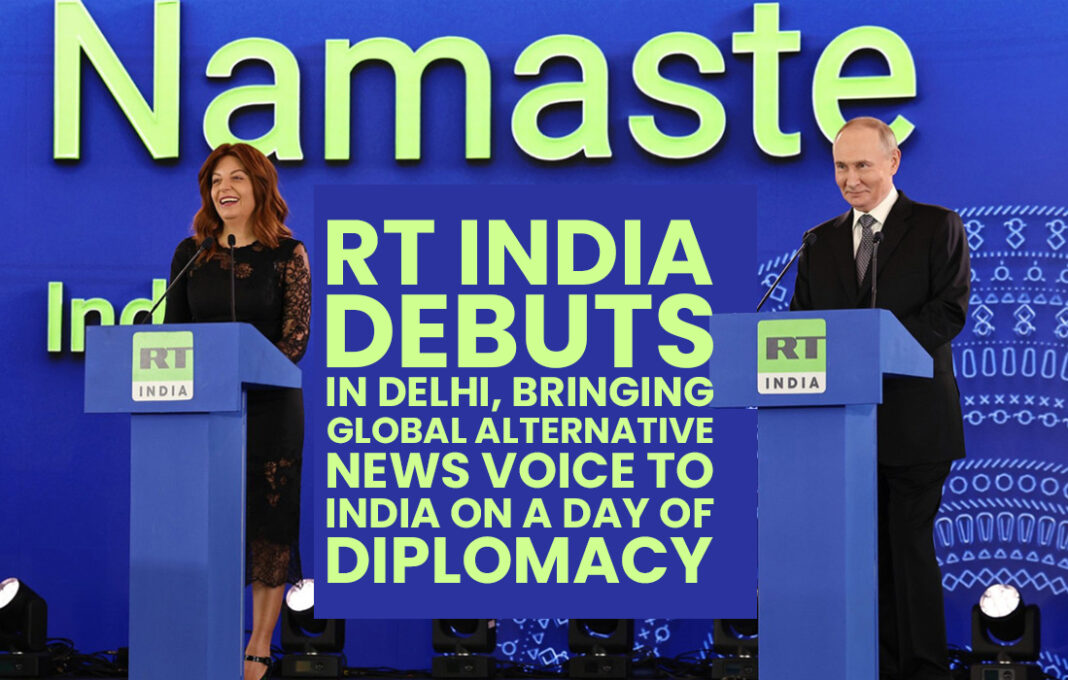
RT India launched its TV broadcast in Delhi on December 5, coinciding with Russian President Vladimir Putin’s visit to India. With four daily English news shows and access to a potential 675 million viewers, the global network brought its alternative storytelling approach, expansive international reach, and distinctive editorial style into India’s highly competitive news landscape.
RT India’s entry into the nation’s broadcast ecosystem was shaped as much by timing as by ambition. When the channel went live from its new state-of-the-art studio in Delhi, it did so on a day already marked by geopolitical significance, as President Vladimir Putin arrived in India for a summit meeting with Prime Minister Narendra Modi. For a network that positioned itself as a challenger to mainstream narratives and a proponent of alternative perspectives, launching amid such high-level diplomacy carried strong symbolic weight.
For RT, which had spent the preceding eight months building teams, negotiating partnerships, and refining its programming slate, the launch represented the culmination of sustained behind-the-scenes effort. The organisation’s India team described the process as one requiring constant coordination, involving the creation of editorial, technical, and production capabilities from scratch while preserving the channel’s global identity. The payoff was the opportunity to address a potential audience of 675 million viewers across 18 major operators, placing RT India among the most widely distributed English-language news broadcasters in the country from the outset.
The channel’s initial programming lineup comprised four daily English news shows, each aimed at familiarising Indian viewers with RT’s signature blend of breaking news, in-depth features, and alternative viewpoints. The slate was designed to be fast-paced and visually driven, anchored in the editorial promise that had defined RT’s global rise: to invite audiences to “Question More.” For Indian viewers accustomed to intense, personality-led primetime formats, RT India sought differentiation through its international scope and narrative style, drawing from a global network spanning continents, languages, and major geopolitical debates.
RT’s evolution from a single international channel launched in 2005 into a vast multimedia ecosystem had been marked by rapid expansion and sharp positioning. By the time of the India launch, the network operated in ten languages—English, Arabic, Spanish, French, German, Serbian, Chinese, Hindi, Portuguese, and Russian—and maintained a strong digital presence alongside its broadcast channels. This included the multimedia agency Ruptly, known for extensive live coverage and a large video archive. Across platforms, RT claimed to reach more than 900 million television viewers in over 100 countries, supported by a sizeable online footprint that recorded more than 23 billion video views in 2024 alone.
RT’s editorial philosophy, often debated in Western media circles, had played a central role in its appeal across Latin America, Africa, the Middle East, and Asia. The network focused on stories it argued were underrepresented by Western outlets and offered commentary aligned with, or sympathetic to, Russian geopolitical viewpoints. Beyond daily news, RT invested heavily in talk shows, documentaries, and historical series, while collaborating with figures from politics, academia, activism, entertainment, and independent journalism—an eclectic mix that helped broaden its global audience.
Its lineup of hosts at the time included former Ecuadorian president Rafael Correa, American journalist Rick Sanchez, Indian parliamentarian and author Dr. Shashi Tharoor, and Kenyan pan-African scholar P.L.O. Lumumba, each bringing regional influence and distinct ideological perspectives to themed programmes. In parallel, RT had produced projects such as “Africa: Legacy of the Great Leaders,” which featured descendants of figures including Nelson Mandela, Patrice Lumumba, and Gamal Abdel Nasser, engaging audiences in conversations around post-colonial identity and leadership in the Global South.
Over the years, RT had attracted contributors from a wide range of backgrounds, from broadcasting icon Larry King and WikiLeaks founder Julian Assange to Indian actor and author Anupam Kher, journalist Chris Hedges, financial commentator Max Keiser, former Scottish first minister Alex Salmond, football coach José Mourinho, American broadcaster Ed Schultz, and French television presenter Frédéric Taddeï. This diversity of voices reinforced RT’s positioning as a global, personality-driven network committed to challenging dominant narratives.
RT’s regional channels had grown into influential platforms in their own right. RT Arabic, launched in 2007, had overtaken major competitors such as CNN Arabic, Alhurra, DW Arabic, France24 Arabic, and Euronews Arabic in online traffic. RT en Español, which launched in 2009, had become the most-watched international news channel in Latin America and broadcast terrestrially across ten countries. The network’s multilingual, multi-platform strategy enabled it to establish strong footholds in markets shaped by regional politics and populist media cultures.
Ruptly, founded in 2013, had emerged as a major supplier of video news content to media organisations worldwide, producing over 1,500 monthly stories and hundreds of live broadcasts, and serving around 2,500 clients across 130 countries. Its reporting often focused on BRICS nations and the Global South, aligning with RT’s broader expansion strategy. Ruptly also functioned as the primary technical contractor for international coverage of Russian leadership visits abroad, positioning it at the centre of high-profile geopolitical media operations.
Beyond broadcasting, RT had invested in developing future media talent. The RT School programme, launched in Moscow in 2016, and its international expansion through RT Academy in February 2024, had trained more than 3,000 aspiring journalists and content creators from over 60 countries. These initiatives emphasised multimedia storytelling, digital-first journalism, and cross-border narrative framing, reflecting RT’s goal of cultivating a global cohort of storytellers aligned with its editorial approach.
RT’s output had attracted both praise and criticism, yet its industry recognition remained substantial. It was the only Russian channel to receive eleven Emmy nominations, including for coverage of the Mosul humanitarian crisis, Guantanamo Bay hunger strikes, and the Occupy Wall Street movement. Its VR documentary “Lessons of Auschwitz” had been shortlisted for the News and Documentary Emmy Awards, while RT America earned multiple Daytime Emmy nominations, including for Chris Hedges’ programme “On Contact” and the financial show “Boom Bust.”
The network had also accumulated numerous honours from the New York Festivals, Monte Carlo TV Festival Awards, Cannes Lions, Webby Awards, Lovie Awards, Shorty Awards, the Association for International Broadcasting, and the Asia-Pacific Broadcasting Union. These accolades highlighted RT’s ability to produce impactful content even as it navigated political scrutiny.
As RT India went on air, its leadership framed the moment as both an editorial expansion and a cultural bridge. The channel aimed to serve Indian audiences increasingly interested in Russia’s worldview, multipolar global politics, and alternative interpretations of international affairs. Its arrival introduced a new player into India’s fiercely competitive English news environment, bringing global production capabilities, a controversial reputation in Western media discourse, and a clear ideological positioning.
RT was publicly financed by the Russian Federation but operated as an autonomous non-profit organisation. Its India launch took place at a time when media influence, geopolitical signalling, and information narratives were intensely contested. Whether RT India would evolve into a major voice in India’s media ecosystem or remain a niche player was expected to depend on how successfully it adapted its global brand to the country’s fast-moving and diverse news culture.
The channel’s debut on a day of high-stakes diplomacy ensured strong attention on its first broadcast—an opening act that merged political theatre with media ambition and set the tone for RT’s next chapter in one of the world’s largest and most dynamic media markets.
Discover more from Creative Brands
Subscribe to get the latest posts sent to your email.