



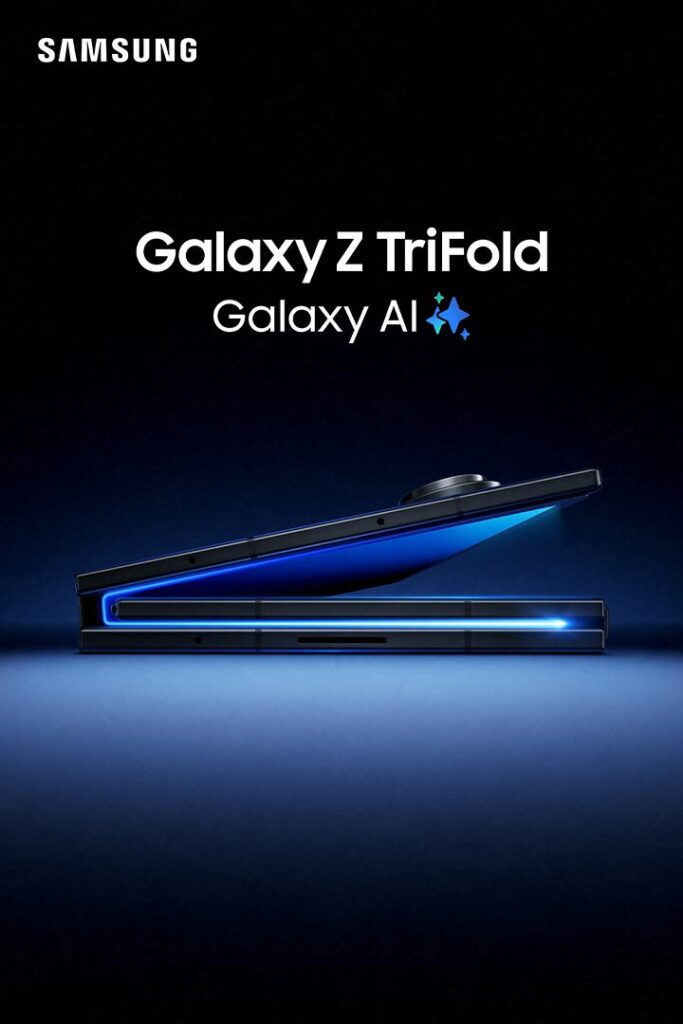
Samsung has unveiled the Galaxy Z TriFold, a device that opens once and then again to form a full, expansive canvas, signalling a bold new chapter in foldable technology. A decade of innovations has led to a phone designed not around form, but around the freedom of seamless transformation.
When Samsung lifted the curtain on the Galaxy Z TriFold, there was a sense of history folding into the moment—quite literally. For more than a decade, the company has been testing the limits of how smartphones can bend, flex, reshape and recombine themselves around the evolving needs of users. The TriFold is the most audacious outcome of that journey so far: a device that opens, then opens again, turning what appears at first to be a compact, pocketable phone into a tablet-sized canvas with surprising ease. More than a technological statement, the company insists it is a declaration of freedom, a reinvention of how people experience mobility, creativity and productivity in one flow.
Standing on the stage where earlier generations of foldables were debuted, Samsung executives described the TriFold not as an incremental addition to the category but as the arrival of a new phase, one that builds on the lessons learned from the Galaxy Fold, Flip and multi-gen iterations that came before them. Each of those devices introduced a change in the way screens could behave. But the TriFold, which cleverly collapses into three layers without creating cumbersome thickness, represents a shift from thinking about foldables merely in terms of form factor to thinking about them as fluid tools that adapt to the user in real time. The company says it is no longer pursuing a novelty but an experience—one that accommodates work, entertainment, multitasking and creative pursuits with an intimacy that static slabs could never offer.
The TriFold’s defining characteristic is its movement: a single fold opens the device to a mid-size display; a second fold reveals a wide, tablet-like expanse. The mechanism has been engineered to feel intuitive and almost invisible, resulting in a device that expands only when needed and disappears when it shouldn’t interrupt life. For users who often shuttle between tasks or switch contexts, this dynamic adaptability could finally close the gap between smartphones and tablets. Instead of carrying multiple devices, the TriFold is designed to shape-shift on demand, offering just enough surface area for reading or streaming, or a full screen for sketching, editing or running multiple apps side by side.
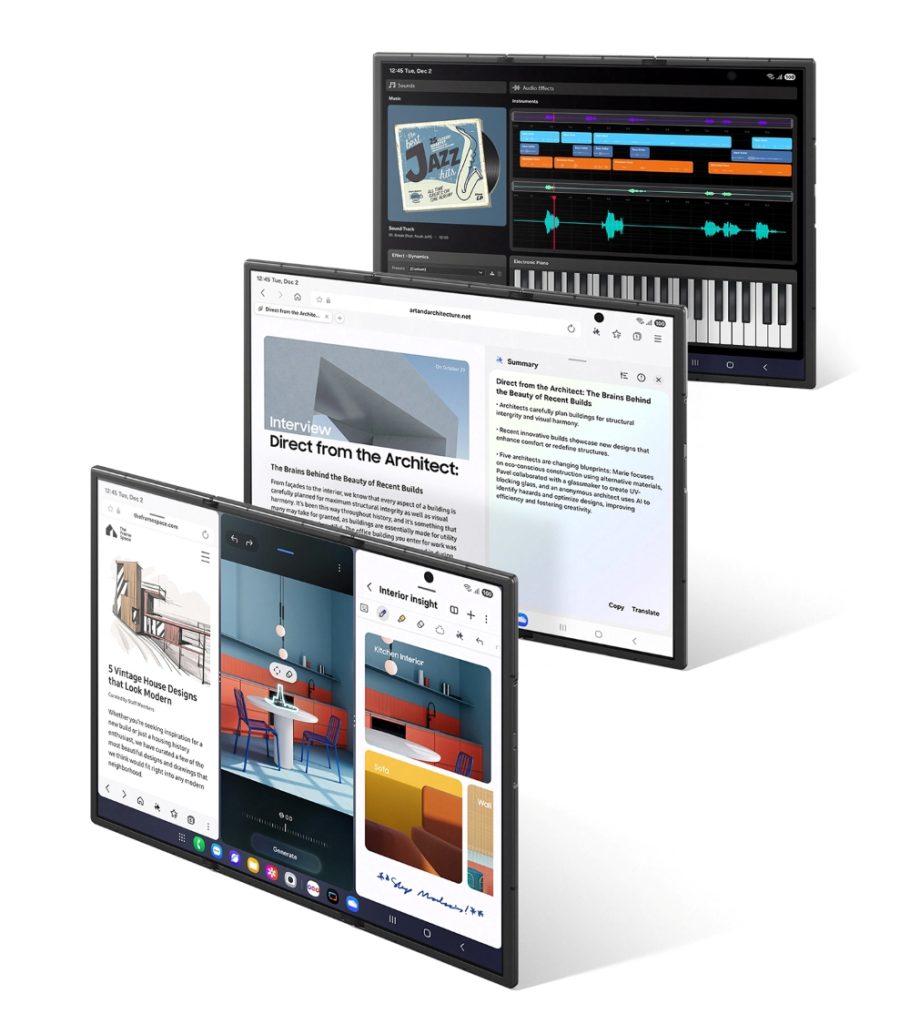
This drive toward freedom, as Samsung describes it, goes beyond the physical architecture of the product. It is reflected in how the software and interface respond to the unfolding experience. The TriFold recognises the user’s intent with each stage of expansion, adjusting window layouts, scaling content smoothly and allowing seamless transitions between modes. The engineering behind this has taken years of studying user habits across earlier foldables, where app continuity, layout optimisation and gesture fluidity became make-or-break aspects of the experience. The company claims the TriFold is the most polished expression of these learnings—a device that understands context and shifts without friction.
Part of this freedom, Samsung suggests, is also psychological. The TriFold aims to reduce the constraints of traditional screen real estate by giving users the feeling that they always have more room available, even when the device rests silently in the palm. In its fully open state, the TriFold gives creators a canvas large enough to sketch or storyboard; professionals can review documents or dashboards without cramped spacing; students can read, highlight and take notes without constantly pinching and zooming. The sense of liberation comes from knowing the device will not limit what you want to do simply because of its size. And yet, when folded down, it becomes something as simple and unobtrusive as a conventional phone, sliding into a pocket or bag without calling attention to itself.
Industry watchers have long speculated about when the foldable category would reach a point where devices felt natural rather than experimental. Samsung’s announcement today suggests that moment may have finally arrived. The company has invested years in improving hinge durability, reducing crease visibility and enhancing screen resilience. The TriFold is positioned as the culmination of those advancements, offering a uniform flatness when fully opened and a hinge system that can endure thousands of transformations. For users who were previously hesitant, durability improvements are likely to become a central part of the product’s appeal.
The unveiling also signalled Samsung’s strategic confidence, not just in foldables as a niche innovation but as a mainstream future for mobile computing. As global smartphone sales plateaued over recent years, foldables represented one of the few growth segments—driven largely by Samsung’s early entry and continued leadership. By introducing a form factor as complex and ambitious as the TriFold, the company is reinforcing its belief that consumers are ready for more sophisticated transformations, not fewer. It is also sending a message to competitors that the foldable race has moved beyond simply bending a screen; it is now about orchestrating an entire ecosystem around flexible hardware.
For developers and partners, the arrival of a triple-fold device opens fresh possibilities. App developers will now have to imagine new ways interfaces can respond to changing geometries, embracing layouts and experiences that were previously unimaginable on a single device. Samsung emphasised that it has worked closely with major app providers to ensure the TriFold offers out-of-the-box optimisation for productivity, creativity and entertainment. With more space and more modes, the device could catalyse a new wave of visual and interaction design.
Yet perhaps the most striking part of today’s launch was how Samsung framed the TriFold: not as a technological spectacle but as a lifestyle idea. The company repeatedly returned to the theme of freedom—freedom from hardware constraints, freedom to choose how much or how little screen one wants at any moment, freedom to collapse complexity into simplicity. It is a philosophy that mirrors broader shifts in consumer mentality, where the desire for flexible, hybrid, multimode tools has grown in parallel with an increasingly fluid digital life.
Of course, the market will ultimately decide whether the Galaxy Z TriFold becomes a milestone product or a transitional experiment. But even in the early moments of its unveiling, there was a sense that something significant had arrived—a new articulation of how far the foldable concept can go, and how deeply it can shape future expectations. A decade of foldables has led Samsung to this point, and the TriFold stands as both a celebration of that journey and a starting point for the next chapter. By turning a phone into a transforming canvas, the company is positioning itself at the edge of possibility, where devices no longer dictate the terms of use but instead evolve with the user. And in that evolution lies the freedom Samsung hopes will define its next ten years of innovation.
Discover more from Creative Brands
Subscribe to get the latest posts sent to your email.