


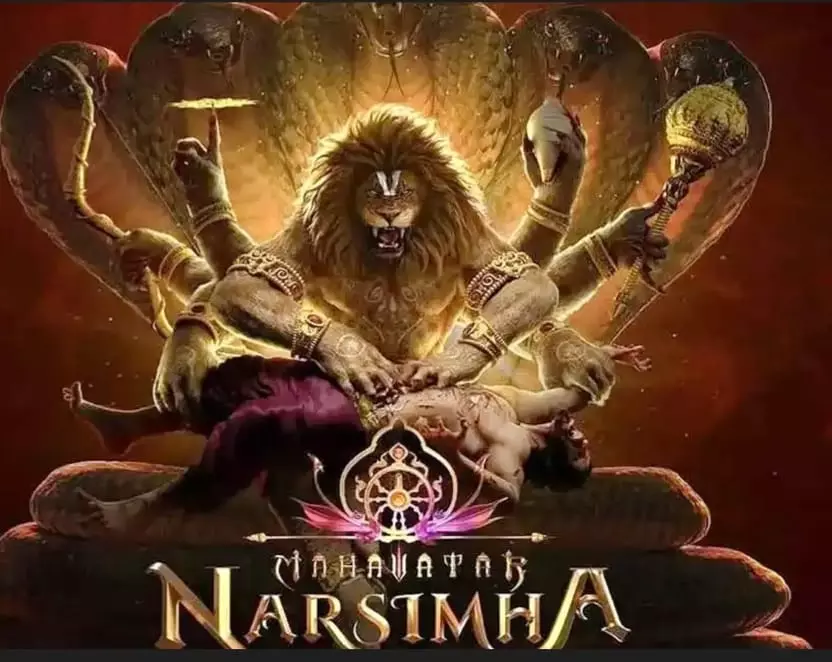
Hombale Films’ Mahavatar Narsimha, directed by Ashwin Kumar, has been shortlisted for the 2026 Oscars in the Best Animated Feature category, marking a major breakthrough for Indian animation. Born from a small studio powered by personal sacrifices, the film now stands alongside global giants, edging India closer to a historic nomination.
Hombale Films’ Mahavatar Narsimha has taken a decisive step toward global recognition, inching closer to the Oscars after being shortlisted for the Best Animated Feature Film category at the 98th Academy Awards. For India’s animation industry, long overshadowed by the dominance of Western and Japanese studios, this moment represents more than a celebration of cinematic achievement. It is a powerful assertion that Indian animation, rooted in its own stories and crafted with its own creative vision, can proudly stand on the world’s biggest stage. Directed by Ashwin Kumar, the film is one of 35 titles vying for a nomination, competing alongside international heavyweights such as The Bad Guys 2, Zootopia 2, Demon Slayer: Infinity Castle, KPop Demon Hunters, The SpongeBob Movie: Search for SquarePants, and The Twits. If it secures a place among the final nominees, Mahavatar Narsimha will become the first Indian animated feature ever to be nominated in this category, marking a historic win for the country’s growing animation ecosystem.
The journey that led to this recognition, however, was anything but soaring. India’s biggest animated blockbuster did not emerge from a massive corporate-backed studio or an assembly line of expensive creative machinery. Instead, it was born in a small, determined workspace where a handful of passionate creators worked relentlessly for five years. Their story is one of grit, risk, and unwavering belief—a story that mirrors the myth it seeks to retell. As the world sees the final visual spectacle, few know the sacrifices behind it. Ashwin Kumar and his team built the film piece by piece through periods of suffocating uncertainty. They spent everything they had, emptied out their savings, and even mortgaged their home. When the pandemic brought production to a halt—twice—many assumed the project would never recover. But the team refused to let go of their dream. Rejections mounted, funding dried up, and industry voices advised them to retreat. Yet, each setback only reinforced their sense of purpose.
“We faced countless rejections,” Ashwin admitted in an interview with Telugu FilmNagar. “But we stood by our story. This isn’t just a cartoon — it’s a film that speaks to adults as much as it does to children.” That sentiment became the foundation of the project. The team’s mission was clear: to challenge the entrenched belief that Indian animation exists only for kids and cannot emotionally or visually compete with global franchises. Rather than imitating Western aesthetics, they wanted to build a homegrown cinematic universe rooted in Indian mythology, one that celebrates the depth of local narratives while pushing animation technology forward. The blend of 2D and 3D animation became a deliberate artistic choice—an attempt to honour traditional Indian storytelling while presenting it through contemporary visual language.
The mythological tale of Prahlada and Hiranyakashipu, which forms the core of Mahavatar Narsimha, has been passed down for centuries, but Ashwin’s team sought to reinterpret it for modern audiences. The depiction of Narsimha—half-man, half-lion—demanded a level of animation precision and emotional nuance that tested the team’s skills and patience. Beyond the technical challenge, the creators were driven by the desire to reclaim Indian mythological storytelling and offer it to global viewers with cinematic ambition. The film’s emotional resonance with audiences in India, where it became a massive box-office success, proved that the appetite for high-quality Indian animation was much larger than the industry had assumed.
Now, standing at the threshold of the Academy Awards, that conviction seems stronger than ever. With nominations scheduled to be announced on January 22, 2026, anticipation runs high. The Oscars ceremony, set to take place on March 15, 2026, at the Dolby Theatre in Ovation Hollywood, could potentially witness an Indian animated feature competing alongside well-established global franchises—an unimaginable scenario just a few years ago. For aspiring Indian animators and storytellers, this shortlisting alone sends a message that the boundaries of what is possible are expanding. It suggests that the world is ready to embrace Indian stories told through Indian visual sensibilities, and that originality can break through even without vast budgets or corporate backing.
What makes Mahavatar Narsimha’s journey even more striking is its contrast with the scale of its competitors. Films such as Zootopia 2 and The Bad Guys 2 are backed by studios with enormous financial power, global marketing teams, and decades of brand equity. Japanese titles like Demon Slayer: Infinity Castle arrive with loyal fanbases and established cinematic universes. Against this backdrop, a film crafted in a modest Indian studio, funded through personal sacrifices, and built through sheer determination stands out as a symbol of creative courage. The global spotlight on the film reflects not only its artistic merit but also the rising curiosity about India’s evolving animation landscape.
The possible Oscar nomination also generates a larger cultural conversation. As India’s film industries increasingly invest in mythology, epics, and historical narratives, animation offers a powerful medium to interpret these stories without the constraints of live-action production. For decades, animation in India was relegated to children’s content, limited budgets, and outsourced service work for foreign studios. Mahavatar Narsimha challenges those assumptions with clarity and confidence. It shows that Indian animators can build narratives with emotional weight, visual sophistication, and global appeal while staying true to the country’s cultural roots.
For Ashwin Kumar and his team, the journey has already been transformative. From being told that Indian animation has no serious market to watching their film compete with global giants, their path mirrors a kind of modern-day myth—one where perseverance becomes its own form of heroism. Whether or not the film secures the final nomination, its presence on the Oscars shortlist is already reshaping perceptions within the industry. It signals that Indian animation is ready for global attention, ready to tell bigger stories, and ready to move beyond old limitations.
As India awaits the Academy’s final announcement, the excitement around Mahavatar Narsimha continues to build. The film’s success has created new inspiration for independent creators, studios, and young artists who see in its journey a blueprint for what can be achieved through passion, risk, and storytelling ambition. From a modest studio filled with dreamers to Hollywood’s most prestigious platform, Mahavatar Narsimha stands as a testament to what Indian animation can accomplish when creators dare to believe in their own stories. And now, with the world watching, India sits on the edge of a historic moment—one that may redefine its place in global
Discover more from Creative Brands
Subscribe to get the latest posts sent to your email.