


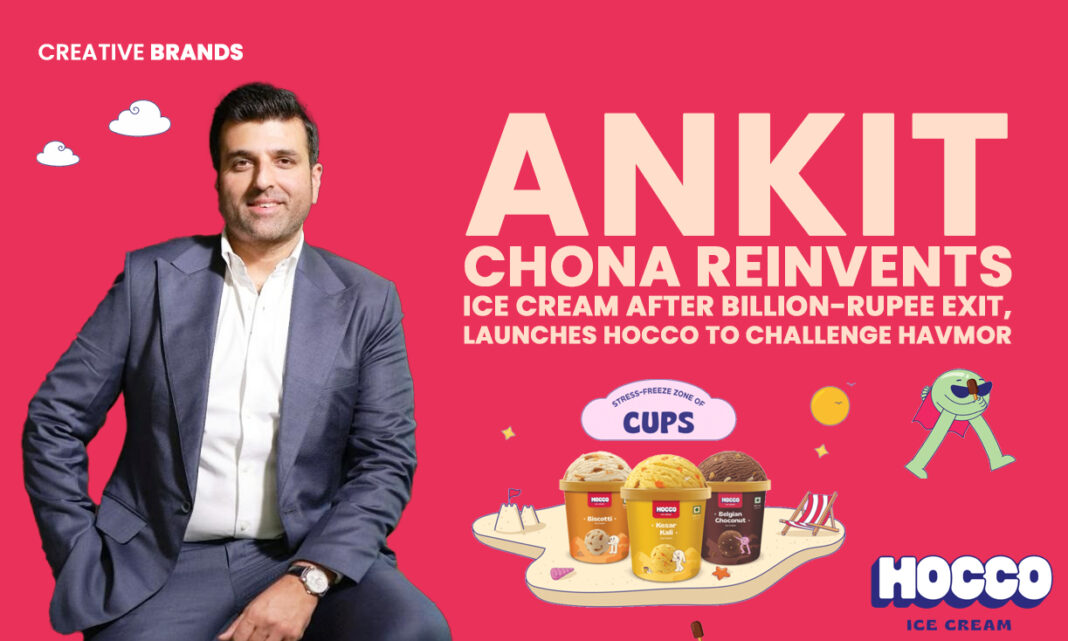
After selling the family’s Havmor Ice Cream empire for ₹1,020 crore, Ankit Chona returned to the ice cream business with Hocco, a premium brand targeting Gen Z and millennials. Combining modern flavors, Instagram-worthy parlors, and stylish branding, Hocco scaled rapidly, proving that heritage, insight, and reinvention can create another billion-rupee success.

What do you do after selling your family ice cream empire for ₹1,020 crore? For most people, that kind of exit would mark the end of a long entrepreneurial chapter. But for Ankit Chona, it became the spark for a reinvention story that is now reshaping India’s premium ice cream landscape — and challenging the very company that bought him out.
The Chona family’s journey in ice cream dates back to 1944, when engineer Satish Chona started a small shop in Karachi. Three years later, the Partition forced him to rebuild his life in Ahmedabad, where he restarted the business from scratch. That modest beginning would go on to transform into Havmor Ice Cream, one of India’s most loved dessert brands, known for its consistency, wide appeal, and emotional connection across generations.
Over the next seven decades, Havmor became a household name, expanding from a neighborhood shop to a national player. Its presence grew not just through product innovation but through a family legacy built on trust and quality. By 2017, the brand had become so valuable that South Korea’s Lotte Confectionery acquired it in a ₹1,020 crore all-cash deal — one of the biggest acquisitions in India’s food and beverage sector at the time. It was the end of an era, but only on paper.
For Ankit, grandson of the founder and one of the key architects of Havmor’s growth, stepping away wasn’t a choice—it was a contractual obligation. The non-compete clause kept him out of the ice cream business for five years. Yet during that time, he found himself observing a shift in consumer culture. Young Indians, especially Gen Z and millennials, wanted more than just good ice cream. They sought experiences: places that looked good on Instagram, flavors that felt global, and brands that spoke their language.
Legacy ice cream parlors, he realised, weren’t evolving fast enough. The interiors were dated, the flavors predictable, and the overall vibe seemed stuck in the past. The gap between what younger consumers wanted and what the market offered was widening — and Ankit was paying attention.
So in 2022, the moment his non-compete expired, he jumped back into the space he knew better than anyone else. The result was Hocco Ice Cream, a brand that combined 70 years of industry wisdom with the energy of a startup built for the present. Hocco positioned itself as a premium but accessible brand — modern in design, bold in flavor, and crafted to resonate with India’s young, style-conscious consumers.
Hocco’s parlors are designed as destinations in themselves: bright, aesthetic spaces that feel instantly Instagrammable. Its flavors range from nostalgic Indian combinations to globally inspired creations, offering a mix that appeals to both memory and novelty. The branding is sleek, youthful, and crafted with an eye on social media culture — a sharp departure from the traditional, family-friendly tone of many older brands.
This fresh approach, supported by the Chona family’s generational expertise and an established supply chain network, allowed Hocco to scale at an extraordinary pace. Within just two years, the brand expanded across multiple Indian cities, crossed 200,000 sales, and hit a valuation close to ₹2,000 crore — almost double the acquisition value of Havmor in less than half the time.
For Indian consumers, Hocco became more than a new label. It became an example of how heritage and reinvention can coexist — how the same family that built an iconic brand could return and build another, entirely different one, without repeating themselves or relying on nostalgia.
For the industry, it signalled something deeper: even in a crowded, competitive sector like ice cream, disruption is possible when you listen closely to what the next generation wants. Instead of relying on old formulas, Hocco leaned into cultural insight, aesthetic experience, and emotional relevance — areas where many legacy brands still lag.
Ankit Chona’s journey is not simply a story of entrepreneurial comeback; it is a case study in resilience, timing, and the courage to disrupt one’s own legacy. He could have walked away after a billion-rupee exit. Instead, he returned with a sharper understanding of the market, a bolder creative vision, and a willingness to challenge the status quo.
In doing so, he proved that lightning can strike twice — when tradition meets reinvention, when experience meets intuition, and when a founder dares to believe that the story of a family business doesn’t end with a sale, but can begin again with a scoop of something new.
Discover more from Creative Brands
Subscribe to get the latest posts sent to your email.