


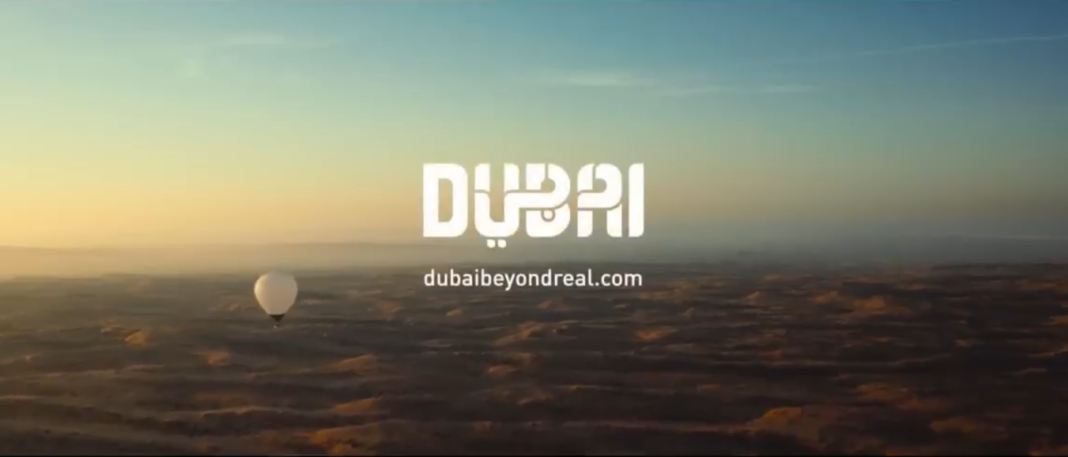
Dubai’s latest tourism campaign, The Hyperbolist, directed by Tom Hooper, redefines advertising by prioritising entertainment and narrative depth. Through a playful dinner party retelling of experiences, the film blurs myth and reality, showing how meaning, not events, drives connection. It sets a benchmark for long-form storytelling in tourism promotion.
Tourism advertising has entered a new era, and Dubai is leading the charge. The city’s latest campaign, The Hyperbolist, is not just a promotional film but a masterclass in narrative-driven advertising. Directed by Academy Award-winner Tom Hooper, the three-minute spot demonstrates how storytelling, when executed with precision and imagination, can elevate tourism marketing into something far more compelling than a glossy brochure or a montage of scenic shots. It is entertainment first, and promotion second.
The film unfolds at a dinner party, where a couple recounts their experiences in Dubai. The husband’s version is dramatic, almost mythic, filled with exaggerations that border on the unbelievable. His tales transform ordinary moments into epic adventures, painting Dubai as a place where reality itself feels heightened. In contrast, the wife offers a grounded perspective, gently correcting his embellishments and anchoring the narrative in lived experience. This interplay between hyperbole and truth creates a dynamic rhythm, pulling the audience into the tension between perception and reality.
What makes The Hyperbolist remarkable is not the events themselves but the meaning those events hold for the characters. A desert safari, a luxury hotel stay, or a stroll through the souks are not presented as mere activities. Instead, they become moments of transformation, shaped by the couple’s differing interpretations. The husband’s mythic retellings suggest Dubai is a place where the extraordinary is commonplace, while the wife’s realism reminds us that the city’s magic lies in its authenticity. Together, their perspectives capture the essence of travel: the stories we tell about our journeys often matter more than the journeys themselves.
This is the crucial distinction between promotion and storytelling. Traditional tourism advertising has long relied on spectacle—panoramic shots of skylines, beaches, and landmarks, accompanied by soaring music and slogans promising unforgettable experiences. Dubai’s campaign, however, recognises that audiences today crave more than spectacle. They want narrative depth, characters they can relate to, and stories that resonate beyond the screen. By weaving entertainment into its promotional fabric, The Hyperbolist sets a new benchmark for how destinations can market themselves in a crowded global landscape.
Tom Hooper’s direction is central to this achievement. Known for his ability to draw emotional nuance from characters in films such as The King’s Speech and Les Misérables, Hooper brings the same sensibility to advertising. He understands that storytelling is not about events but about the meaning those events carry. His framing of the husband’s grandiose tales against the wife’s grounded corrections creates a layered narrative that feels both humorous and heartfelt. The audience is entertained, but they are also invited to reflect on how travel experiences are remembered, retold, and mythologised.
The campaign’s success lies in its ability to connect with viewers on a human level. Rather than presenting Dubai as a distant, aspirational fantasy, it positions the city as a place where real people have real experiences—experiences that can be retold with humour, exaggeration, and affection. This approach makes the destination feel accessible while still retaining its aura of wonder. It is a delicate balance, and one that many tourism campaigns fail to strike.
As a director myself, I recognise the craft at play here. Advertising often struggles to achieve genuine storytelling because it is constrained by time and the need to deliver a clear message. Yet The Hyperbolist demonstrates that even within three minutes, it is possible to create real characters with real depth. The husband and wife are not caricatures; they are recognisable figures whose dynamic mirrors the way couples often recount shared experiences. Their interplay is both entertaining and authentic, and it is this authenticity that makes the campaign resonate.
The broader implication is that tourism advertising is no longer just about selling destinations. It is about creating narratives that audiences want to engage with, share, and remember. In an age where attention spans are fragmented and competition for viewers is fierce, entertainment becomes the most effective form of promotion. Dubai’s campaign understands this perfectly. By prioritising storytelling, it ensures that the city is not just seen but felt.
This shift also reflects a larger trend in advertising. Brands across industries are increasingly recognising that audiences respond to stories, not slogans. Whether it is a luxury product, a social campaign, or a tourism initiative, the most successful advertisements are those that entertain while they inform. Dubai’s campaign exemplifies this philosophy, showing that tourism promotion can be cinematic, character-driven, and emotionally resonant.
In the end, The Hyperbolist is more than a film about Dubai. It is a film about storytelling itself—about how we shape our experiences into narratives that define how we remember them. The husband’s hyperboles and the wife’s corrections remind us that travel is not just about what we do but about how we tell the story of what we did. That is the true magic of tourism, and it is what makes Dubai’s campaign so powerful.
By setting the standard for narrative-driven advertising, Dubai has positioned itself not only as a destination but as a storyteller. The city’s campaign proves that the future of tourism promotion lies in entertainment, character, and meaning. It is a lesson for advertisers everywhere: if you want to connect, tell a story worth retelling.
Discover more from Creative Brands
Subscribe to get the latest posts sent to your email.