


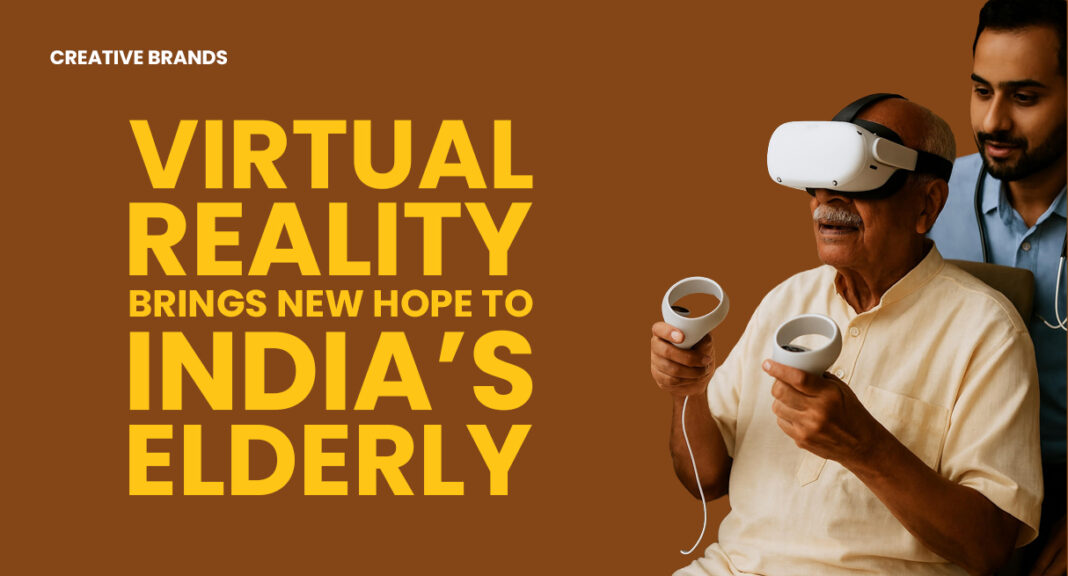
India’s elderly are discovering relief from anxiety and monotony through virtual reality therapy. Startups like Rewin Health, in partnership with Apollo Hospitals, have delivered over 100,000 VR sessions, transforming physiotherapy into emotionally meaningful experiences. With the senior population projected to reach 300 million by 2050, VR could redefine geriatric care.
For decades, geriatric care in India has been defined by routine physiotherapy sessions, often marked by repetition and a sense of futility. Stroke survivors, arthritis patients, and those recovering from falls have long been asked to perform mechanical exercises—lifting an arm twenty times, walking a few steps, repeating motions until fatigue sets in. Yet the greatest challenge has not always been physical weakness. It has been boredom, the gnawing fear of falling, and the emotional toll of feeling disconnected from life. Now, a new wave of innovation is changing that narrative, and it comes in the form of virtual reality.
Startups such as Rewin Health, working alongside institutions like Apollo Hospitals, are pioneering VR-based rehabilitation programs that are reshaping how India approaches elderly care. More than 100,000 VR sessions have already been delivered, and the results are striking: participants have reported a 91 percent drop in anxiety symptoms. For a demographic often overlooked in the rush of technological progress, this is nothing short of revolutionary.
The secret lies not in the technology itself but in how it reframes therapy. Vijay Karunakaran, CEO of Rewin Health, explains that the success of VR rehabilitation stems from its ability to make therapy emotionally meaningful rather than mechanical. In traditional physiotherapy, lifting an arm twenty times feels like a chore. But when a patient dons a VR headset and is transported to a Virtual Temple, the same movement becomes part of an Aarti, a Hindu ritual of worship. Walking across a room is no longer a clinical exercise—it is a spiritual journey toward a deity. Therapy ceases to be a set of sterile repetitions and instead becomes an act of devotion, memory, and cultural connection.
This blending of technology with cultural resonance is particularly powerful in India, where rituals and traditions form the backbone of daily life. For elderly patients, many of whom have spent their lives immersed in such practices, VR offers not just physical rehabilitation but emotional continuity. It allows them to reconnect with familiar experiences even as their bodies struggle with age-related limitations. The headset becomes a portal, not just to virtual landscapes but to dignity, meaning, and hope.
The impact extends beyond individual patients. Families, often burdened by the emotional and financial strain of caring for elderly relatives, are finding relief in seeing their loved ones engaged and motivated. Hospitals and care facilities, too, are beginning to recognize the potential of VR to reduce dependency on medication, lower rates of depression, and improve recovery outcomes. In a country where healthcare resources are stretched thin, especially in rural areas, scalable solutions like VR could prove transformative.
India’s demographic trajectory underscores the urgency of such innovation. By 2050, the nation’s elderly population is projected to reach 300 million, a figure larger than the entire population of many countries. This surge will place immense pressure on healthcare systems already grappling with limited infrastructure and workforce shortages. Traditional models of care will struggle to cope, making technological interventions not just desirable but essential.
Virtual reality is not a panacea. It cannot replace the need for trained physiotherapists, caregivers, or medical infrastructure. But it can complement them, offering a tool that makes therapy engaging, reduces anxiety, and fosters emotional resilience. The 91 percent drop in anxiety symptoms reported among participants is a testament to its potential. Anxiety, often overlooked in geriatric care, can exacerbate physical conditions, slow recovery, and diminish quality of life. Addressing it through immersive experiences could significantly improve outcomes.
The broader implications are equally compelling. As India positions itself as a hub for digital innovation, VR in healthcare represents a convergence of technology and social impact. It demonstrates how startups can collaborate with established institutions to deliver solutions that are not only cutting-edge but deeply human. It also raises questions about accessibility—how to ensure that such therapies reach beyond urban hospitals to rural communities where elderly care is most neglected.
There are challenges to overcome. Cost remains a barrier, as VR equipment and software are not yet affordable for widespread use. Training healthcare workers to integrate VR into therapy sessions requires investment and time. Cultural acceptance, while promising, must be nurtured carefully to avoid alienating those unfamiliar with technology. Yet the momentum is undeniable. With each session delivered, with each patient who finds joy in therapy, the case for VR grows stronger.
In many ways, this innovation reflects a broader shift in how India views its elderly. No longer passive recipients of care, they are being reimagined as active participants in their own healing journeys. Virtual reality gives them agency, transforming exercises into rituals, movements into meaning, and therapy into something worth looking forward to.
As the country marches toward 2050, the question is not whether VR will play a role in geriatric care but how expansive that role will be. Will it remain a niche intervention in select hospitals, or will it become a standard part of elderly rehabilitation across the nation? The answer will depend on policy, investment, and the willingness of healthcare providers to embrace innovation.
For now, the sight of an elderly patient, once hesitant to lift an arm, now performing an Aarti in a virtual temple, offers a glimpse of what the future could hold. It is a reminder that technology, when aligned with culture and compassion, can do more than heal bodies—it can restore spirits. And in a country preparing to care for 300 million elderly citizens, that restoration may prove to be the most vital therapy of all.
Discover more from Creative Brands
Subscribe to get the latest posts sent to your email.