


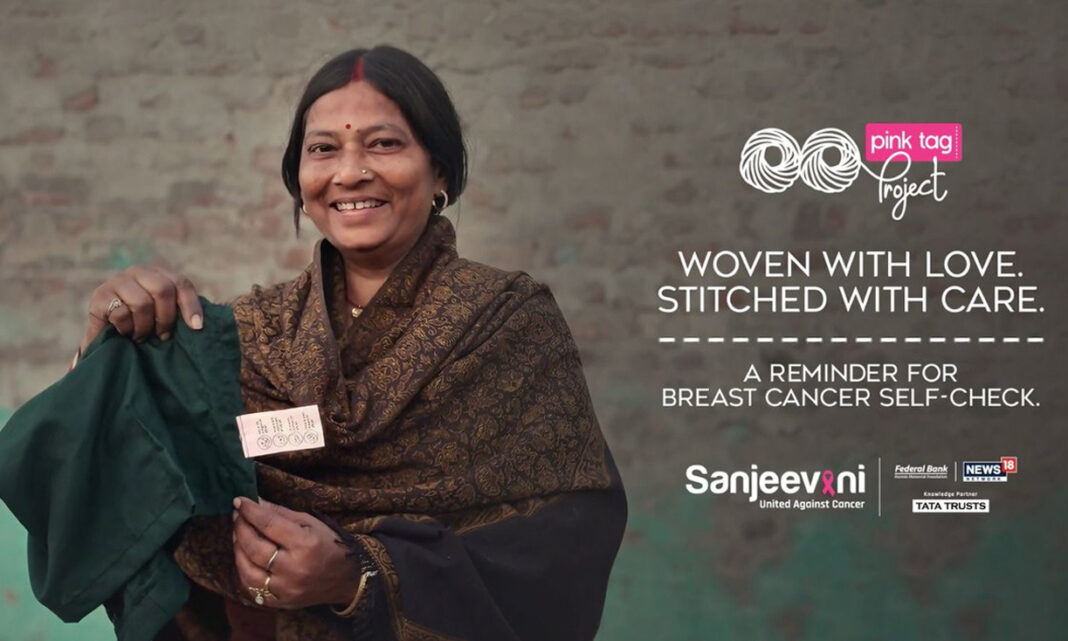
The Sanjeevani: United Against Cancer initiative has launched the third edition of the Pink Tag Project, placing self-breast examination instructions inside women’s garments. Designed as a quiet, intimate health prompt, the campaign empowers women to prioritise self-care amid daily responsibilities, transforming a routine dressing moment into a potentially lifesaving habit.
The Sanjeevani: United Against Cancer initiative has built its reputation on campaigns that nudge rather than shout, that embed care into lived reality rather than into fleeting moments of awareness. The launch of the third edition of its Pink Tag Project continues that philosophy with notable clarity. Jointly led by Federal Bank Hormis Memorial Foundation, News18 Network, and Tata Trusts, this year’s campaign meets women in the spaces that are often least observed by society but most revealing of how women navigate their days: the private, brief, and intimate choreography of getting dressed. It is here, in the quiet minutes when garments are lifted, adjusted, chosen, and changed, that the campaign seeks to whisper its message of self-preservation — to remind women that self-care is not indulgence, nor vanity, nor time away from responsibility; it is survival.
The Pink Tag Project began from what campaign creators describe as a painfully evident insight. Across households in India, women bear the invisible load that powers their families. They stitch together domestic routines and emotional safety, manage finances, raise children, maintain elderly care, and increasingly contribute to livelihoods outside the home through work and entrepreneurship. In this continuous relay, their own health occupies the bottom rung of priority. The campaign recognises that this is not due to negligence or ignorance but due to structure and circumstance: women are conditioned to give first and attend to themselves only after everyone else has been accounted for. In many cases, that ‘after’ never arrives.
From this insight emerged a deceptively simple intervention. Instead of asking women to find time for health check-ups in already stretched schedules, the campaign embeds a reminder into a moment women already inhabit daily. The Pink Tag, a small label stitched inside garments like blouses, kurtas, and innerwear, sits discreetly beside the familiar wash-care instruction. On it are printed clear and simple directions for self-breast examination. When a woman takes a garment off the hanger, lays it down, or wears it against her skin, the Pink Tag enters her field of attention. That location is intentional. It is a moment no one else can interrupt, and one in which women are immersed in their own bodies. It is the one part of the day that is both routine and private. The creators argue that this intimacy gives the reminder both dignity and effectiveness. It does not lecture, scold, or demand; it nudges.
The campaign’s short film traces this journey from idea to implementation, following tailors, volunteers, designers, and medical advisors as they shape an insight into an object, and then into a practice. The film itself is restrained. Shot in a documentary tone with minimal narration, it avoids the sentimental dramatisation that often surrounds cancer awareness campaigns. Instead, it shows lived context: a tailor stitching tags with practised focus, a woman folding washed clothes, a factory floor where garments move like steady mechanical breath, and homes where women prepare for another long and bustling day. When the film reveals the Pink Tag in use, it feels less like a surprise reveal and more like a detail that always belonged there — a piece of design logic rather than a decorative flourish.
Campaign observers note that this choice allows the message to resonate without moralising. Self-breast examination is neither portrayed as a daunting medical chore nor as a dramatic act of survival. It is positioned as a small but vital habit, no different from brushing teeth or checking the day’s temperature. The approach aligns with a broader behavioural design strategy used in health awareness campaigns globally: integrate the cue into an existing behaviour rather than introducing a new one. The Pink Tag becomes a behavioural bridge. The aim is not disruption but repetition; not awareness for a day, but habit over months and years.
M V S Murthy, chief marketing officer of Federal Bank, articulates this philosophy succinctly. “Real change doesn’t come from heightened campaigns,” he explains, emphasising the difference between attention and adoption. “It comes from interventions that whisper, consistently, intimately, and with empathy.” For the Foundation, partnering with local actors — in this case tailors and volunteers — is central to the intervention’s credibility. Tailors are trusted figures in communities, particularly for women’s garments, and their participation elevates the Pink Tag from a corporate health message to a community-embedded practice. “This is not charity — this is empowerment,” Murthy adds. “This is about meeting women where they are, in their daily lives, and giving them the agency to protect themselves.” His remarks underline the campaign’s framing: health as autonomy rather than as vulnerability, and self-care as a right rather than as a trend.
From the media partner’s perspective, participation is not merely about amplification but about continuity. Sidharth Saini, COO of News18 Studios, notes that Network18’s cause-driven work focuses on insight rather than noise. “Reach matters, but participation matters more,” he says. The network’s national presence allows the campaign to reach diverse cultural contexts, but the ultimate measure of success is whether the Pink Tag becomes part of how communities remember to check for early breast cancer symptoms. “It is not disruptive; it is lived,” Saini emphasises, suggesting that health awareness has to move from messaging to muscle memory.
The statistic that anchors the campaign is familiar to public health experts: breast cancer remains one of the most common cancers among women in India, and late detection significantly worsens outcomes. While urban awareness has improved over the past decade, early screening is still far from universal, especially in semi-urban and rural communities where family roles, time scarcity, and cultural hesitations converge. The Pink Tag Project does not claim to solve the systemic challenges that surround cancer screening, diagnosis, and treatment. Instead, it focuses on the first step — recognition — and on shifting the point of recognition from the clinic to the home.
Observers of the campaign note that this choice reflects a broader cultural shift in health communication in India, where the terrain is not merely medical but social. In many households, women’s pain or discomfort is either normalised or deprioritised, often leading to dangerous delays in seeking treatment. A habit-based prompt, embedded in an object that women already value and interact with, seeks to subtly counter that tendency. If repeated hundreds of times across months, the action could trigger earlier conversations with doctors, families, and peers.
The Pink Tag Project thus stands at the intersection of design, gender, and public health, relying on the belief that change emerges not just in hospitals or campaigns but in the micro-rituals of everyday life. By entering those rituals, the campaign recognises women not as passive recipients of care but as active agents of their own wellbeing — even if the care begins with a whisper stitched into a seam.
Discover more from Creative Brands
Subscribe to get the latest posts sent to your email.